

Home
Ideodyssey
a journey in ideas


Contents
Page
Current
Chapter:
2
Birthplace
of
Writing.


Play
TRACK 4
Previous
Chapter
Next
Chapter

rigins
Writing
of

Bouchard’s Discovery
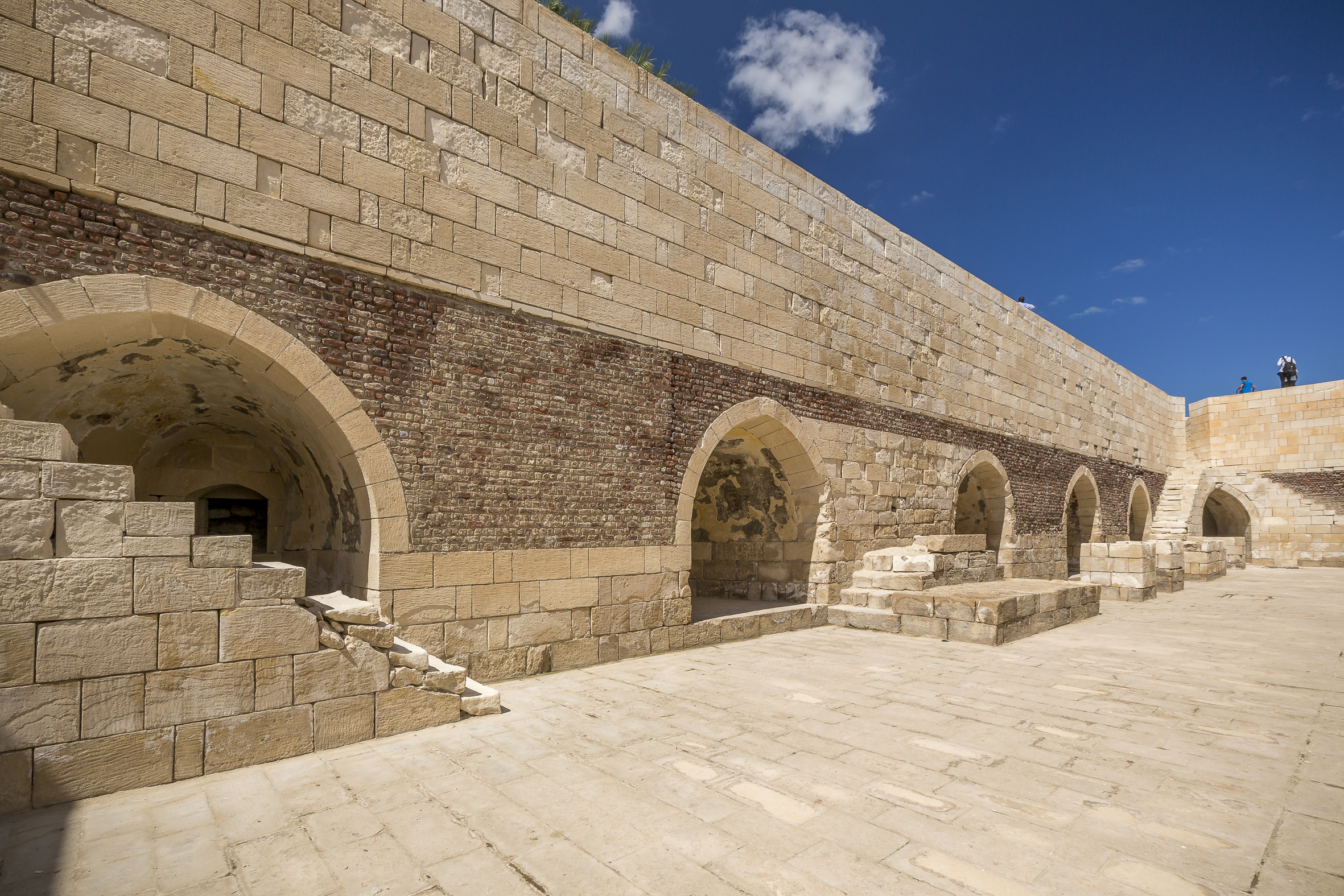
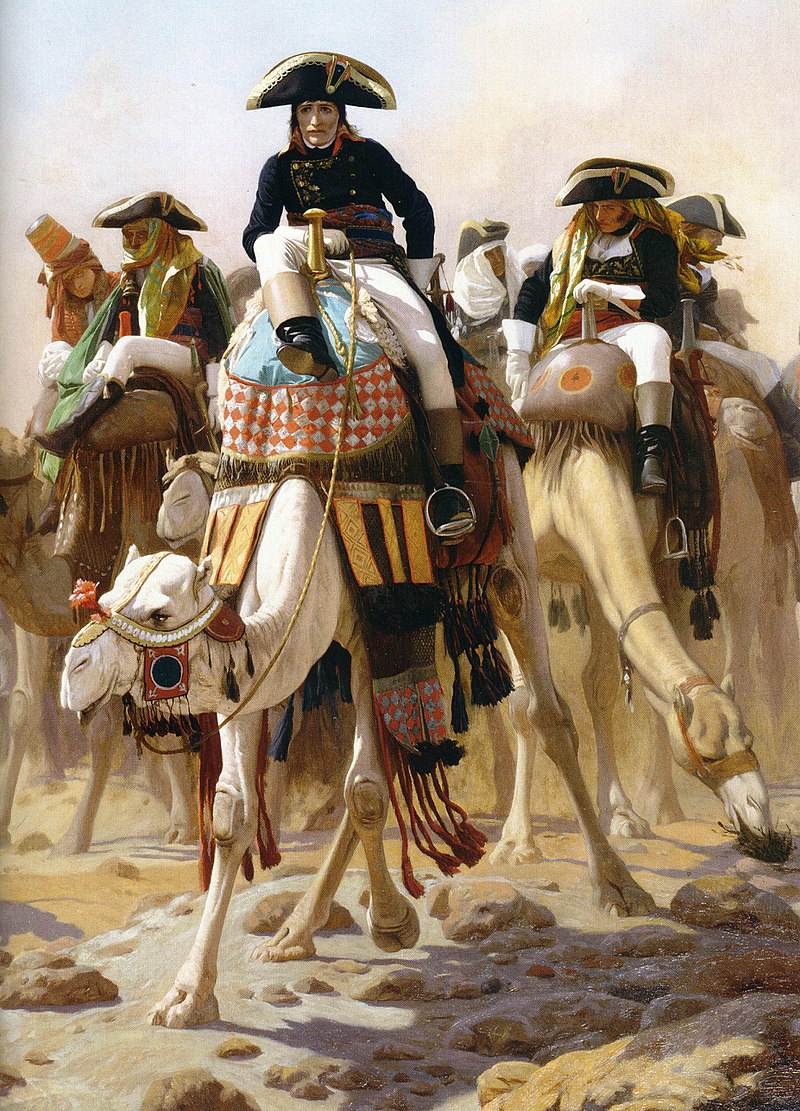
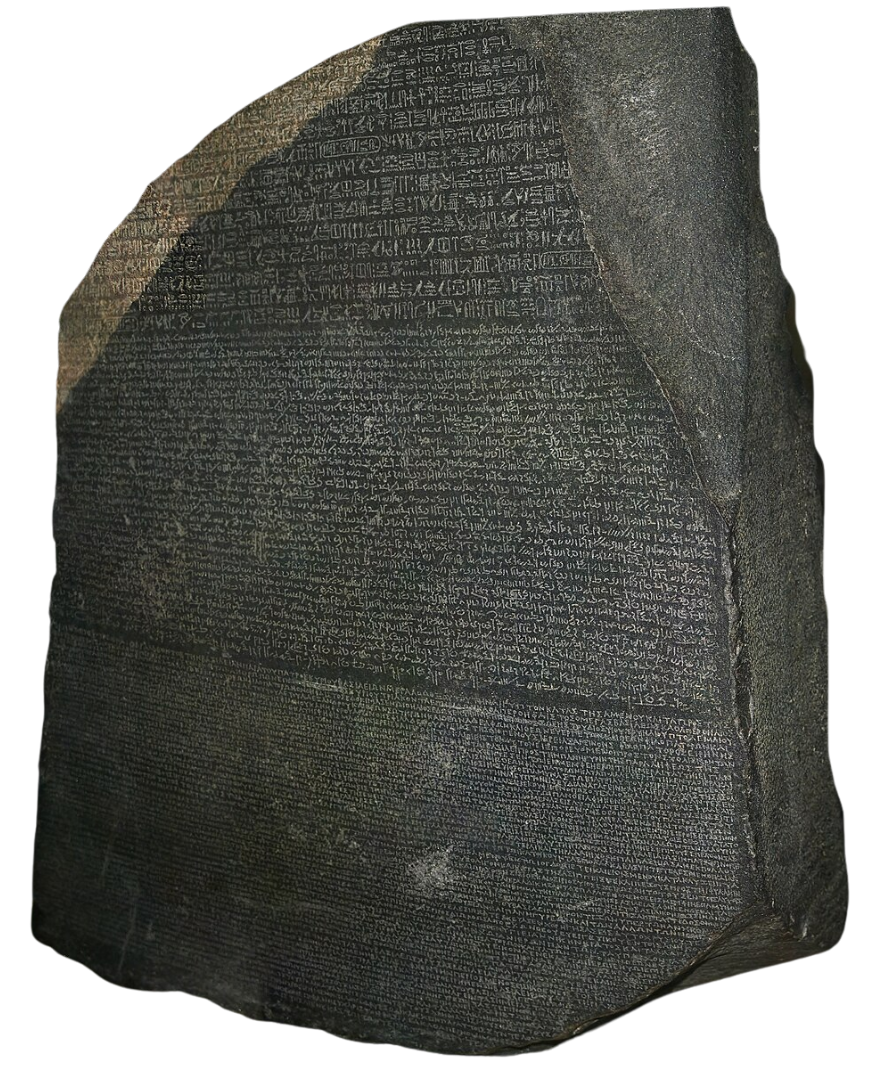
On 19th July 1799, troops of Napoleon’s Armée d’Orient under the command of Lieutenant Pierre-François Bouchard were toiling under the scorching Egyptian sun, hastily constructing defences at Fort Julien on the Mediterranean Coast. After France’s conquest of Egypt from the Ottomans the year before, the British Royal Navy had decimated their fleet in the Battle of the Nile, stranding its soldiers there surrounded by hostile forces. With their enemies closing in, Bouchard was given the arduous task of refitting the dilapidated Mamluk fortifications that had been built centuries prior. Bouchard’s men dutifully began the backbreaking task of digging up large stone slabs that the Mamluks had originally sourced from nearby ancient Egyptian ruins and using them to repair the fort’s walls. One particular piece, caught the eye of Bouchard, etched with hundreds of ancient symbols. Many stones had previously been found in the area inscribed with Ancient Egyptian hieroglyphs, but this one was inscribed not only with hieroglyphs, but with two other scripts as well: Demotic (a cursive form of hieroglyphs) and Ancient Greek. This 760kg piece of granodiorite was the first of its kind ever found and would later go on to be named the Rosetta Stone, after the nearby township of Rashid (Rosetta in French).¹ ²
𑁨
Birthplace of Writing
Intro
What Is Writing?
Birthplace
of Writing
Children of
Egypt
Cuneiform:
"Neanderthal
Script"
Oracle
Bones
Extinct
Scripts
Invented
Writing
Punctuation
& Symbols
Number
Systems
Lessons
From Writing


Tip: Hover cursor over image to pause slideshow 👆🏻
← Click image to enlarge
↑
Click here to pause slideshow
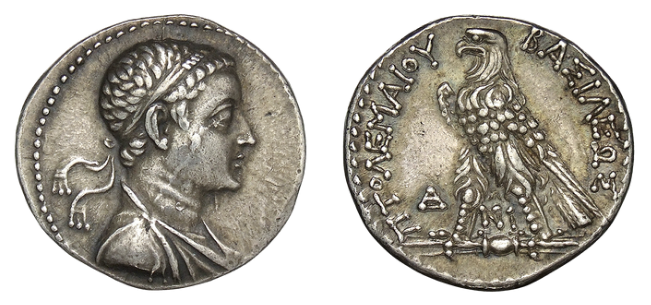
Little did Bouchard realise at the time, but this find would go on to become one of the greatest discoveries for the field of linguistics and the study of ancient writing systems. Written in 196 BCE as a priestly proclamation dedicated to the Hellenistic King, Ptolemy V Epiphanes, the stone is most famous for providing the key to deciphering Ancient Egyptian hieroglyphs and understanding the Ancient Egyptian language, which up until that point were more or less, a complete mystery. Less commonly known though is that it also paved the way for comparative linguists to understand the nature and origins of most of the world’s writing systems, which ultimately trace their roots to Ancient Egyptian Hieroglyphs.³
Egyptian Hieroglyphs
According to Egyptian mythology (as recorded by Plato in Phaedrus), Theuth (or Thoth), the god of wisdom and scribe to the gods gave medu netjer – “the words of the gods" to King Thamus in the form of hieroglyphs, in much the same way that Prometheus gave fire to man or Yahweh gave Moses the Ten Commandments. Thamus regarded this new system of writing with scepticism, believing it would result in a weakening of the human intellect, giving only an illusion of wisdom rather than true understanding.⁴ Read any comments section on YouTube today and you might be inclined to agree with him. Plato (perhaps suspiciously) portrays Socrates as echoing the same sentiments as Thamus, decrying writing as an impediment to memory.⁵
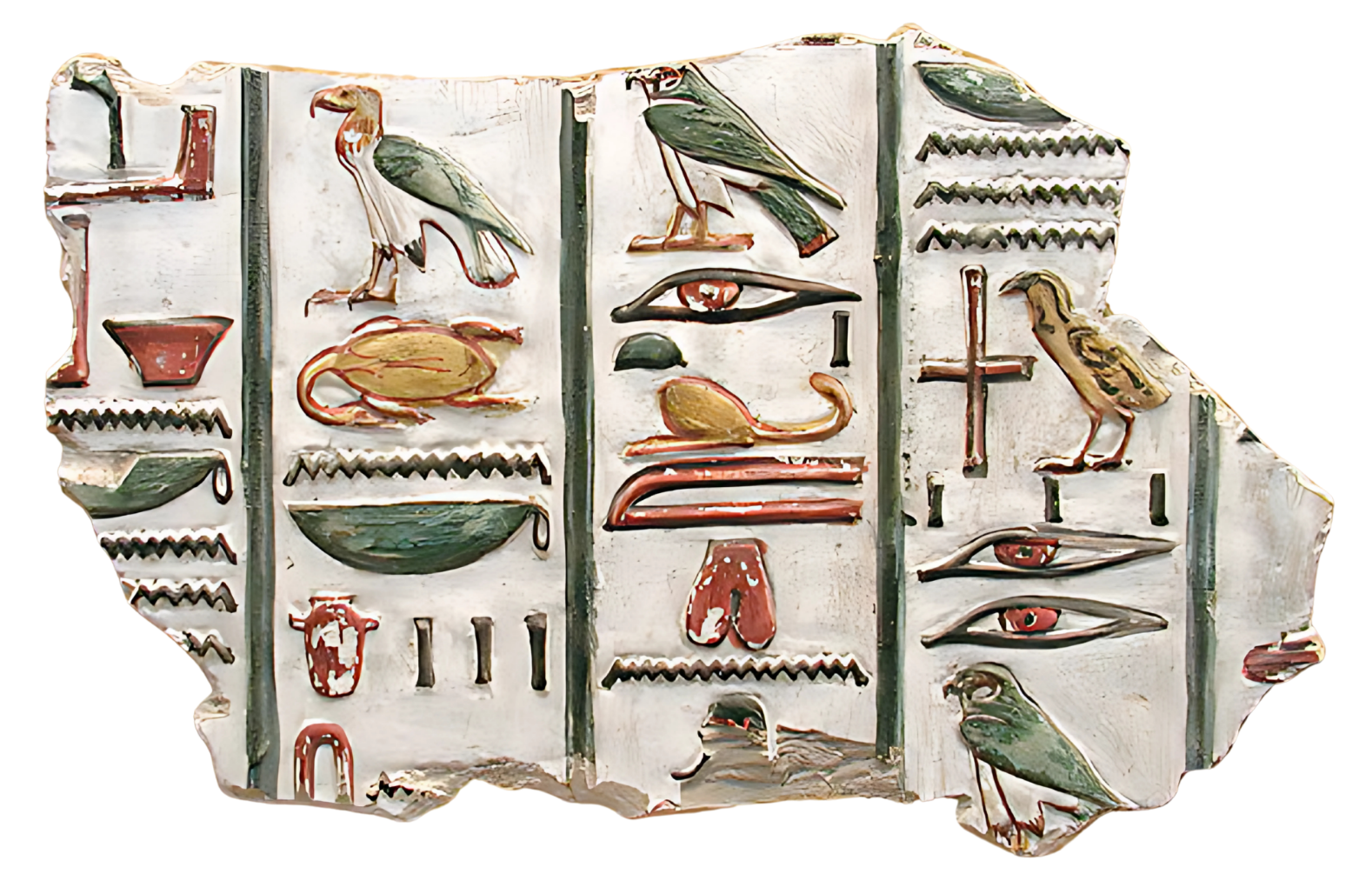
Unfortunately for those that love a good tall tale, the emergence of Egyptian hieroglyphs was in fact much more mundane. The ancestors of hieroglyphs (proto-hieroglyphs) emerged some time in the 4th millenium BCE, and like all ancient writing systems, started as simple pictograms. The hieroglyph 𓆉, for example, represented a literal turtle. These pictograms later developed in complexity into ideograms and logograms, so that 𓋹 (ankh) could represent the concept of life, and the symbol of a sitting man (𓀀) could represent the 1st person pronoun ‘I’ or ‘me’. At the time when the Rosetta Stone was discovered, it was believed that this was where the function of hieroglyphs ended. In other words, they were believed to be strictly non-phonetic. This is partly the fault of misguided Greek writers. In the 1st century BCE historian Diodorus Siculus wrote “… their script does not work by putting syllables together to render an underlying sense, but by drawing objects whose metaphorical meaning is impressed on the memory …”⁶ He is referring to the use of hieroglyphs as ideograms. Unfortunately, most of the Ancient Greek writers did not fully understand the nature of Egyptian writing, helping to mislead later Egyptologists who had very few primary sources on the matter.
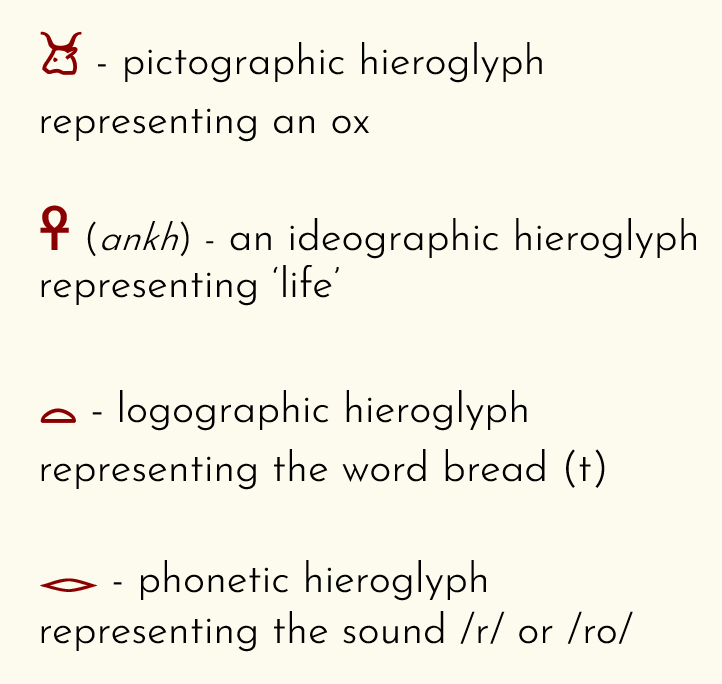
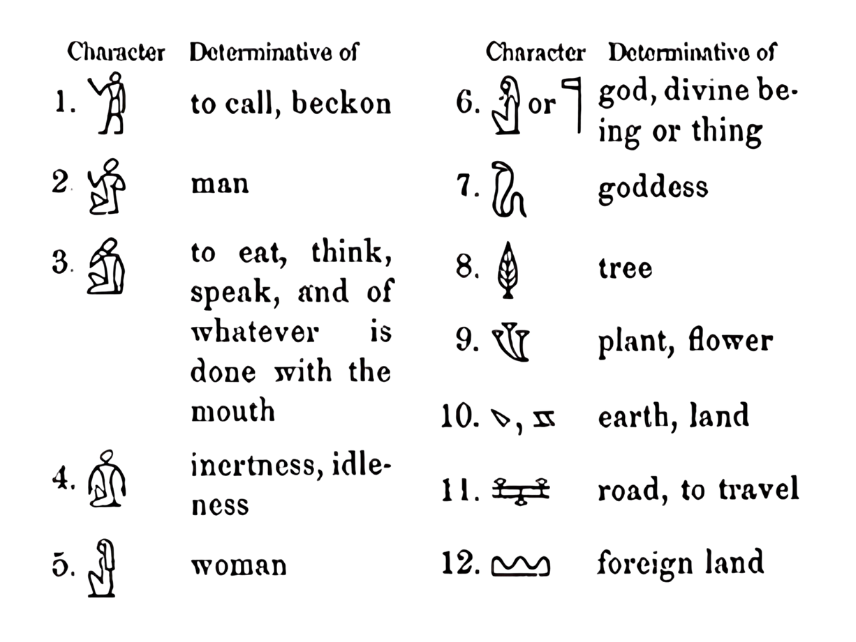
Over time, and unbeknownst to Diodorus Siculus, ideographic and logographic hieroglyphs also came to be used phonetically through the rebus principle. For example, the hieroglyphs for the sun (ra)(𓇳) or the god of the same name (𓁞) could be used to represent the syllable /ra/ in a longer word or name such as Rameses. In fact multiple hieroglyphs could be used to represent the same sounds. Likewise, the Ancient Egyptian word for mouth was ro with the logograph 𓂋 used. Eventually, however, this symbol could be used to represent the sound /r/ or the syllable /ro/ in the spelling of a word or name. Some hieroglyphs also represented consonant clusters such as 𓄟 (three skins tied together) which represented /ms/. Vowels were mostly absent from Egyptian spellings, needing to be deduced by the reader. To differentiate them from phonograms, logograms often included a vertical stroke underneath them (|). Thus, the hieroglyph of a house with a stroke below it () represented the logogram for 'house' (per), but the hieroglyph alone could represent the sound /p/ or /pr/.⁷ Three strokes (|||) below a logogram represented a plural noun. Furthermore, some symbols were used as determinatives – mute ideograms that signified the semantic grouping of the word, for example an animal (𓄛) or something involving movement ().⁸ Modern Chinese characters employ a similar function with the use of radicals.
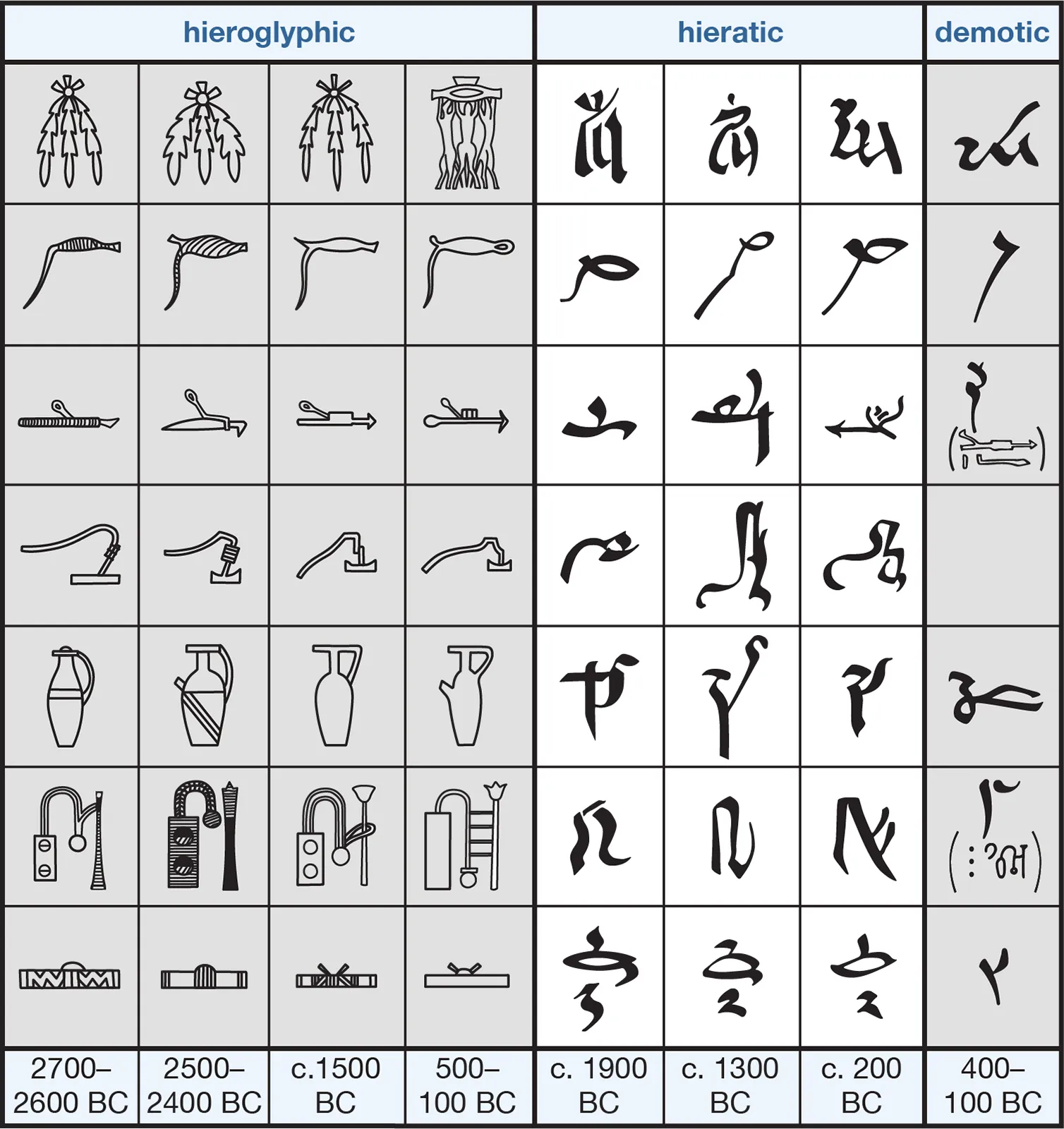
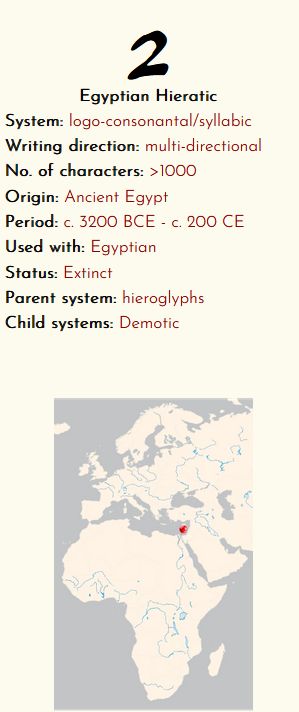
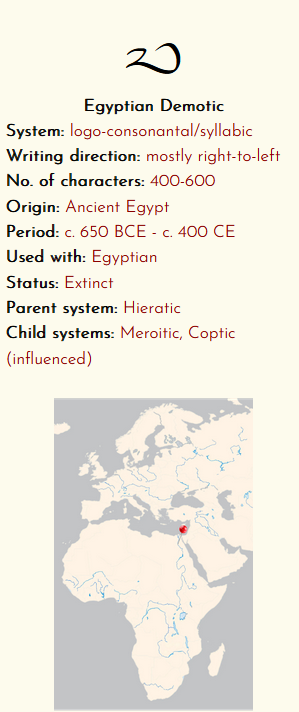
By the time the dedication to Ptolemy V was inscribed on the Rosetta stele, Egyptian writing was a mixed logographic/phonetic system. An initial set of around 1000 graphemes (symbols) was used during the Old Kingdom period, reducing to around 750 during the Middle Kingdom period before increasing again to the many thousands by the Hellenistic period in which Ptolemy reigned.⁹ But it was made even more confusing for early Egyptologists by the parallel development of cursive hieroglyphic forms in Hieratic and Hieratic’s descendant Demotic (from about 650 BC onwards). These cursive forms were used for more common purposes and were generally used more phonetically than their hieroglyphic parent. Herodotus wrote in the 5th century BCE "They [the Egyptians] employ two kinds of writing; one is called sacred, the other common [demotic]."¹⁰ The word ‘hieroglyph’, in fact, comes from the Greek hieros (sacred) and glyphe (carving) while demotic comes from demotikos meaning ‘popular’ or ‘of the common people’.
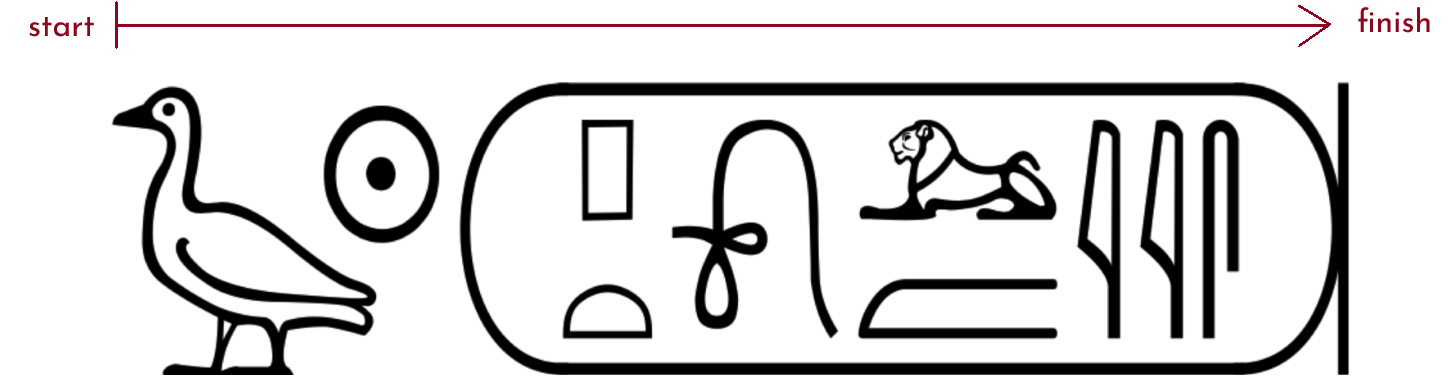
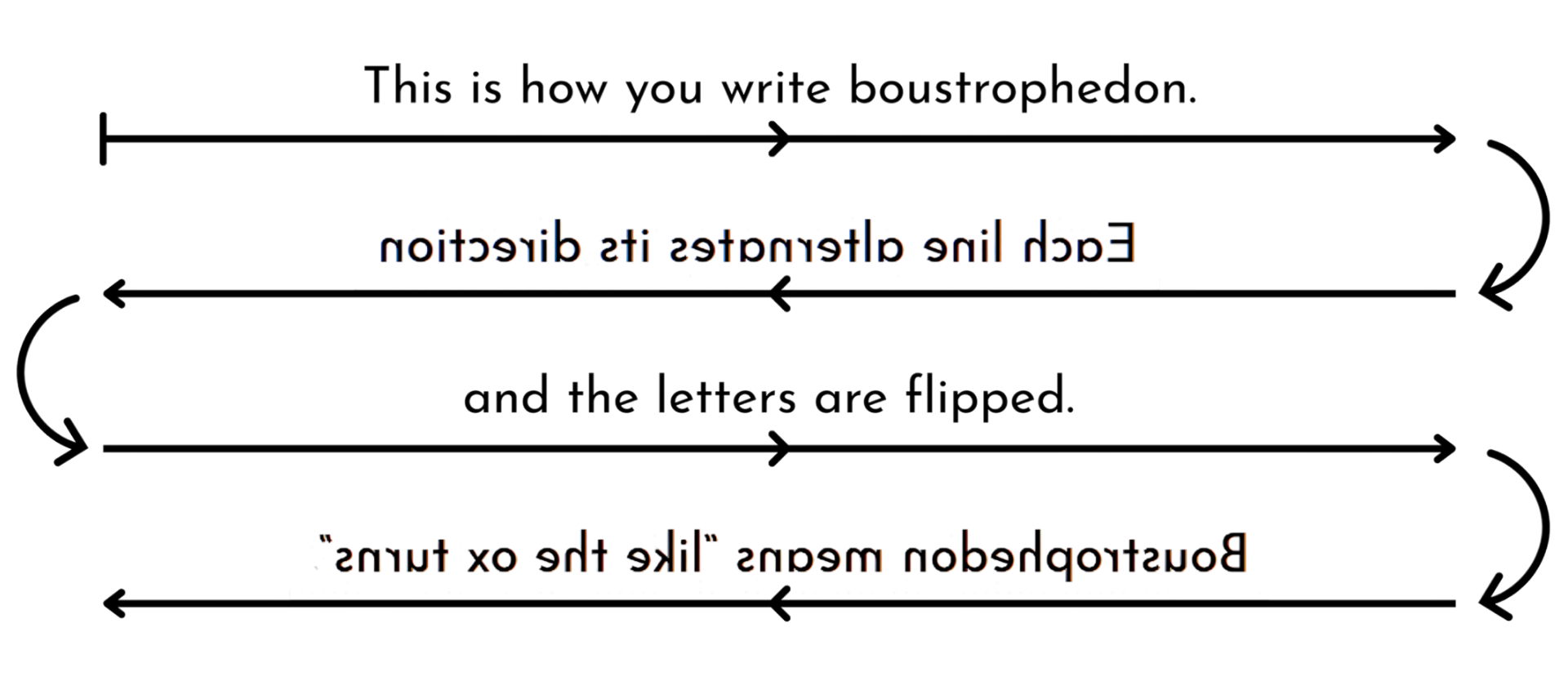
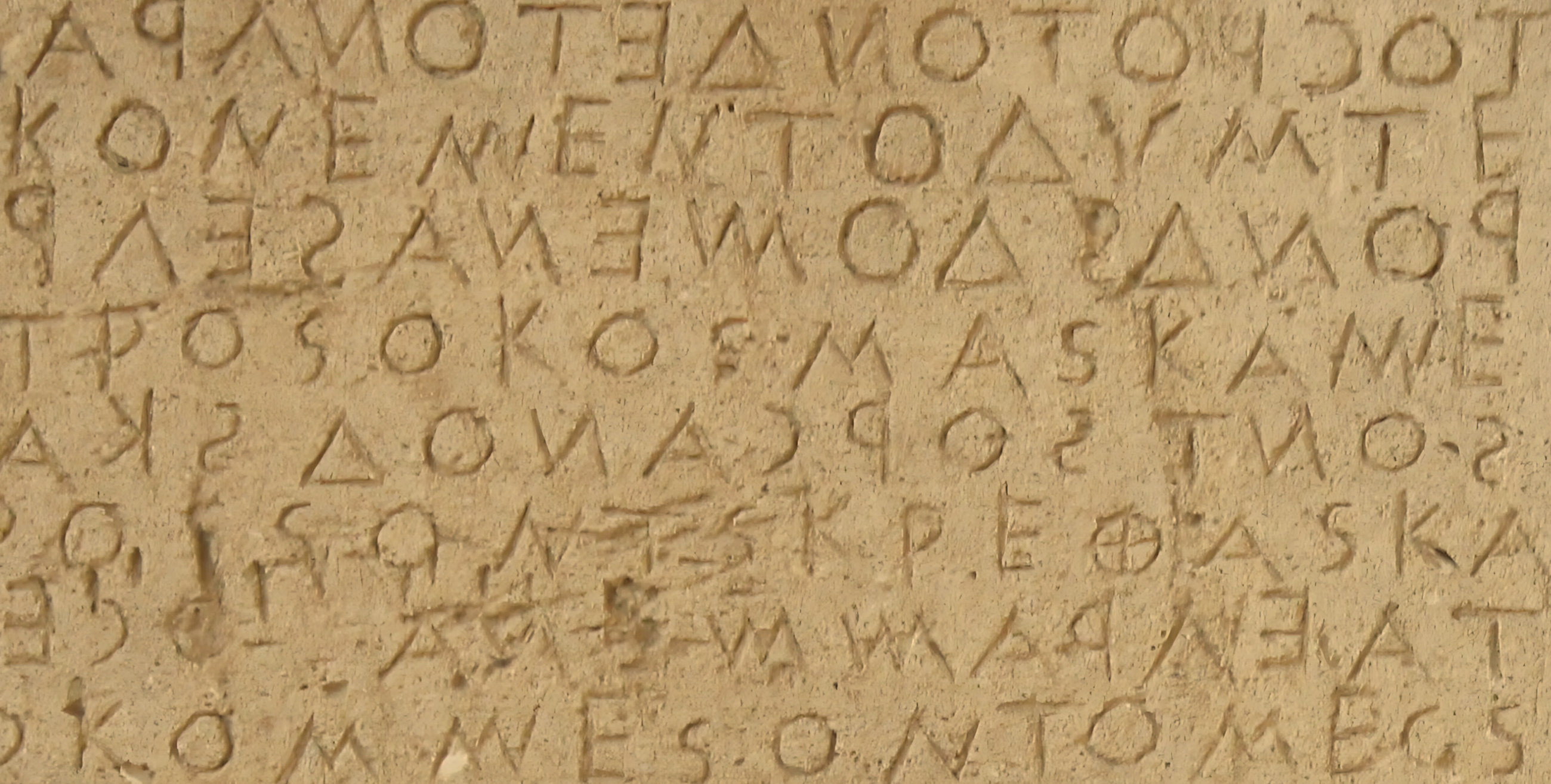
Hieroglyphs were mostly engraved into or painted on stone early on and later written on papyrus with reed pens called calamuses. They could be written in any direction, although the characters faced toward the direction from which a reader started. Hieroglyphs could also be written boustrophedon (alternating directions like a ploughed field with characters mirrored), common in ancient writing systems.¹¹ Hieratic and Demotic meanwhile were written mostly on papyrus and almost exclusively unidirectionally from right to left.¹² So it’s no wonder that the Ancient Greek writers and the poor sods trying to decipher Egyptian symbols pre-Rosetta had a sorry time! In fact, even within Ancient Egyptian society, only a small number of educated elites would have known how to fully use the system.
Egyptian hieroglpyhs, Hieratic, Demotic
Click here →
𓄿
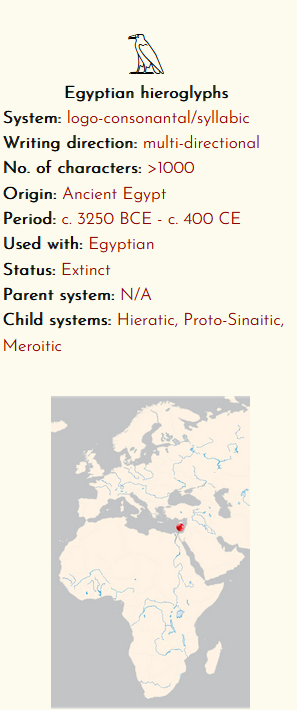
Egyptian hieroglyphs
System: logo-consonantal/syllabic
Writing direction: multi-directional
No. of characters: >1000
Origin: Ancient Egypt
Period: c. 3250 BCE - c. 400 CE
Used with: Egyptian
Status: Extinct
Parent system: N/A
Child systems: Hieratic, Proto-Sinaitic, Meroitic
Egyptian Hieratic
System: logo-consonantal/syllabic
Writing direction: multi-directional
No. of characters: >1000
Origin: Ancient Egypt
Period: c. 3200 BCE - c. 200 CE
Used with: Egyptian
Status: Extinct
Parent system: hieroglyphs
Child systems: Demotic
Egyptian Demotic
System: logo-consonantal/syllabic
Writing direction: mostly right-to-left
No. of characters: 400-600
Origin: Ancient Egypt
Period: c. 650 BCE - c. 400 CE
Used with: Egyptian
Status: Extinct
Parent system: Hieratic
Child systems: Meroitic, Coptic (influenced)
Decipherment of the Rosetta Stone
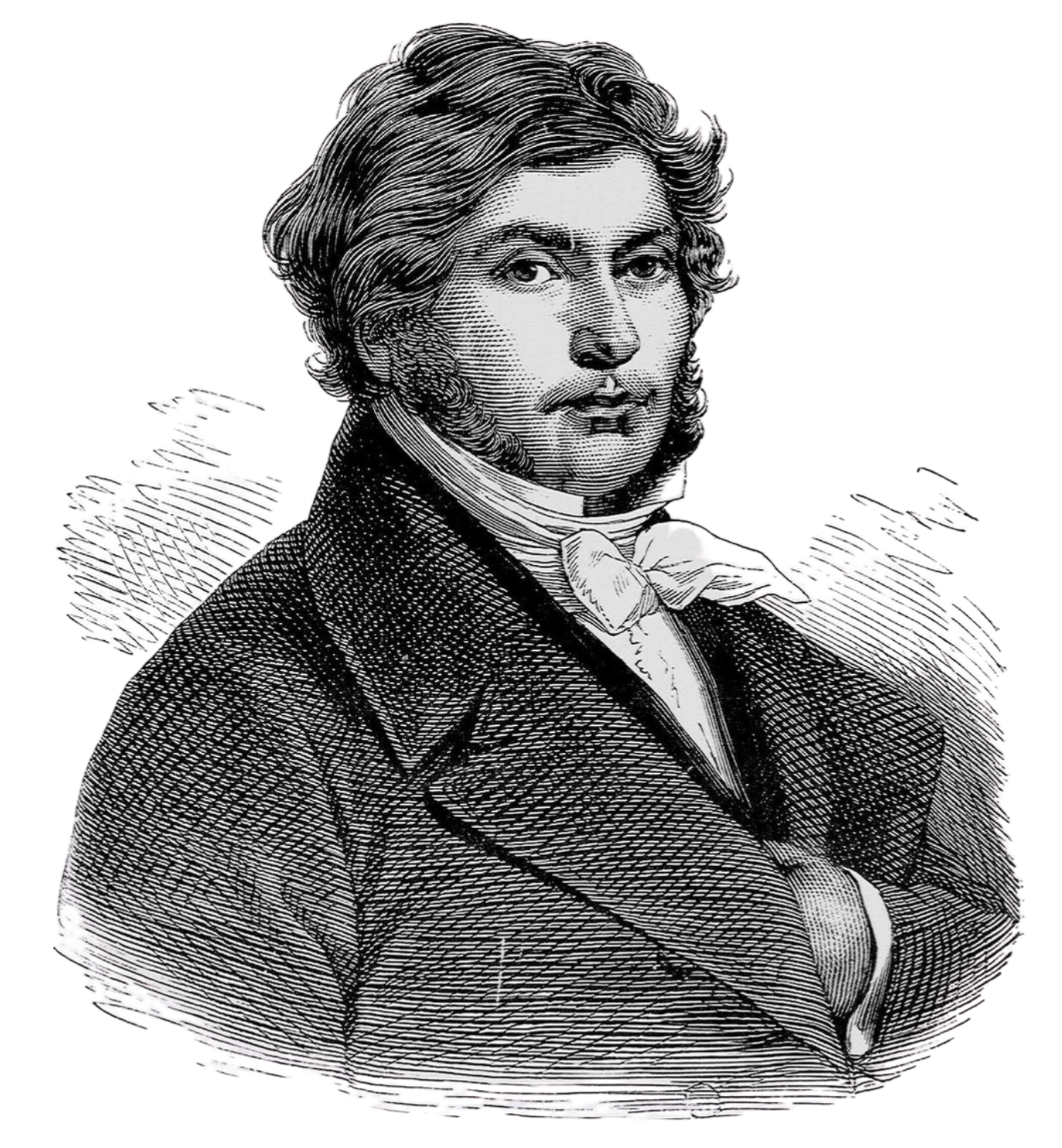
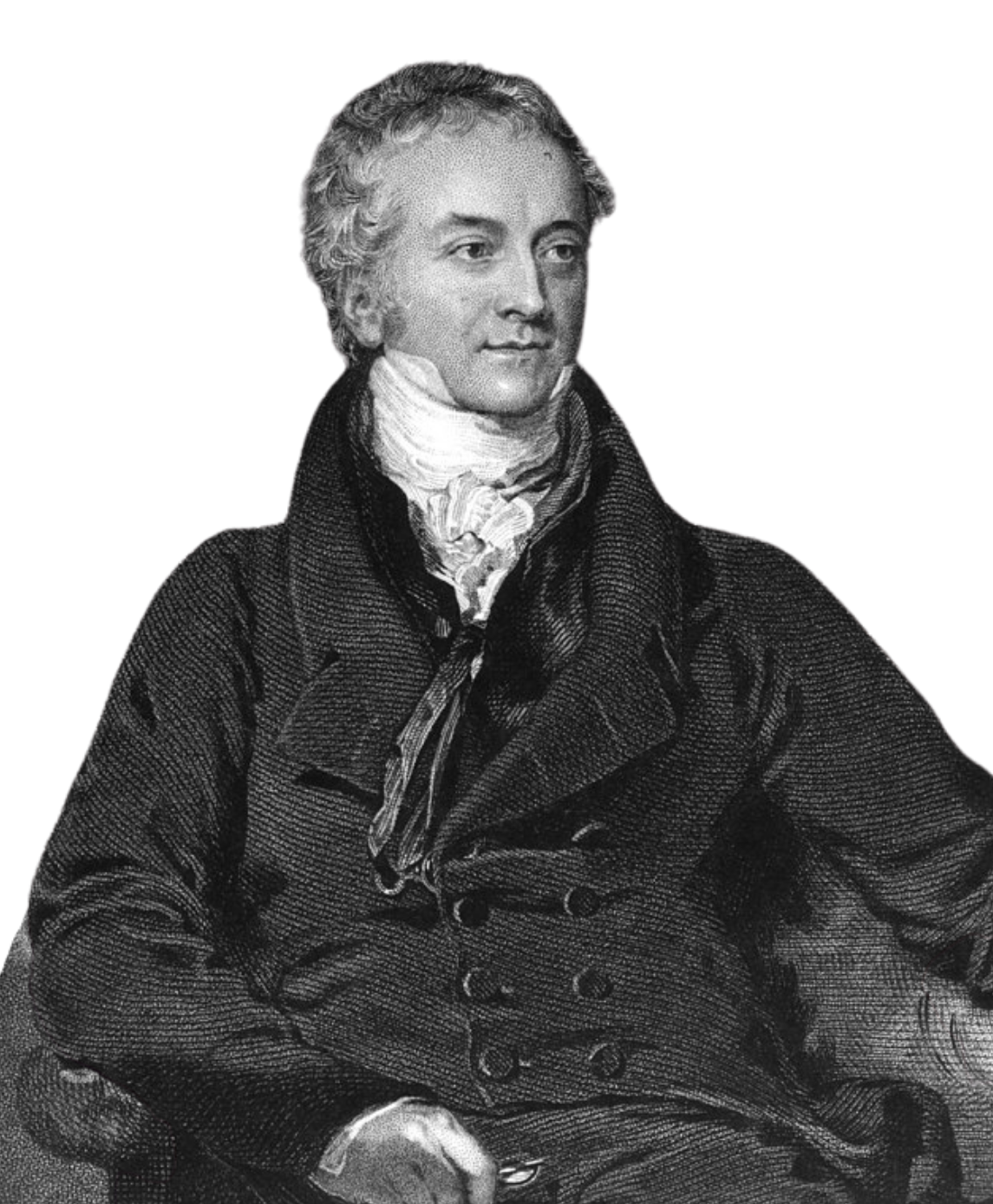
So how exactly was the stone deciphered? The mystery took more than 20 years to be solved, with Frenchman Jean-François Champollion commonly credited with the deed, but largely assisted by the work of others including Englishman Thomas Young who interpreted the name of Ptolemy, Georg Zoëga who identified many determinatives and Johan Åkerblad who made significant progress deciphering Demotic. The key to the decipherment lay in three important aspects: 1. the text was written in three different scripts (hieroglyphic, Demotic and Ancient Greek), 2. the message was more-or-less the same in all three of them, and 3. Coptic (the latest variant of the Egyptian language) was still spoken at the time.
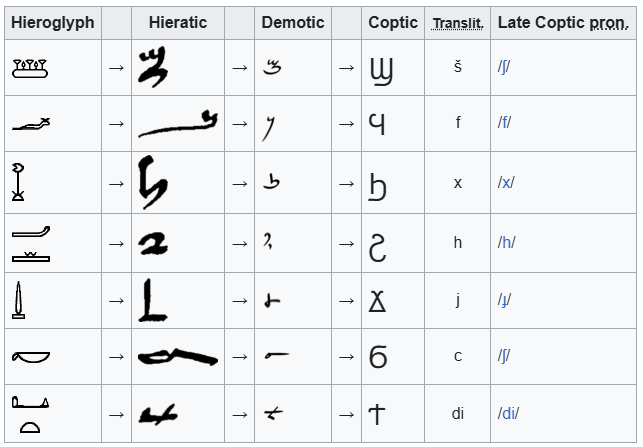
Now a functionally dead language, Coptic is today only used for liturgical purposes within the Coptic Church (in much the same way as how Latin is only used by the Catholic Church). But knowledge of it was easily accessible for scholars at the time. Coptic gives us a peek into what the Ancient Egyptian language looked (or more accurately, sounded like). After the Hellenistic conquest of Egypt, the Coptic script was developed, based primarily on the Ancient Greek alphabet with some characters borrowed from Demotic where Greek letters were insufficient in representing indigenous sounds. It was through this knowledge and by comparing the Demotic to the Greek texts that scholars deduced that Demotic had a phonetic function and surmised that hieroglyphs, as predecessors, may have functioned in the same way.¹³

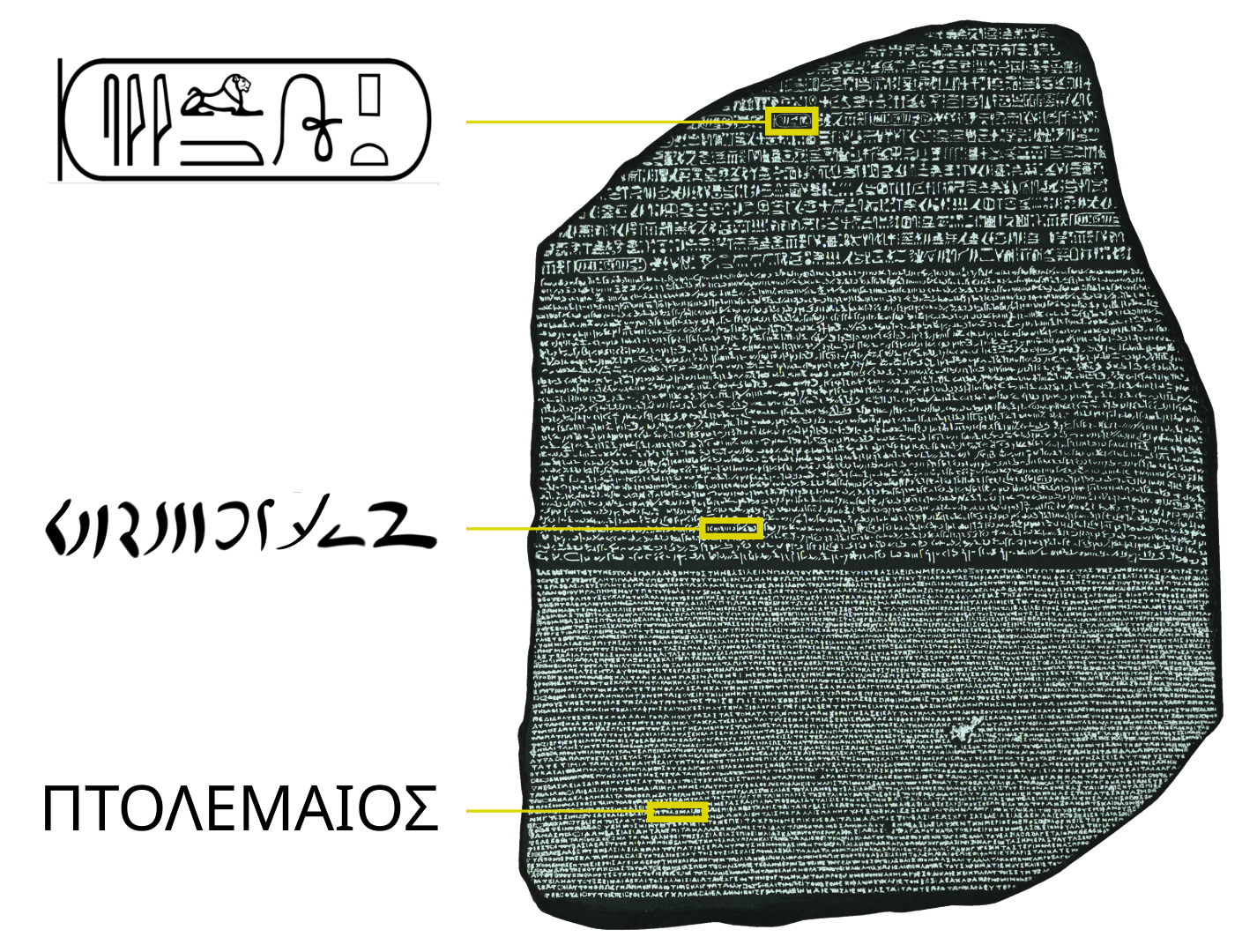
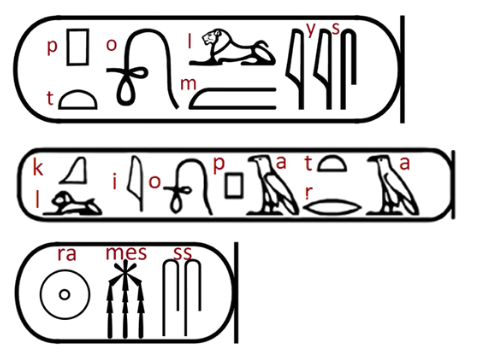
Thanks to the work of Zoëga, it was already known that royal names were enclosed in cartouches (ovals with a line at the end). By comparing the cartouches in the hieroglyphic text with the Ancient Greek text, Young was able to interpret the cartouche of Ptolemy (Πτολεμαῖος). Using the associated sounds for the hieroglyphs used in it. Additional hieroglyphs in the cartouche of Cleopatra were then easily deducible. The correct direction of reading was also confirmed.¹⁴ The final breakthrough came when Champollion used his knowledge of Coptic and the hieroglyphs deciphered so far to deduce the cartouche of Ramses. Knowing that Coptic was related to Ancient Egyptian and knowing the Coptic word for sun was ré, he deduced that the hieroglyph depicting the sun (𓇳) might also be pronounced as /ré/ or something similar such as /ra/, and knowing that the hieroglyph of a folded cloth represented the /s/ sound from Ptolemy’s cartouche, he was then able to deduce that the missing letter was /mes/. At that point he knew he had cracked the code, famously exclaiming “Je tiens l'affaire!” (“I’ve got it!”). The door to understanding hieroglyphs and the Ancient Egyptian language was then flung wide open and subsequently, the tracing of the all its descendent writing systems.¹⁵
Watch: Egyptian Hieroglyphs Decoded | History Hit
See: hieroglyph catalogue (Gardiner List)
Continue to Chapter 3 →
Glossary of terms
Chapter 2
Boustrophedon: an ancient writing style where lines of text alternate direction, going left-to-right then right-to-left, like the path of an ox plowing a field
Calamus: a reed pen used in ancient times for writing, particularly on materials like papyrus
Cartouche: an oval or oblong enclosure around a group of Egyptian hieroglyphs, typically signifying a royal name.
Consonant Cluster: a group of two or more consonants pronounced together without intervening vowels
Demotikos: Ancient Greek for "popular" or "of the common people"
Determinative: a non-phonetic symbol added to a word to clarify its meaning or category (e.g., action, object, person)
Glyph: a visual symbol or character, such as those in hieroglyphic writing, that represents a sound, idea, or object.
Grapheme: the smallest functional unit of a writing system (like a letter or symbol) that conveys a distinction in meaning or sound
Hieros: Ancient Greek for "sacred"
Papyrus: a writing material made from the pith of the papyrus plant, used extensively in ancient Egypt and the Mediterranean world
Proto-hieroglyphs: early forms of Egyptian hieroglyphs that appeared before the fully developed hieroglyphic system
Rebus principle: the use of pictures to represent sounds or syllables rather than whole words, often as a step toward phonetic writing
Useful Links
Ancient Egyptian Cartouches: https://www.timetrips.co.uk/pharaoh%20names.htm
Egyptian Hieroglyph Catalogue (Gardiner List): https://www.egyptianhieroglyphs.net/gardiners-sign-list/
Hieroglyph keyboard: https://www.lexilogos.com/keyboard/hieroglyph.php
Omniglot - Ancient Egyptian Scripts: https://www.omniglot.com/writing/egyptian.htm
Penn Museum – Write Your Name in Hieroglyphs: https://www.penn.museum/cgi/hieroglyphsreal.php
World History - Egyptian Hieroglyphs: https://www.worldhistory.org/Egyptian_Hieroglyphs/
Footnotes
Chapter 2
1. ‘Everything you ever wanted to know about the Rosetta Stone’, British Museum, 14 July 2017, <https://www.britishmuseum.org/blog/everything-you-ever-wanted-know-about-rosetta-stone> [accessed April 2025]
2. ‘Rosetta Stone’, Encyclopædia Britannica, 25 April 2025, <https://www.britannica.com/topic/Rosetta-Stone> [accessed April 2025]
3. Peter T. Daniels and William Bright, The World’s Writing Systems, Oxford University Press, 1996, p. 2
4. Benjamin Jowett, The Dialogues of Plato in Five Volumes, Vol. 1, 3rd ed. Oxford University Press, 1892, pp. 483–489, quoted in Plato’s Myths - Thamus and Theuth (Phaedrus 274b–278d), <https://www.john-uebersax.com/plato/myths/phaedrus.htm> [accessed April 2025]
5. Peter T. Daniels, ‘Part IX: Scripts Invented in Modern Times’ in Peter T. Daniels and William Bright, The World’s Writing Systems, Oxford University Press, pg. 577
6. Maurice Pope, The Story of Decipherment: From Egyptian Hieroglyphs to Maya Script, Thames & Hudson, 1999, p. 16
7. Mark Collier and Bill Manley, How to Read Egyptian Hieroglyphs: A Step-by-Step Guide to Teach Yourself, University of California Press, 2003
8. Alan Gardiner in Jim Loy, Determinative Signs In Egyptian, Jim Loy, <https://web.archive.org/web/20131220123438/http://www.jimloy.com/hiero/determin.htm> [accessed April 2025]
9. Priscila Scoville, ‘Egyptian Hieroglyphs’, World History Encyclopaedia, 02 July 2015, <https://www.worldhistory.org/Egyptian_Hieroglyphs/> [accessed April 2025]
10. Herodotus, The Histories, translated by A.D. Godley, Harvard University Press, 1920, Book II, Section 37
11. Amy Tikkanen, ‘Boustrophedon’, Encyclopædia Britannica, <https://www.britannica.com/art/boustrophedon> [accessed April 2025]
12. Helmut Brunner and Peter F. Dorman, ‘Hieroglyphic Writing‘, Encyclopædia Britannica, <https://www.britannica.com/topic/hieroglyphic-writing> [accessed April 2025]
13. Lesley Adkins, and Roy Adkins, The Keys of Egypt: The Obsession to Decipher Egyptian Hieroglyphs, Harper Collins, 2000
14. E.A. Wallace Budge, ‘Egyptian Hieroglyphic Writing’ in Kroeber, Alfred Louis, Source Book in Anthropology, Harcourt, Brace and Company, 1931
15. Lesley Adkins and Roy Adkins, The Keys of Egypt: The Obsession to Decipher Egyptian Hieroglyphs, Harper Collins, 2000, p. 180
Fig. 2.1: Mostafa Wael, ‘Rashid for Wiki’, Wikimedia Commons, <https://commons.wikimedia.org/wiki/File:Rashid_For_Wiki-11.jpg> [CC BY-SA 4.0, accessed April 2025]
Fig. 2.2: Jean-Léon Gérôme, ‘Napoleon and His General Staff in Egypt’, Wikimedia Commons, <https://upload.wikimedia.org/wikipedia/commons/thumb/9/9b/Bonaparte_en_Egypte.jpg/800px-Bonaparte_en_Egypte.jpg> [public domain, accessed April 2025]
Fig. 2.3: Ptolemy V Epiphanes Tetradrachm, illustration by Saczewski, Reinhard, World History Encyclopaedia, <https://www.worldhistory.org/uploads/images/19213.jpg> [public domain, accessed April 2025]
Fig. 2.4: Rosetta Stone at the British Museum, illustration by Hillewaert, Hans, Wikimedia Commons, <https://commons.wikimedia.org/wiki/File:Rosetta_Stone.JPG> [CC BY-SA 4.0, accessed April 2025]
Fig. 2.5: Hieroglyphs from the tomb of Seti I, (background removed, image enhanced), illustration by Jon Bodsworth, Wikimedia Commons, <https://commons.wikimedia.org/wiki/File:Hieroglyphs_from_the_tomb_of_Seti_I.jpg> [free to use with attribution, accessed April 2025]
Fig. 2.6: David Schrader, ‘Egyptian Graphemes’ (© author’s own, 2025)
Fig. 2.7: Hieroglyphic determinatives, (background removed), in Budge, E.A. Wallace, ‘Egyptian Hieroglyphic Writing’ in Kroeber, Alfred Louis, Source Book in Anthropology, Harcourt, Brace and Company, 1931, <https://www.originalsources.com/Document.aspx?DocID=9S1BLG9NBE5IMEA#>
Fig. 2.8: Egyptian hieroglyphs, hieratic script, and demotic script, image adapted from G. Moller, Zeitschrift des Deutschen Vereins für Buchwesen und Schrifttum, ii, 1919, p. 79, (public domain), reproduced by Encyclopædia Britannica, <https://www.britannica.com/topic/hieratic-script> [accessed April 2025]
Fig. 2.9: David Schrader, ‘Hieroglyph Direction of Writing’, (author’s own, 2025), based on @Zemanst, Ptolemy cartouch, Wikimedia Commons, <https://commons.wikimedia.org/wiki/File:Ptolemy_I.Sot%C3%A9r_birth_cartouche.png> [CC BY-SA 4.0]
Fig. 2.9b: David Schrader, ‘Boustrophedon’, (© author’s own, 2025)
Fig. 2.10: @PRA, Law of Gortyn – Crete, (image cropped and enhanced), Wikimedia Commons, <https://commons.wikimedia.org/wiki/File:Crete_-_law_of_Gortyn_-- _boustrophedon.JPG> [CC BY-SA 3.0, accessed April 2025]
Fig. 2.11: Georg Moritz Ebers, ‘Francisco Champollion’ (1882), illustration by Fondo Antiguo de la Biblioteca de la Universidad de Sevilla, Wikimedia Commons, <https://commons.wikimedia.org/wiki/File:Egipto,_1882_%22Francisco_Champollion%22_(21649057896).jpg> [CC BY 2.0, accessed April 2025]
Fig. 2.12: Thomas Young Portrait, illustration by AIP Emilio Segrè Visual Archives, Wikimedia Commons, <https://commons.wikimedia.org/wiki/File:Portrait_of_Thomas_Young.jpg> [public domain, accessed April 2025]
Fig. 2.13: @Afanous, ‘Coptic Alphabet’, Wikimedia Commons, <https://commons.wikimedia.org/wiki/File:CopticLetters.svg> [CC BY-SA 3.0, accessed April 2025]
Fig. 2.14: ‘Letters derived from Demotic’, Coptic Script, Wikipedia, <https://en.wikipedia.org/wiki/Coptic_script> [CC BY-SA 4.0, accessed April 2025]
Fig. 2.15: David Schrader, ‘Rosetta Stone’ (© author’s own, 2025) based on illustrations sourced from Wikimedia Commons, <https://commons.wikimedia.org/wiki/File:Rosetta_Stone_BW.jpeg> [public domain, accessed April 2025], <https://commons.wikimedia.org/wiki/File:Ptolemy_I.Sot%C3%A9r_birth_cartouche.png> [CC BY-SA 4.0, accessed April 2025]
Fig. 2.16: David Schrader, ‘Cartouches’, (author’s own, 2025), based on cartouches sourced from Wikimedia Commons, <https://commons.wikimedia.org/wiki/File:Ptolemy_I.Sot%C3%A9r_birth_cartouche.png> [CC BY-SA 4.0, accessed April 2025], Time Trips, <https://www.timetrips.co.uk/pharaoh%20name%20answers.htm> [with permission, accessed April 2025], Adkins, Lesley and Adkins, Roy, The Keys of Egypt: The Obsession to Decipher Egyptian Hieroglyphs, Harper Collins, 2000, p. 180
Share this page
To the
Top
To the
Bottom