
Contents
Page
Current
Chapter:
4
The
Neanderthal
Script


Play
TRACK 6
Previous
Chapter
Next
Chapter
rigins
Writing
of

Discovery
In the early 1600s, an Italian aristocrat by the name of Pietro della Valle undertook a pilgrimage to the Holy Land. After visiting Jerusalem and other holy sites, he spent some time further exploring the Middle East, ending up in Baghdad where he married an Assyrian Christian woman. While there, he visited some of the historical sites in the region such as the ruins of the former Mesopotamian cities of Nineveh and Ur. While perusing the crumbling stone relics, he stumbled upon some bricks with strange inscriptions. Taking them with him on his return to Italy, Europeans had some of the first samples of one of the world’s oldest writing systems - cuneiform¹, which I refer to as the "neanderthal script" because, as we will see, it had a tragic fate similar to that of homo sapiens' evolutionary cousins.
Genesis
In common usage in Mesopotamia by around 2900 BCE, the name cuneiform is based on the Latin cuneus (wedge), as it was made by pressing a wedge-shaped reed stylus into wet clay, with a set of between 600 and 1000 characters.² It was gradually developed by the Sumerians from around 3400 BCE in the form of proto-cuneiform, based on early pictograms. Proto-cuneiform became more simplified and abstract over time and like Egyptian hieroglyphs, eventually developed a phonetic component through the rebus principle, forming a full writing system. Like its “rival” system Egyptian hieroglyphs, knowledge of how to read it was all but forgotten by the 1st c. CE, since replaced by newer phonetic scripts such as Aramaic, Greek and Latin. Some linguists have speculated that cuneiform may have actually influenced the development of Egyptian hieroglyphs, but this is considered an antiquated view, out of line with modern findings. We can, however, much later see evidence of the two scripts being used side by side in bilingual documents such as the Egyptian-Hittite Peace Treaty of 1259 BCE.³
𑁪
Cuneiform:
the "neanderthal script"
𒆠𒂗𒄀


Intro
What
Is
Writing?
Birthplace
of
Writing
Children
of
Egypt
Cuneiform:
"Neanderthal
Script"
Oracle
Bones
Extinct
Scripts
Invented
Writing
Punctuation
&
Symbols
Number
Systems
Lessons
From
Writing


Tip: Hover cursor over image
to pause slideshow 👆🏻
↑
Click here to pause slideshow
← Click image to enlarge
Decipherment
Indeed, it wasn’t until after the cracking of the Rosetta Stone in the mid-19th century that linguists started to make serious attempts to decipher cuneiform. In the end, this was achieved in much the same way, through comparative linguistics. During the Persian Achaemenid empire (550 - 330 BCE) monuments often included inscriptions written in multiple languages, many of which used their own variants of cuneiform. One of the most famous of these is the Behistun Inscription, a rock relief commissioned by Darius I (the Great) in 520 BCE, written simultaneously in Old Persian, New Elamite and Late Babylonian (a dialect of Akkadian) with their own cuneiform variants.
The Behistun inscription (and others), like the Rosetta stone, was instrumental in the system’s decipherment. It was the Danish mathematician Carsten Niebuhr who first correctly ascertained that the relief consisted of three separate inscriptions in different languages and cuneiform variants which he labelled as class I, II and III (later identified as Persian, Elamite and Babylonian respectively). He determined that Persian cuneiform was alphabetic due to only having 34 different symbols, while the Elamite and Babylonian were syllabic and logo-syllabic respectively due to having far more symbols. Niebuhr also managed to decipher the Old Persian word for 'king', which proved to be a foot in the door. Later the German philologist Georg Friedrich Grotefend, started to decipher the phonetic values of cuneiform by comparing the names of royal figures such as Darius and Xerxes. Through this, he and other linguists were slowly able to piece together Persian cuneiform.⁴ The Old Persian language was later determined to be an Indo-European language related to Sanskrit rather than a Semitic language.


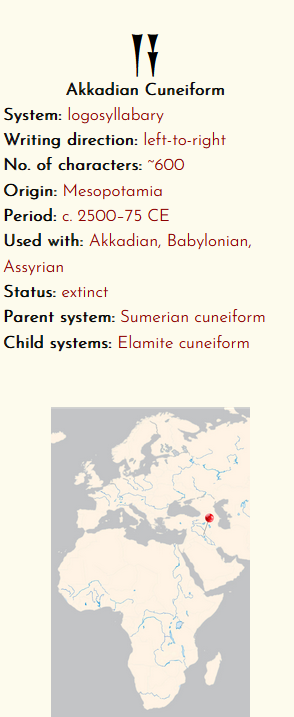
While the New Elamite cuneiform has not yet been deciphered (largely due to Elamite being a language isolate), linguists were able to subsequently decipher Babylonian cuneiform. Scholars such as Henry Rawlinson, Edward Hinks and Jules Oppert noted the similarities between the Babylonian inscriptions and the cuneiform that was written on many of the tablets unearthed in Mesopotamia – later identified as Akkadian. Akkadian was the ancestor of Assyrian and Babylonian, and used to write texts such as the Code of Hammurabi and the Cyrus Cylinder. As Grotefend had done with Old Persian, the scholars were able to ascertain the names of Babylonian kings such as Nebuchadnezzar II, and from there, decipher a host of other characters both syllabic and ideographic. They were later aided when it was ascertained that Akkadian (and subsequently Babylonian and Assyrian) were Semitic languages by comparing Babylonian words to known Semitic languages. For example, the first person pronoun 𒀀𒈾𒆪 (a-na-ku) is a cognate with the Biblical Hebrew אָנֹכִי (anokhí).⁵ Another example is the Akkadian word for ‘god’ ilim (𒀭) which is a cognate with the Phoenician ʾl, Ugaritic
ʾl-h-m, Hebrew El/Eloah/Elohim, Arabic Allah and supposedly (although disputed) forms the etymology of the names Babylon (the Latin form of the Akkadian Babilim or ‘gate of god’) and the Tower of Babel (literally ‘tower of Babylon’ in Biblical Hebrew).⁶



Sumerian cuneiform – a cultural treasure
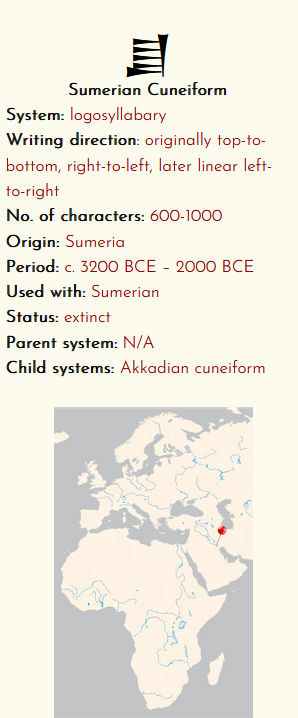
But Akkadian cuneiform is not the oldest form of cuneiform. It was in fact appropriated from a neighbouring civilisation – the Sumerians. They originally used cuneiform to write the Sumerian language, a non-Semitic language isolate once falsely believed to be an Akkadian dialect. It was used to write famous texts such as the Epic of Gilgamesh and Eridu Genesis. Sumerian was subsequently deciphered through Akkadian texts that broke down Sumerian grammar and vocabulary to preserve it after it began to go out of use.⁷ Much like Egyptian hieroglyphs, Sumerian cuneiform originally developed out of pictograms and a specialised token system that used them for bookkeeping (see Chapter 1). Later these evolved into more abstract logograms and phonograms (often rotating in the process) with anywhere between 700 and 2000 unique signs.⁸
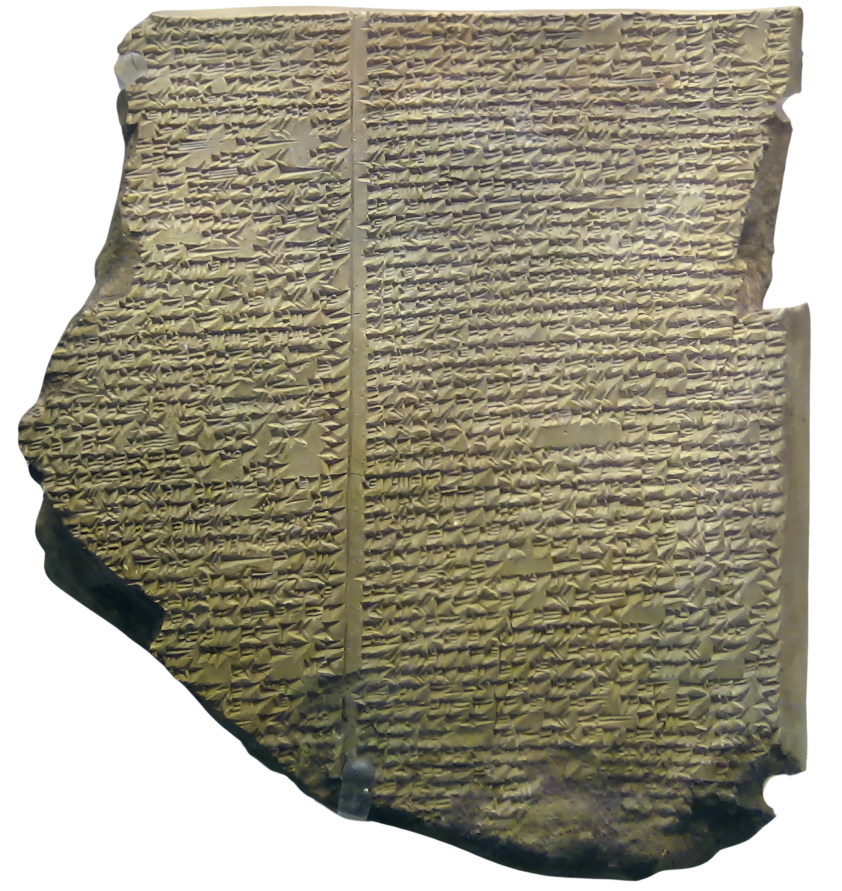
Sumerian cuneiform, like, Egyptian hieroglyphs, used the rebus principle to represent sounds with their characters, but was mostly syllabic, focussing largely on consonant-vowel pairings. For example, the symbol 𒌓, evolving from a pictographic circle, represented the sun (the Sumerian word for sun being ud). But it could also be used to represent the syllable
/ud/.⁹ For example, the Sumerian city of Udnun (known to the Akkadians as Adab) was spelt 𒌓𒉣𒆠 (ud-nunᴷᴵ). Cuneiform, like hieroglyphs, also used determinatives at the start or end of a word to give it semantic context. The last symbol in the name of the city of Udnun, 𒆠 (ki), is a determinative for 'place' or 'city'.¹⁰ The Sumerian symbol 𒀀 could logographically represent 'water' (the Sumerian word for water being [a]), but it could also be used to phonetically represent the sound /a:/ in a longer word such as 𒀀𒈠 (ama), meaning mother/father.¹¹ The symbol 𒀭(dinĝir) based on the pictograph for star (dinĝir in Sumerian), could represent the logograms for 'god'/'goddess' (also dinĝir), the supreme Sumerian deity Anu, 'sky'/'heaven' (an) and also as a determinative to refer to a specific god or something religious in nature.¹² Hence the storm/rain god Iškur (Adad in Akkadian) is written logographically as 𒀭𒅎 with the 𒀭 determinative.¹³ Similarly, the determinative for king was 𒈗 (lugal)¹⁴ seen in the name of Lugal-Zage-Si (𒈗𒍠𒄀𒋛), the last Sumerian king, who reigned from 2358 to 2334 BC.¹⁵
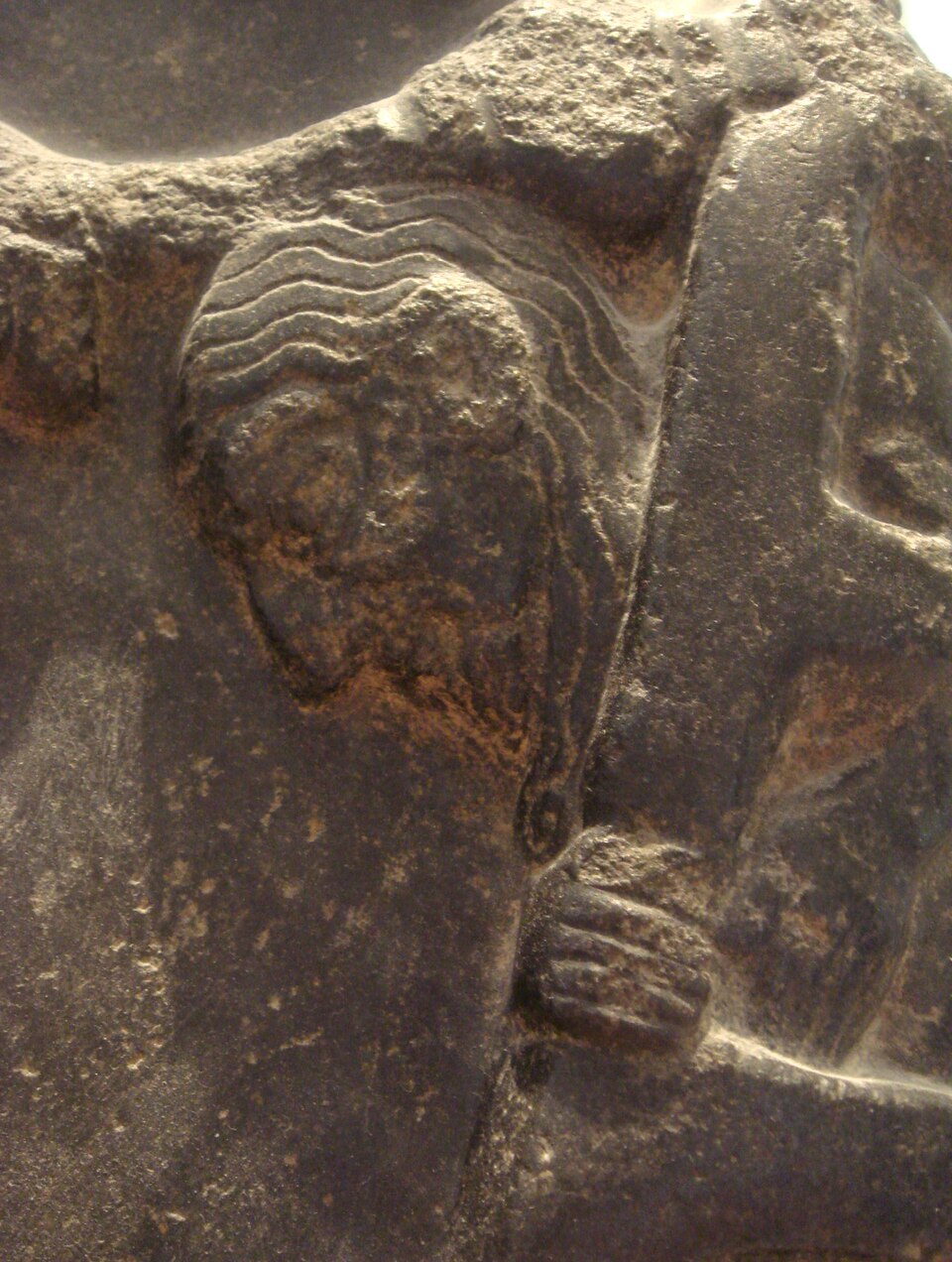
Cultural appropriation
Akkadian cuneiform was an appropriation of the Sumerian cuneiform for the Akkadian language after the dominance of Sumer by Sargon of Akkad. The Akkadians adopted many of the existing Sumerian symbols along with their names and phonetic values, despite the two languages not being related. This is in the same way that Greek borrowed the letter names and phonetic values of its unrelated Phoenician ancestor. For example, the symbol 𒌓 (ud), retained its Sumerian name and phonetic value when it was appropriated for Akkadian, despite the Akkadian word for sun (as well as the god of the same name) being šamšu, not ud.¹⁶ Likewise, the Sumerian symbol 𒀀 (a) retained its name and phonetic value in Akkadian, despite the Akkadian word for water being mû.¹⁷ The city of Akkad, for example, was spelt 𒀀𒂵𒉈𒆠 (a-ka-deᴷᴵ)¹⁸. Early Sumerian cuneiform was written from top to bottom and right to left (like classical Chinese), but later shifted to a linear left-to-right orientation, probably to make it easier for right-handed scribes to write on clay tablets. From Akkadian, separate Babylonian and Assyrian dialects later evolved with their own cuneiform variants, and from there, different regional variants formed all over the Near East such as Ugaritic, Hittite, Elamite and Persian.¹⁹


A cuneiform alphabet?
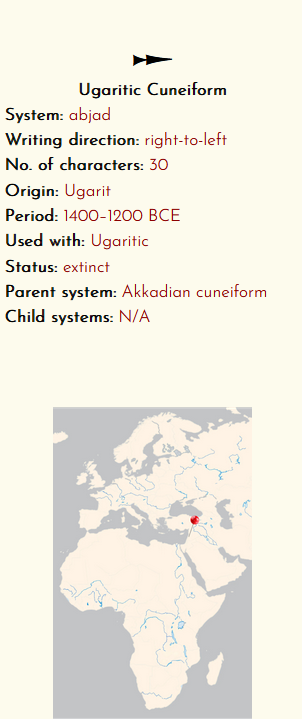
Ugaritic cuneiform was the first form of cuneiform used purely phonetically. It was an abjad used from around 1400 BCE for the Ugaritic language, a now extinct Western Semitic language from the west coast of modern-day Syria. It contained 30 letters, written from left to right. While the characters themselves were inspired by Akkadian cuneiform, Ugaritic did not copy directly from it. Some letters were repurposed Akkadian characters, but many new ones were created to better represent Ugaritic phonemes. The letters in this system had a fixed order, starting with 𐎀 (‘a), 𐎁 (b), 𐎂 (g), and this is the letter order that Phoenician borrowed and by extension Greek and Latin. Some have hypothesised that the Phoenician letters themselves may have actually derived from Ugaritic cuneiform rather than proto-Sinaitic. However, this is a marginal view among linguists. In fact, it is much more likely that Ugaritic was influenced by proto-Canaanite.²⁰

Old Persian - appeasing a king's insecurities
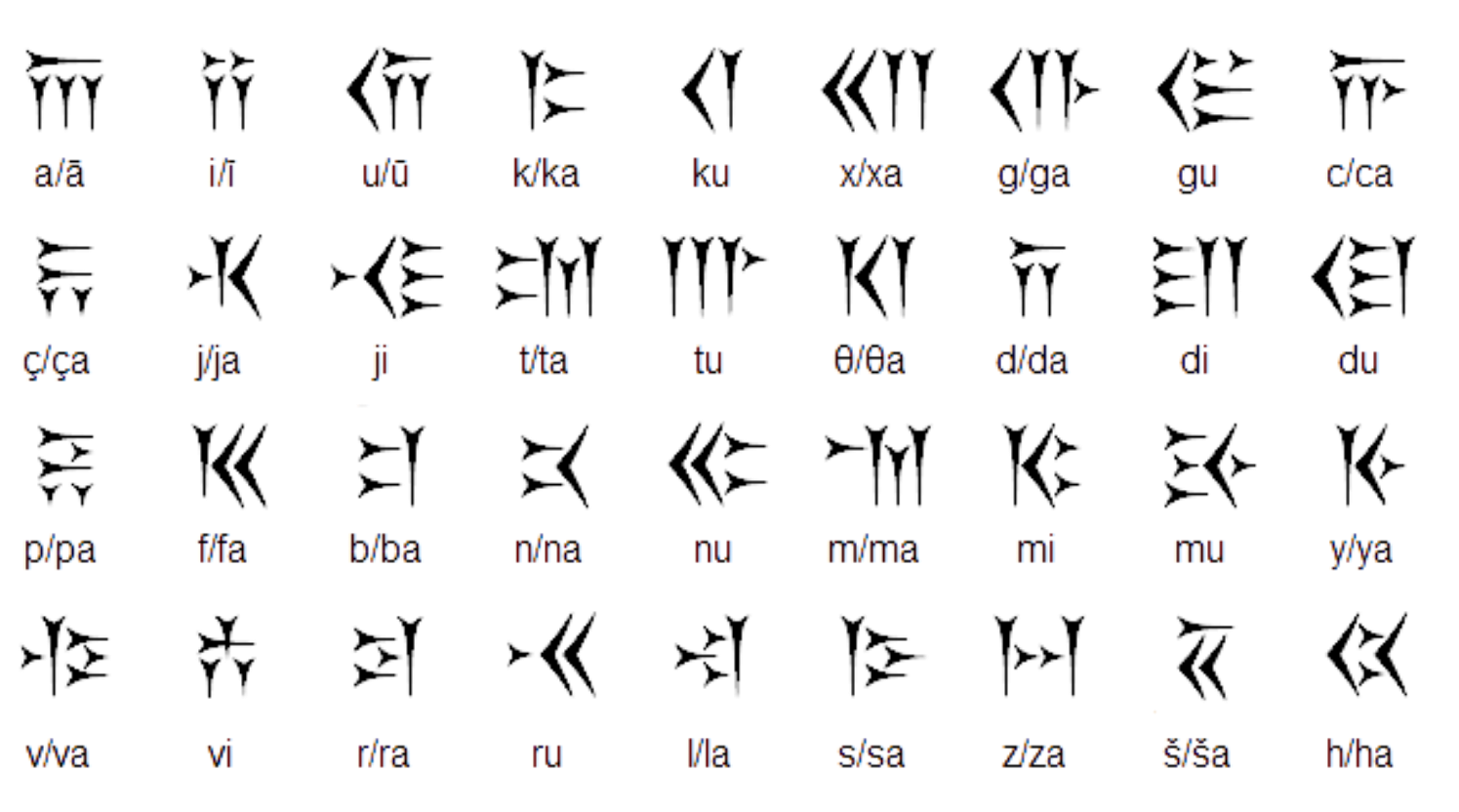
At the time of the Achaemenid Empire, the Persians hadn’t developed their own indigenous script. Feeling left out, the Persian king Darius I (the Great) (550 - 486 BCE), commissioned the creation of Old Persian cuneiform. Like Ugaritic, it replaced the logo-syllabic Akkadian cuneiform with a mostly phonetic system. But unlike Ugaritic, it was not fully alphabetic. It was instead a semi-syllabary with some characters representing phonemes (i.e. letters) and others representing syllables. It also maintained some logograms such as those for ‘god’ (𐏎), ‘country’ (𐏌/𐏍) and ‘king’ (𐏋). Over all, it was much easier to learn than Akkadian (Babylonian) or Elamite cuneiform due to its simplified set of characters.²¹ And yet it was still mainly only used for official inscriptions within the Achaemenid empire. The lingua franca within the empire was, after all, Aramaic, which used its own alphabet; itself a descendant of the Phoenician script.²²


Aramaic – the alpha of alphabets
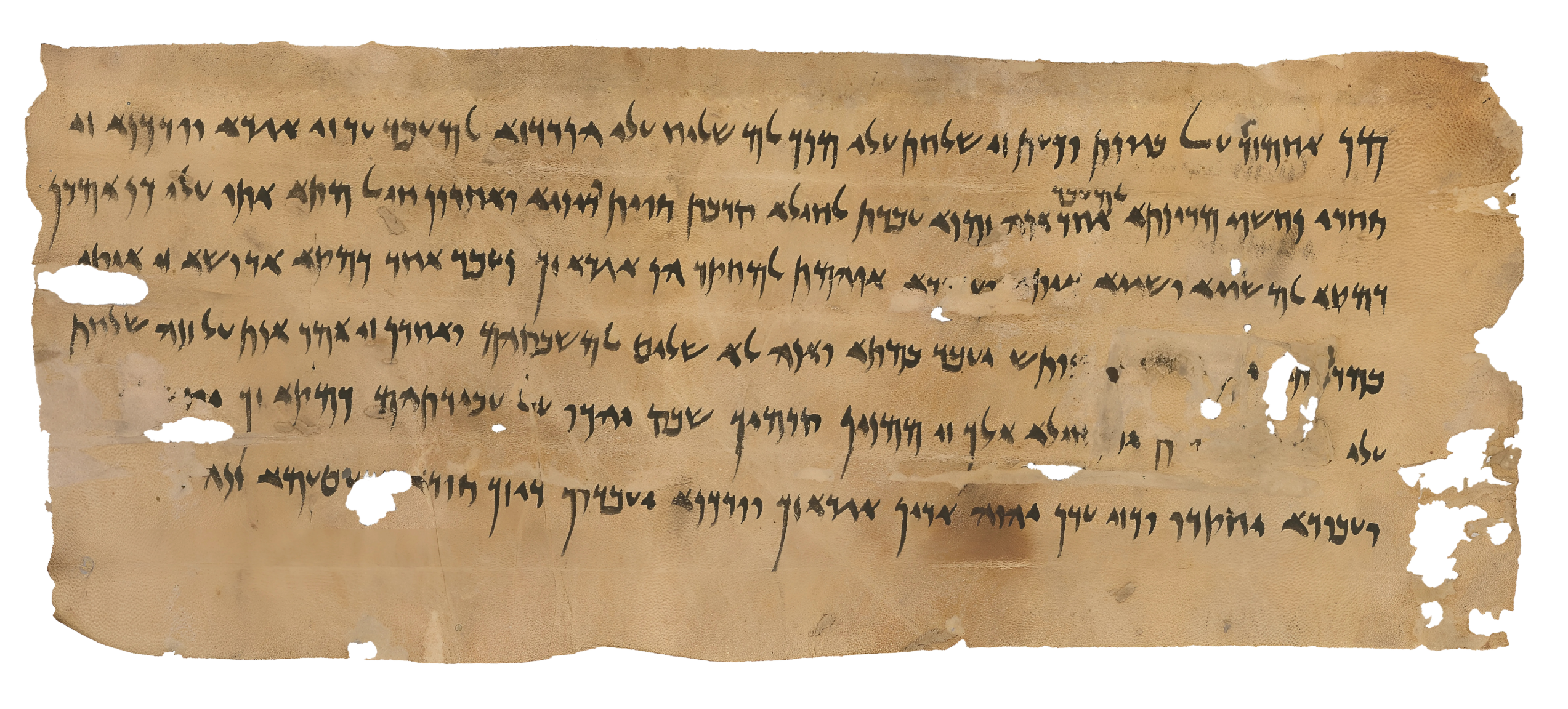
The adoption of Aramaic script in the Near East was undoubtedly expedited by the Achaemenids’ use of the Aramaic language. The preceding Neo-Assyrian and Neo-Babylonian empires had in fact already put the wheels in motion, using it as their lingua franca. This made widespread use of the Aramaic script a natural consequence. Nonetheless, the improved simplicity, efficiency, and accessibility of Aramaic script over cuneiform is indisputable. Unlike cuneiform, which often required mastering hundreds of symbols, alphabets like Aramaic use a small set of easily learnable letters, adaptable to different languages. This allowed Aramaic to spread quickly throughout the empire through cultural transmission. Additionally, Aramaic was easier to write on materials like papyrus, unlike cuneiform, which relied on bulky clay tablets. Despite Aramaic being the primary script of the empire, cuneiform remained the prestige script, and continued to be used for centuries in specific contexts such as royal inscriptions and monuments like the one at Behistun.²³ This might be compared with the lingering use of Latin in legal and ceremonial texts in English-speaking countries.
Alexander arrives
Thus, when Alexander the Great conquered the Achaemenid Empire in 330 BCE, the concept of the alphabet was already well-entrenched. When the Greeks took over, Greek was easily adopted as the official language of administration with Aramaic continuing as a ‘demotic’ script. But from the Hellenistic period onwards Aramaic script began to be used more for local languages, evolving into a series of regional variants including the Semitic scripts Hebrew, Syriac and Arabic (through Nabataean) in the west, Pahlavi (used for Middle Iranian) in the centre, the Indic scripts Kharosthi and Brahmi in the East and the Iranic Sogdian in the north (around modern-day Uzbekistan). The fate of cuneiform is thus a tragic one. The Seleucid Empire (the Eastern successor to Alexander’s Empire) maintained its use for some limited religious and legal purposes, but it gradually fell out of use over the centuries. The last known official cuneiform inscription was made around 75 CE in the Babylonian city of Uruk, when its author impressed his cuneus for the last time.²⁴ Cuneiform, like many other scripts, languages and biological species, thus died out in the same way as the Neanderthals; with a whimper rather than a scream, unable to compete with its more sophisticated evolutionary rivals.²⁵ ²⁶
Watch: Writing Cuneiform | Irving Finkel - Getty Museum
Click here →
See: Chart of Cuneiform Signs
Cuneiform Variants
𒋗
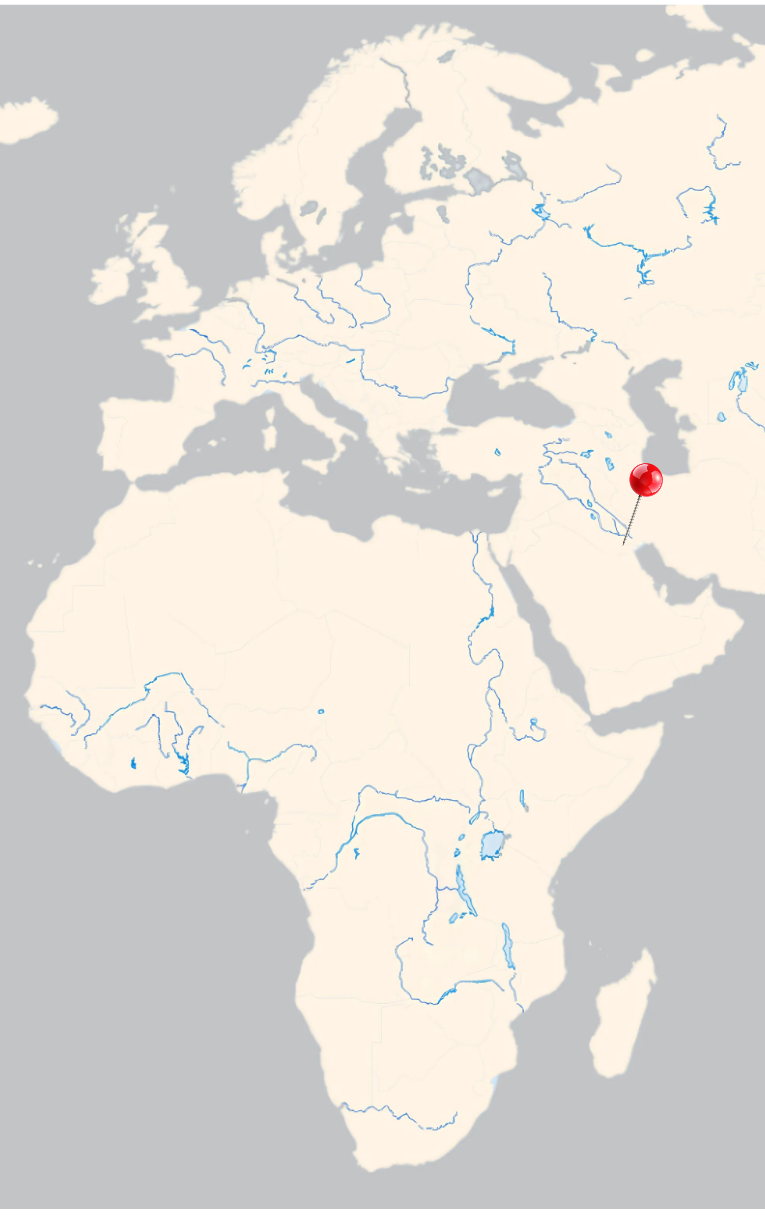
Sumerian Cuneiform
System: logosyllabary
Writing direction: originally top-to-bottom, right-to-left, later linear left-to-right
No. of characters: 600-1000
Origin: Sumeria
Period: c. 3200 BCE – 2000 BCE
Used with: Sumerian
Status: extinct
Parent system: N/A
Child systems: Akkadian cuneiform
𒀀
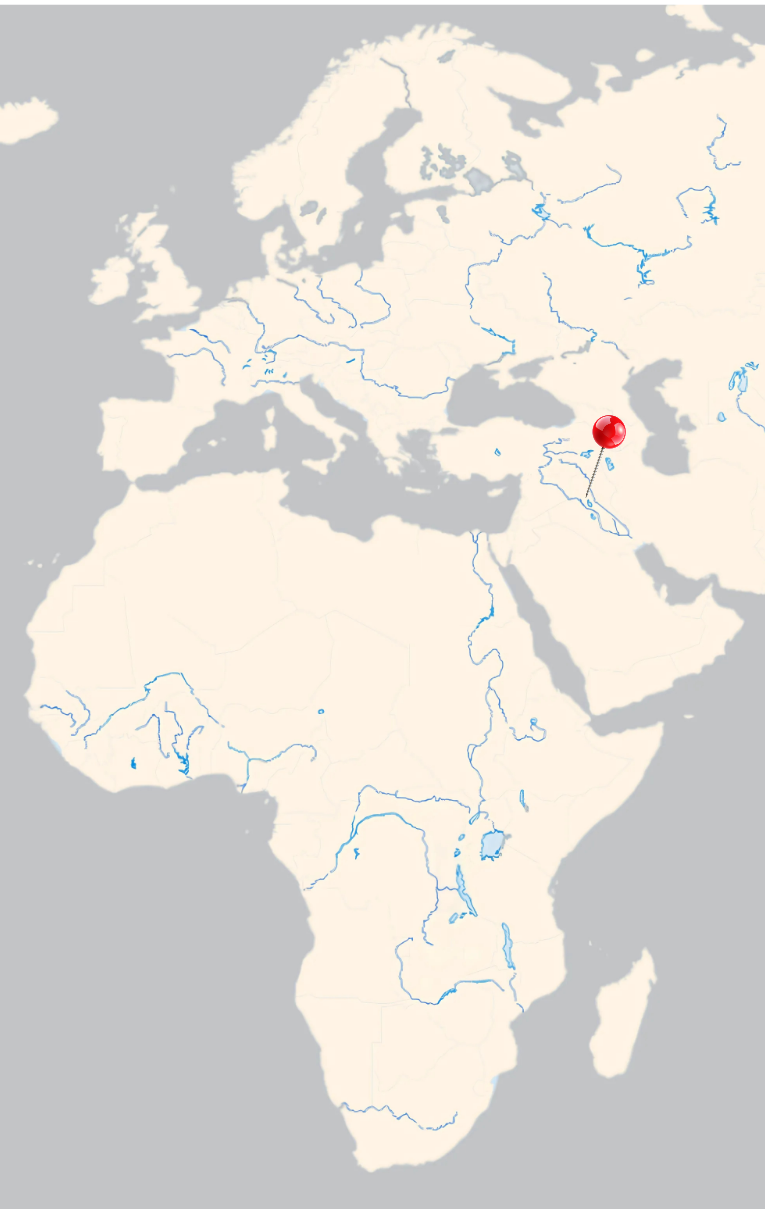
Akkadian Cuneiform
System: logosyllabary
Writing direction: left-to-right
No. of characters: ~600
Origin: Mesopotamia
Period: c. 2500–75 CE
Used with: Akkadian, Babylonian, Assyrian
Status: extinct
Parent system: Sumerian cuneiform
Child systems: Elamite cuneiform
𐎀
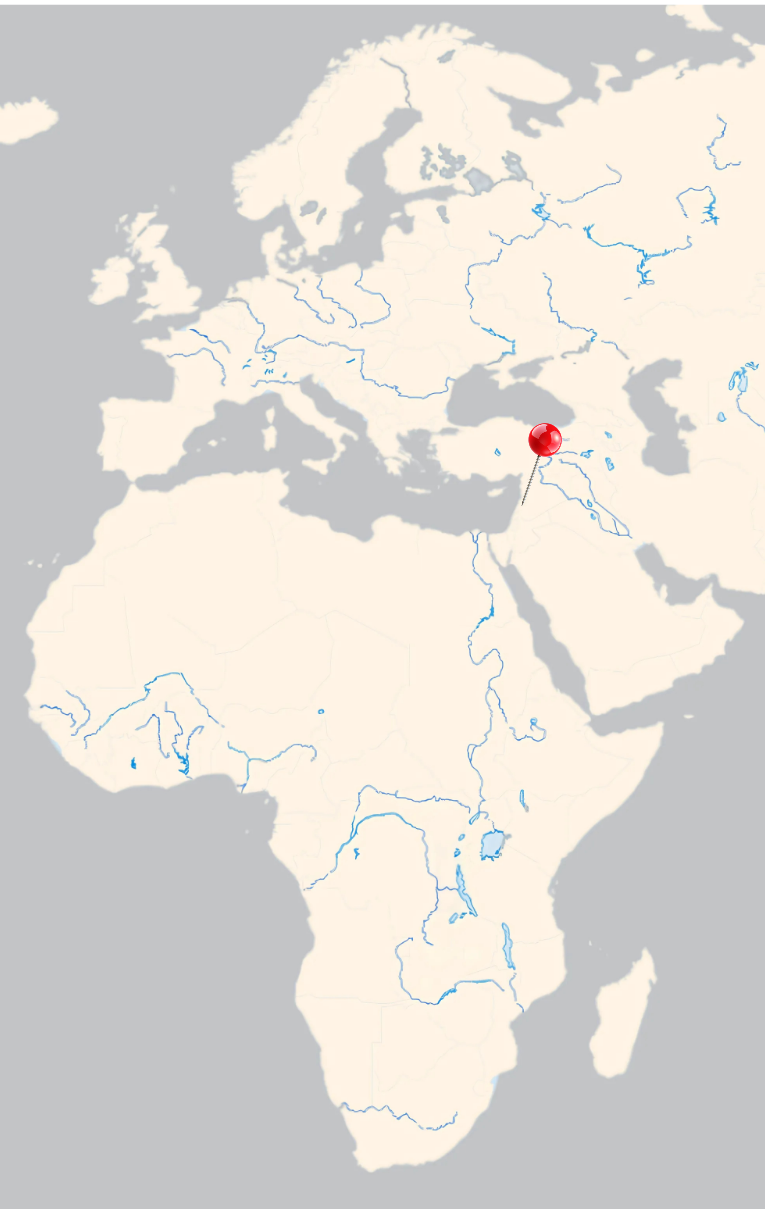
Ugaritic Cuneiform
System: abjad
Writing direction: right-to-left
No. of characters: 30
Origin: Ugarit
Period: 1400–1200 BCE
Used with: Ugaritic
Status: extinct
Parent system: Akkadian cuneiform
Child systems: N/A
𒉏
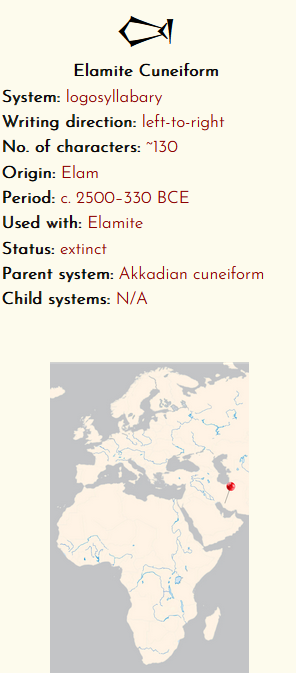
Elamite Cuneiform
System: logosyllabary
Writing direction: left-to-right
No. of characters: ~130
Origin: Elam
Period: c. 2500–330 BCE
Used with: Elamite
Status: extinct
Parent system: Akkadian cuneiform
Child systems: N/A
𐎠
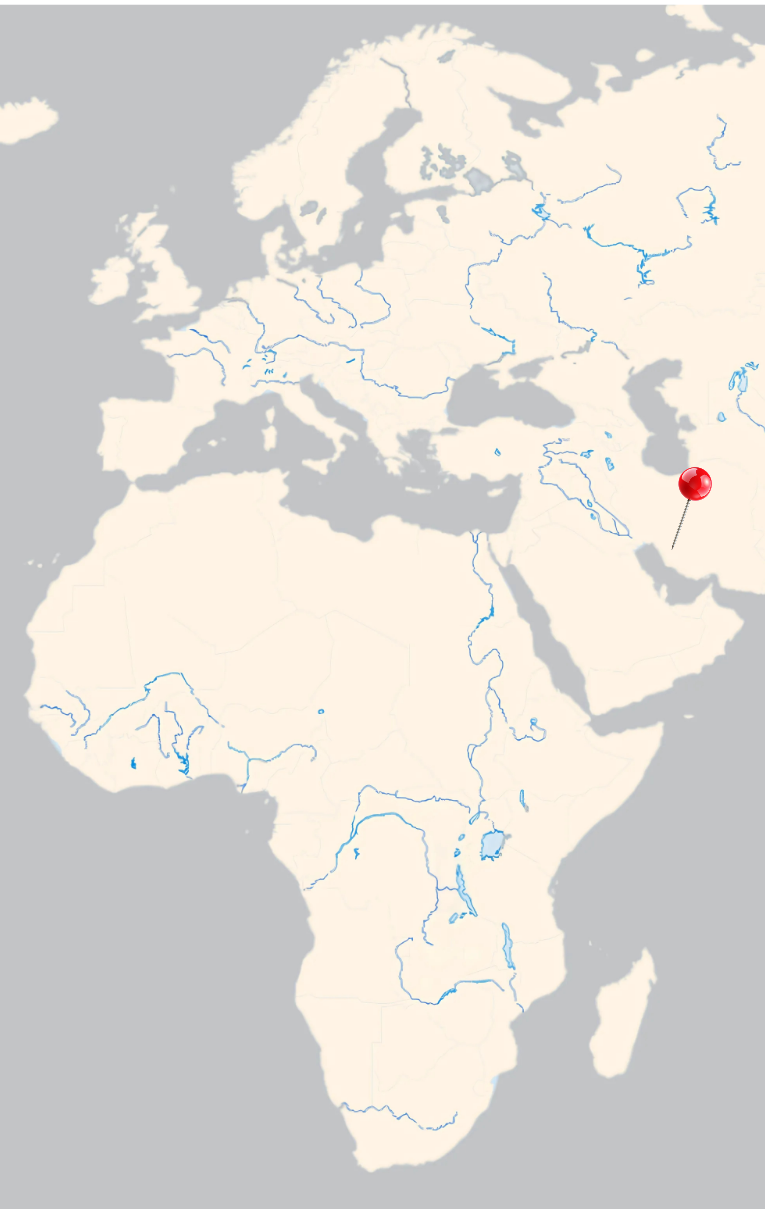
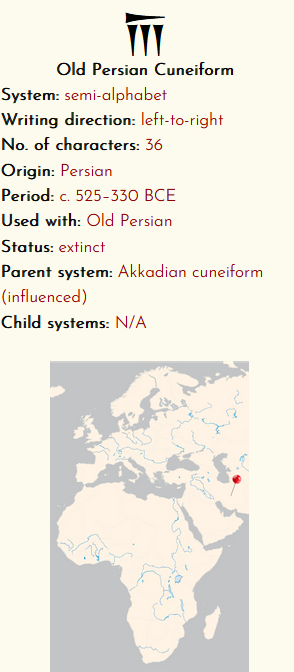
Old Persian Cuneiform
System: semi-alphabet
Writing direction: left-to-right
No. of characters: 36
Origin: Persian
Period: c. 525–330 BCE
Used with: Old Persian
Status: extinct
Parent system: Akkadian cuneiform (influenced)
Child systems: N/A

Click this symbol on the keyboard to change script
↓
Continue to Chapter 5 →
Glossary of terms
Chapter 4
Abjad: a writing system where each symbol typically represents a consonant, leaving most vowels unwritten
Determinative: a non-phonetic symbol added to a word to clarify its meaning or category (e.g., action, object, person)
Lingua franca: a language used as a common means of communication between people who do not share a native language
Cognate: a word that shares a common origin with a word in another language due to descent from a common ancestral language
Cuneus: Latin for 'wedge', a mark made by a wedge-shaped stylus in clay, characteristic of cuneiform writing
Inscription: text that is engraved, carved, or written on a durable surface
Logogram: a written character that represents a whole word rather than a single sound or syllable
Logosyllabary: a writing system combining logograms and syllabograms
Mesopotamia: from Greek meso (middle) and potamos (river), meaning "land between rivers", an historical region between the Euphrates and Tigris rivers around modern day Iraq, Kuwait, Syria and Turkey
Papyrus: a writing material made from the pith of the papyrus plant, used in antiquity
Phonogram: a symbol representing a sound or combination of sounds in speech
Pictogram/Pictograph: a symbol or drawing that represents a physical object or concept, one of the earliest forms of visual communication
Rebus principle: the use of symbols or pictures to represent words or parts of words based on sound rather than meaning
Relief: a sculptural technique where the written or carved elements project from the background surface
Semi-syllabary: a writing system in which some signs represent syllables and others represent individual sounds
Stylus: a pointed tool used for inscribing or writing on soft materials like clay or wax
Tablet: a flat slab of material, often clay or stone, used as a surface for writing
Useful Links
Archaeology.org – The World’s Oldest Writing: https://archaeology.org/collection/the-worlds-oldest-writing/
Cuneiform character list: https://home.zcu.cz/~ksaskova/Sign_List.html
Neocities – Cuneiform Writing Techniques in the Ancient Near East: https://cuneiform.neocities.org/CWT/CWT
Neocities – How to Write Cuneiform: https://cuneiform.neocities.org/CWT/howtowritecuneiform
Penn Museum – Write Your Name in Cuneiform: https://www.penn.museum/cgi/cuneiform.php
Smithsonian – What the Heck is Cuneiform Anyway?: https://www.smithsonianmag.com/history/what-heck-cuneiform-anyway-180956999/
World History – Cuneiform: https://www.worldhistory.org/cuneiform/
Footnotes
Chapter 4
1. ‘Valle, Pietro Della’, in Encyclopædia Britannica, vol. 27, <https://en.wikisource.org/wiki/1911_Encyclop%C3%A6dia_Britannica/Valle,_Pietro_della>
2. Christopher Woods, Visible Language: Inventions of Writing in the Ancient Middle East and Beyond, Oriental Institute of the University of Chicago eBooks, 2010, p. 33
3. ‘The First Recorded Treaty in History’, Egypt Museum, <https://egypt-museum.com/the-first-recorded-treaty-in-history/> [accessed May 2025]
4. Samuel Kramer, The Sumerians: Their History, Culture & Character, University of Chicago Press, 1963, pp. 10-12
5. idib, pp. 16-18
6. ‘Ilu, Fandom - Myth & Folklore Wiki, <https://mythus.fandom.com/wiki/%CA%BEIlu> [accessed April 2025]
7. Samuel Kramer, The Sumerians: Their History, Culture & Character, University of Chicago Press, 1963, pp. 20-23
8. Christopher Woods, Visible Language: Inventions of Writing in the Ancient Middle East and Beyond, Oriental Institute of the University of Chicago eBooks, 2010, p. 37
9. ‘Ud’, Wiktionary, <https://en.wiktionary.org/wiki/%F0%92%8C%93> [accessed April 2025]
10. ‘Ki’, Wiktionary, <https://en.wiktionary.org/wiki/%F0%92%86%A0> [accessed April 2025]
11. ‘A’, Wiktionary, <https://en.wiktionary.org/wiki/%F0%92%80%80> [accessed April 2025]
11. ‘An’, Wiktionary, <https://en.wiktionary.org/wiki/%F0%92%80%AD> [accessed April 2025]
12. ‘Adad’, Wiktionary, <https://en.wiktionary.org/wiki/%F0%92%80%AD%F0%92%85%8E> [accessed April 2025]
13. ‘Lugal’, Wiktionary, <https://en.wiktionary.org/wiki/%F0%92%88%97> [accessed April 2025]
14. Christopher Woods, Visible Language: Inventions of Writing in the Ancient Middle East and Beyond, Oriental
15. Institute of the University of Chicago eBooks, 2010, p. 43
16. ‘Ud’, Wiktionary, <https://en.wiktionary.org/wiki/%F0%92%8C%93> [accessed April 2025]
17. ‘A’, Wiktionary, <https://en.wiktionary.org/wiki/%F0%92%80%80> [accessed April 2025]
18. ‘Akkad‘, Wiktionary, <https://en.wiktionary.org/wiki/%F0%92%80%80%F0%92%82%B5%F0%92%89%88%F0%92%86%A0> [accessed April 2025]
19. Andrea Seri, ‘Adaptation of Cuneiform to Write Akkadian’, in Christopher Woods, Visible Language: Inventions of Writing in the Ancient Middle East and Beyond, Oriental Institute of the University of Chicago eBooks, 2010, pp. 88-93
20. Joseph Lam, ‘Invention and Development of the Alphabet’ in Christopher Woods (ed.), Visible Language: Inventions of Writing in the Ancient Middle East and Beyond, Oriental Institute of the University of Chicago, 2011, pp. 191-192
21. K. E. Eduljee, ‘Old Persian – Achaemenid Era Cuneiform Decipherment’, Heritage Institute, <https://www.heritageinstitute.com/zoroastrianism/languages/oldPersian.htm> [accessed April 2025]
22. Irving Finkel and Jonathan Taylor, Cuneiform, The British Museum Press, 2015, p. 70
23. idib, pp. 70-71
24. ‘Cuneiform Tablet: Late Babylonian Grammatical Text’, The Met, <https://www.metmuseum.org/art/collection/search/321677> [accessed April 2025]
25. Joseph Naveh, Early History of the Alphabet: An Introduction to West Semitic Epigraphy and Palaeography, Magnes Press, 1982, pp. 125-126
26. Irving Finkel and Jonathan Taylor, Cuneiform, The British Museum Press, 2015, pp. 70-71
Fig. 4.1: Pietro della Valle, Wikimedia Commons, <https://commons.wikimedia.org/wiki/File:Portret_van_Pietro_della_Valla,_RP-P-1909-4464.jpg> [public domain, accessed April 2025]
Fig. 4.2: Ali Daniel, cuneiform demonstration, screenshot from ‘Clay Tablet with Cuneiform Writing’, YouTube, <https://www.youtube.com/watch?v=00R7WVzlzbI> [accessed May 2025]
Fig. 4.2b: David Schrader, illustration of cuneus, based on illustration by @LessayCatus, , <https://commons.wikimedia.org/wiki/File:Calame-1.jpg> [CC BY-SA 2.5, accessed July 2025]
Fig. 4.3: Proto-cuneiform tablet, (background removed), Wikimedia Commons, <https://commons.wikimedia.org/wiki/File:Tablet_of_pre-cuneiform_writing-AO_19936-IMG_6732.JPG> [CC BY-SA 3.0, accessed April 2025]
Fig. 4.4: Egyptian-Hittite peace treaty – Akkadian, (background removed), illustration by Osama Shukir Muhammed Ami, Wikimedia Commons, <https://commons.wikimedia.org/wiki/File:Clay_tablet,_Egyptian-Hittite_peace_treaty_between_Ramesses_II_and_%E1%B8%AAattu%C5%A1ili_III,_mid-13th_century_BCE._Neus_Museum,_Berlin.jpg> [CC BY 4.0, accessed April 2025]
Fig. 4.5: Egyptian-Hittite peace treaty – Egyptian, (image cropped), illustration by Olaf Tausch, Wikimedia Commons, <https://commons.wikimedia.org/wiki/File:Karnak_%C3%84gyptisch-Hethitischer_Friedensvertrag_05.jpg> [CC BY-SA 3.0, accessed April 2025]
Fig. 4.5b: David Schrader, ‘Darius I in Old Persian Cuneiform’, (© author’s own, 2025)
Fig. 4.6: Behistun Inscription, Wikimedia Commons, <https://commons.wikimedia.org/wiki/File:Behistun_inscription_reliefs.jpg> [public domain, accessed May 2025]
Fig. 4.7: Mason, William Albert, Cuneiform pictographic signs (vertical), (background removed), Wikimedia Commons, <https://commons.wikimedia.org/wiki/File:Cuneiform_pictographic_signs_(vertical).jpg> [public domain, accessed April 2025]
Fig. 4.8: Bertin, G, Nebuchadnezzar II in cuneiform, Wikimedia Commons, <https://commons.wikimedia.org/wiki/File:Nebuchadnezzar_in_Akkadian.png> [public domain, accessed April 2025]
Fig. 4.9: Henry Rawlinson, Wikimedia Commons, <https://commons.wikimedia.org/wiki/File:Henry_Rawlinson_(crop).jpg> [public domain, accessed April 2025]
Fig. 4.10: Edward Hincks, Wikimedia Commons, <https://commons.wikimedia.org/wiki/File:Edward_Hincks.jpg> [public domain, accessed April 2025]
Fig. 4.11: Jules Oppert, Wikimedia Commons, <https://commons.wikimedia.org/wiki/File:Julius_N._Oppert_(cropped).jpg> [public domain, accessed April 2025]
Fig. 4.12: Cyrus Cylinder, (background removed), illustration by @Prioryman, Wikimedia Commons, <https://commons.wikimedia.org/wiki/File:Cyrus_Cylinder_front.jpg> [CC BY-SA 3.0, accessed April 2025]
Fig. 4.13: Behistun Inscription (close), (colour enhanced), illustration by @KendallKDown, Wikimedia Commons, <https://commons.wikimedia.org/wiki/File:BehistunInscriptiondetail.jpg> [CC BY-SA 3.0, accessed April 2025]
Fig. 4.14: Tablet of Epic of Gilgamesh, (background removed), illustration by Mike Peel, Wikimedia Commons, <https://commons.wikimedia.org/wiki/File:British_Museum_Flood_Tablet_1.jpg> [CC BY-SA 4.0, accessed April 2025]
Fig. 4.15: Lugal Zage-si, illustration by @ALFGRN, Wikimedia Commons, <https://commons.wikimedia.org/wiki/File:Prisoner_exiting_a_cage,_on_an_Akkadian_Empire_victory_stele_circa_2300_BCE,_Louvre_Museum.jpg> [CC BY-SA 2.0, accessed April 2025]
Fig. 4.16: Evolution of cuneiform, (image enhanced and re-arranged, background removed), in John Huehnergard and Christopher Woods, ‘Akkadian and Eblaite’ in Roger D. Woodard, The Cambridge Encyclopedia of the World’s Ancient Languages, Cambridge University Press, 2004, p. 222, accessed from Wikimedia Commons, <https://commons.wikimedia.org/wiki/File:Cuneiform_evolution.jpg> [public domain, accessed April 2025]
Fig. 4.17: Evolution of cuneiform, (background removed), in William Albert Mason, A History of the Art of Writing, Macmillan, 1920, p. 256
Fig. 4.18: @AnonMoos, ‘Ugaritic Chart of Letters’, Wikimedia Commons, <https://commons.wikimedia.org/wiki/File:Ugaritic_Chart_of_Letters.svg> [public domain, accessed April 2025]
Fig. 4.19: Old Persian cuneiform alphabet, (background removed), ‘Old Persian Cuneiform’, Omniglot, <https://www.omniglot.com/writing/opcuneiform.htm> [© with permission, accessed April]
Fig. 4.20: Aramaic letter, illustration by Khalili Collections, Wikimedia Commons, <https://commons.wikimedia.org/wiki/File:Khalili_Collection_Aramaic_Documents_IA01.jpg> [CC BY-SA 4.0, accessed April 2025]
Fig. 4.21: Le Brun, Charles, ‘Entry of Alexander into Babylon’ (1665), Wikimedia Commons, <https://commons.wikimedia.org/wiki/File:Charles_Le_Brun_-_Entry_of_Alexander_into_Babylon.JPG> [public domain, accessed April 2025]
Fig. 4.22: Kandahar Ashoka Edict, (colour enhanced), Wikimedia Commons, <https://commons.wikimedia.org/wiki/File:AsokaKandahar.jpg> [public domain, accessed April 2025]
Share this page
To the
Top
To the
Bottom