

Home
Ideodyssey
a journey in ideas


Contents
Page
Current
Chapter:
7
Invented
Writing


Play
TRACK 9
Previous
Chapter
Next
Chapter

rigins
Writing
of
← Click image to enlarge
Tip: Hover cursor over image to pause slideshow 👆🏻

𑁭
Invented Writing
As we’ve seen, writing follows a more-or-less universal evolutionary progression, from literal depiction in its infancy to high abstraction in its maturity. The majority of the world’s writing systems evolved organically in this process, through cultural diffusion, with subtle mutations along the way. That being said, there have been many deliberate attempts to invent writing systems, either by modifying existing ones or by designing them “from scratch”. These are termed ‘constructed writing systems’ or ‘neographies’.
While it’s hard to determine just how much human interference was intentional at each stage of the development of an ancient writing system, it is clear that modifications were usually piecemeal in nature rather than wholesale, evolutionary rather than revolutionary. Thus, the term ‘constructed’ must be used cautiously. In more recent times though, we have a more intact historical record, documenting the conscious efforts and motives behind their invention. Some neographies invented in modern times were indeed designed to preserve or revive indigenous illiterate languages, but the majority since the Early Middle Ages were conceived by religious men with missionising motives behind them i.e. to introduce scripture to illiterate peoples. These include Gothic, Glagolitic, Cyrillic, Armenian, Georgian, Kana, Cree, Yugtun and Vai among others.
However, even intentionally constructed neographies were still largely based on, or inspired by previously existing scripts; Cyrillic from Greek, Kana from Chinese, etc. And for those that were designed “from scratch”, even they were not conceived in a vacuum and thus their inventors borrowed the underlying principles of scripts that they came in contact with, often tweaking them in innovative ways.


Intro
What
Is
Writing?
Birthplace
of
Writing
Children
of
Egypt
Cuneiform:
"Neanderthal
Script"
Oracle
Bones
Extinct
Scripts
Invented
Writing
Punctuation
&
Symbols
Number
Systems
Lessons
From
Writing


↑
Click here to pause slideshow
Korean Hangul – the most innovative writing system of all time?
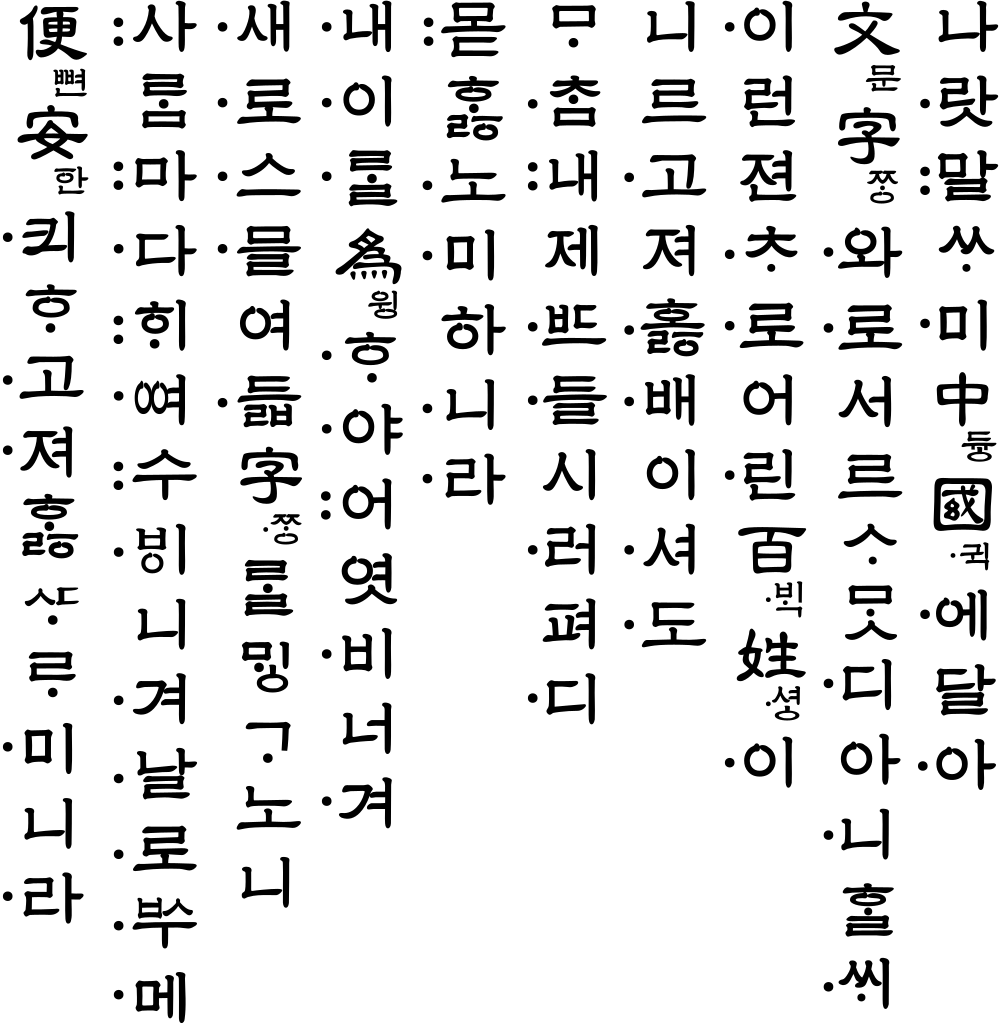
Perhaps the most wholesale design of a writing system ever conceived was that of Korean Hangul (or Hangeul). Created by commission of King Sejong in 1443, it was designed to bring literacy to the common people by offering a very logical and easy-to-learn set of characters that were also more compatible with Korean phonology. The system uses a featural alphabet consisting of 24 basic letters based on visual representations of the mouth and tongue, which combine to form syllabic blocks read from the top-left letter (in a varying manner depending on the letters used).
Before its invention, Korean was solely written using the complex set of Chinese characters (Hanja when used for Korean). The ability to write was, therefore, restricted to the educated elites, especially the yangban (official administrators) who dedicated their lives to learning it. These classes were, therefore, resistant to Hangul’s implementation, with their monopoly on knowledge threatened. They considered it a vulgar corruption of Confucian principles. Hanja continued to be used as the writing system of the elite until as late as 1945.¹ Today it is only used for very limited purposes such as passports, birth certificates and newspaper headlines (usually alongside Hangul). Koreans are very proud of their national script. So much so that South Korea has dedicated an entire public holiday to it since 1970.²


Efforts have even been made since 2008 to use Hangul to preserve the endangered indigenous dialect of Cia-Cia in Indonesia, whose phonology cannot be accurately expressed with either the Latin script or the Arabic script previously used in Indonesia.³


Hangul, due to its hugely innovative features remains somewhat of an outlier when it comes to pre-modern constructed writing systems. And despite this, it still wasn’t invented out of thin air. The letters themselves were based on mouth and tongue placements, thus anchoring them to the observable world. It was also not without external cultural influences offering linguistic insights. Linguists believe, for example, that Hangul may have been inspired by phonetic Brahmic scripts, and some of the character shapes may have even been inspired by Mongolian characters. The syllabic block style of Hangul was furthermore inspired by Chinese characters (giving Hangul the label ‘siniform’), hence why they are less linear than Western alphabets or Brahmic abugidas.⁴ ⁵ Korean was also originally written vertically right to left like Chinese. The point here is not to undermine the amazing linguistic achievement that is Hangul, but rather to remind the reader that writing is a product of cultural transmission that cannot be invented ex nihilo in any abstract form.
Watch: About Hangeul | National Hangeul Museum
Click here →

Click this symbol on the keyboard to change script
↓
*Typing letters will form syllabic blocks
e.g. ㅎ+ㅏ+ ㄴ = 한
Consonant | Approx Sound (IPA) | Vowel | Approx Sound (IPA) |
|---|---|---|---|
ㄱ | g/k (/k~g/) | ㅞ | we (/we/) |
ㄲ | strong k (/k͈/) | ㅢ | ui (/ɰi/ or /ɯi/) |
ㅋ | aspirated k (/kʰ/) | ㅗ | o as in go (/o/) |
ㄷ | d/t (/t~d/) | ㅜ | u as in boot (/u/) |
ㄸ | strong t (/t͈/) | ㅡ | eu as in put (/ɯ/) |
ㅌ | aspirated t (/tʰ/) | ㅣ | i as in see (/i/) |
ㅂ | b/p (/p~b/) | ㅐ | ae as in bed (/ɛ/) |
ㅃ | strong p (/p͈/) | ㅔ | e as in net (/e/) |
ㅍ | aspirated p (/pʰ/) | ㅚ | oe as in way (/we/, /ø/) |
ㅈ | j/ch (/tɕ~dʑ/) | ㅟ | wi as in we (/ɥi/) |
ㅉ | strong ch (/tɕ͈/) | ㅑ | ya (/ja/) |
ㅊ | aspirated ch (/tɕʰ/) | ㅕ | yeo (/jʌ/) |
ㅅ | s (/s/) | ㅛ | yo (/jo/) |
ㅆ | strong s (/s͈/) | ㅠ | yu (/ju/) |
ㅎ | h (/h/) | ㅒ | yae (/jɛ/) |
ㄴ | n (/n/) | ㅖ | ye (/je/) |
ㅁ | m (/m/) | ㅘ | wa (/wa/) |
ㄹ | r/l (/ɾ~l/) | ㅙ | wae (/wɛ/) |
ㅇ | ng (/ŋ/); silent initially | ㅝ | wo (/wʌ/) |
ㅞ | we (/we/) | ||
ㅢ | ui (/ɰi/ or /ɯi/) |
Constructed scripts from North America
Scripts for Indigenous Languages
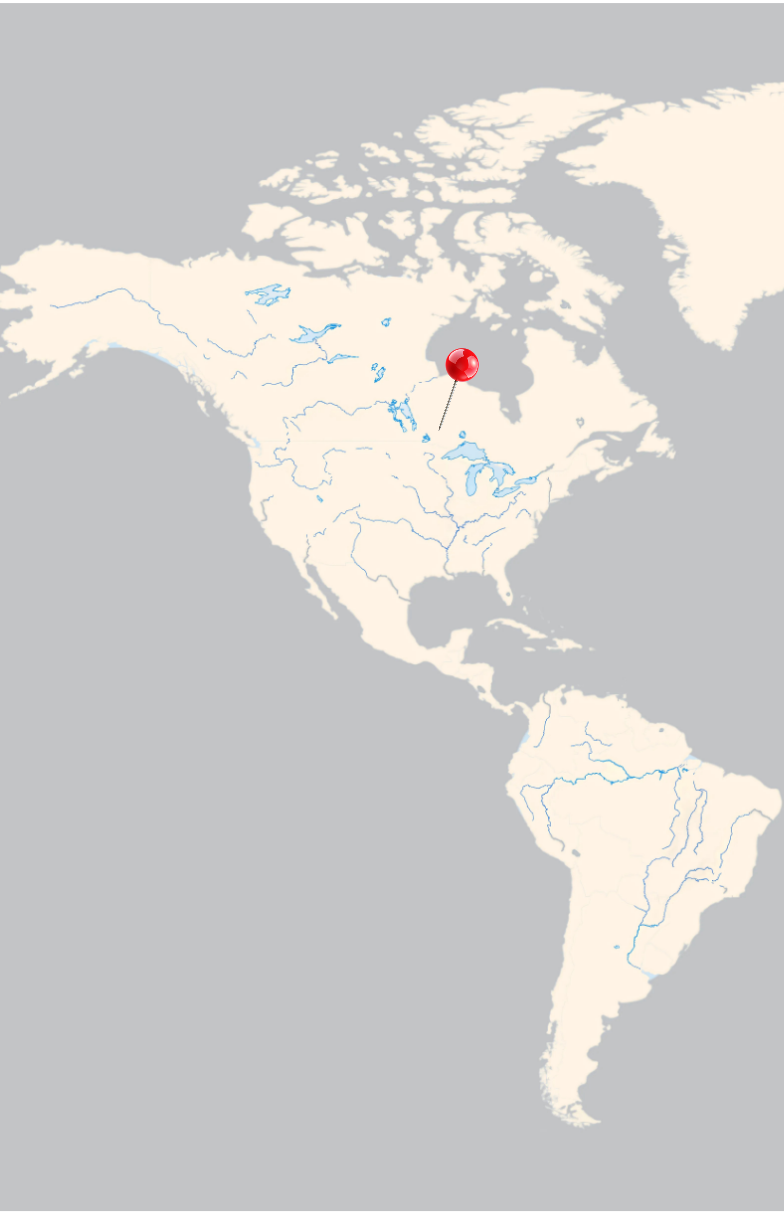
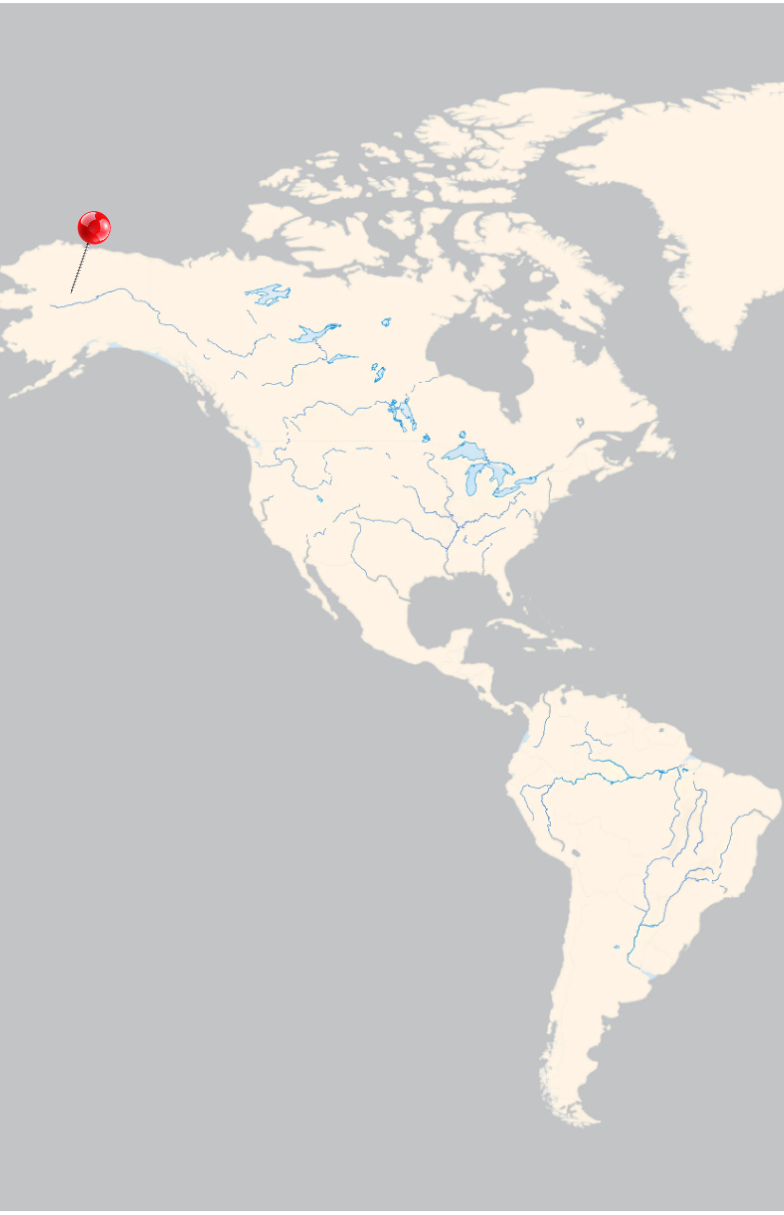
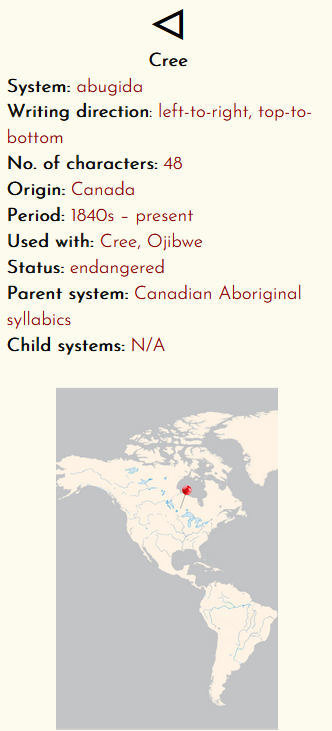
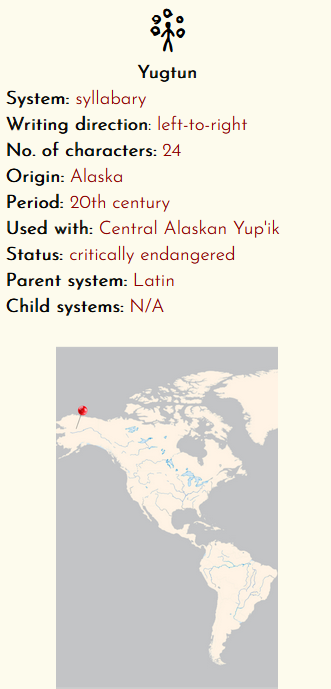
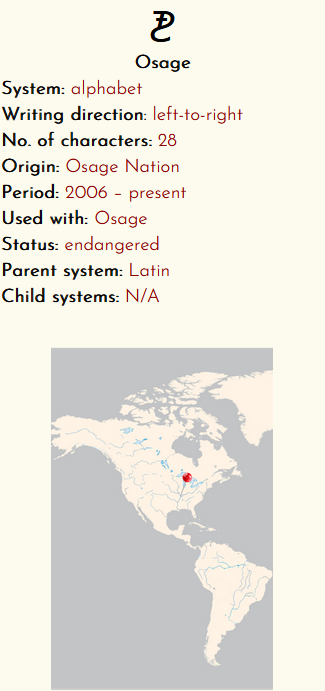
Attempts have been made in more recent times to artificially create scripts for indigenous languages, in an attempt to preserve or revive them. In North America, these include the 19th century Cherokee Syllabary (invented by a Cherokee polymath Sequoya who was influenced by the European “talking leaves”)⁶, Canadian Aboriginal Syllabics influenced by Devanagari (invented by missionary James Evans) and its child systems such as the Cree, Obijwe, and Inuktitut syllabaries⁷, and the Latin-based Osage alphabet (invented by Herman Mongrain Lookout in the 21st century)⁸. The Yugtun or Alaskan syllabary, used for the Alaskan Yup’ik language was invented around the year 1900 by an indigenous man named Uyaqoq who repurposed native pictograms with inspiration from Latin to preach the Bible in his native tongue, but today, it has been almost completely supplanted by Latin.⁹
Deseret - the Mormon script
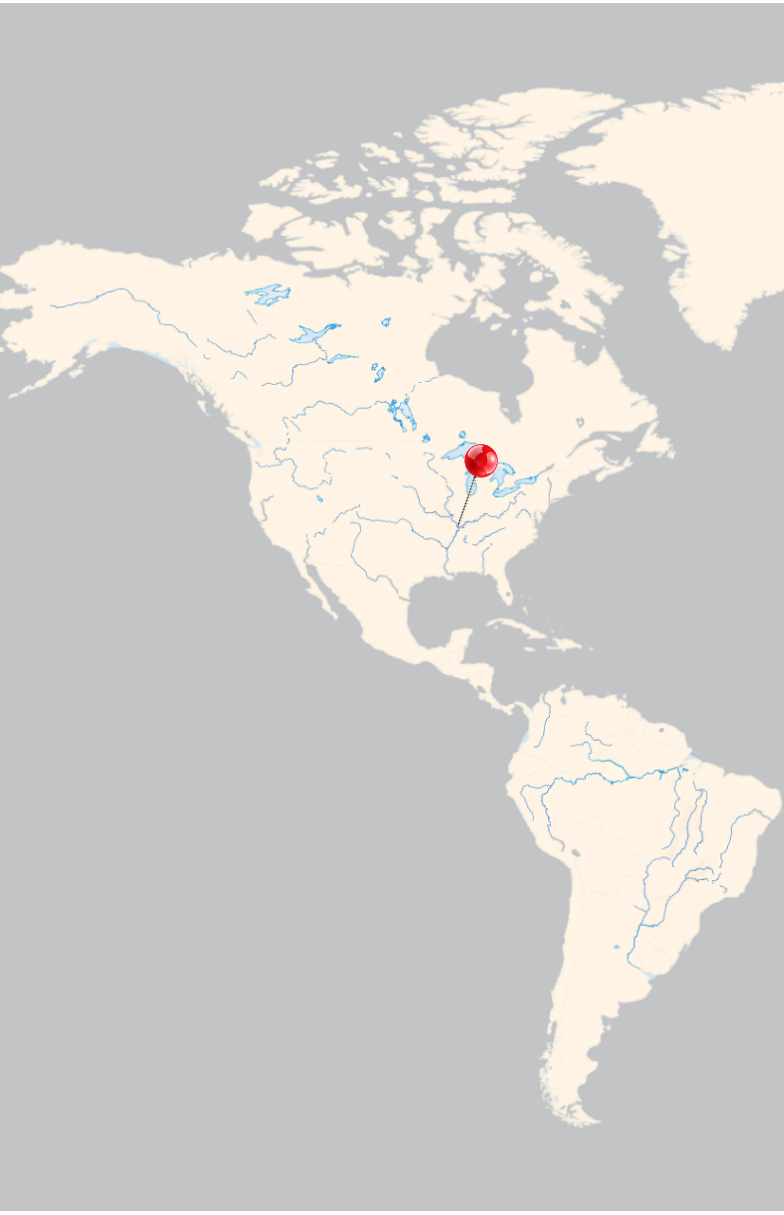
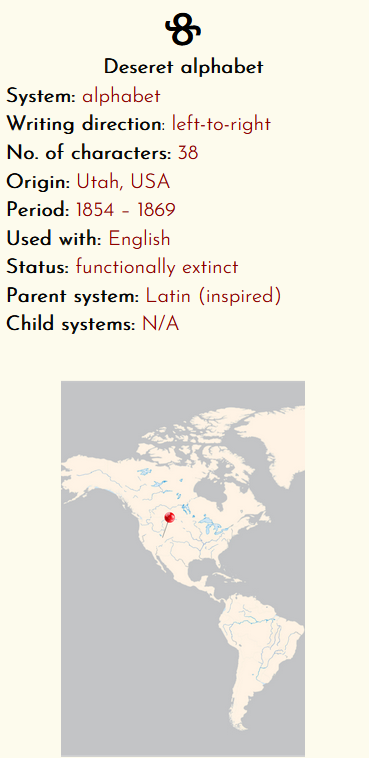
Yet another example of religion being the catalyst for the construction of a script is the Deseret alphabet. It was developed in the 19th century by Mormon settlers in Utah in attempted language reforms which were part of their broader attempts to reorder society in the Mormon vision. It was promoted by the Church of Latter Day Saints (Mormon Church) with the name of the script deriving from a reference to the Book of Mormon where deseret has the meaning of 'honeybee'. While there were some official church documents printed in the script, it failed to gain any real traction and lost any real advocacy after 1869.⁹ᵇ


Watch: ᑖᒻ ᔅᑳᑦ and ᖃᓂᐅᔮᖅᐸᐃᑦ | Tom Scott
Click this symbol on the keyboard to change script
↓
Constructed African scripts
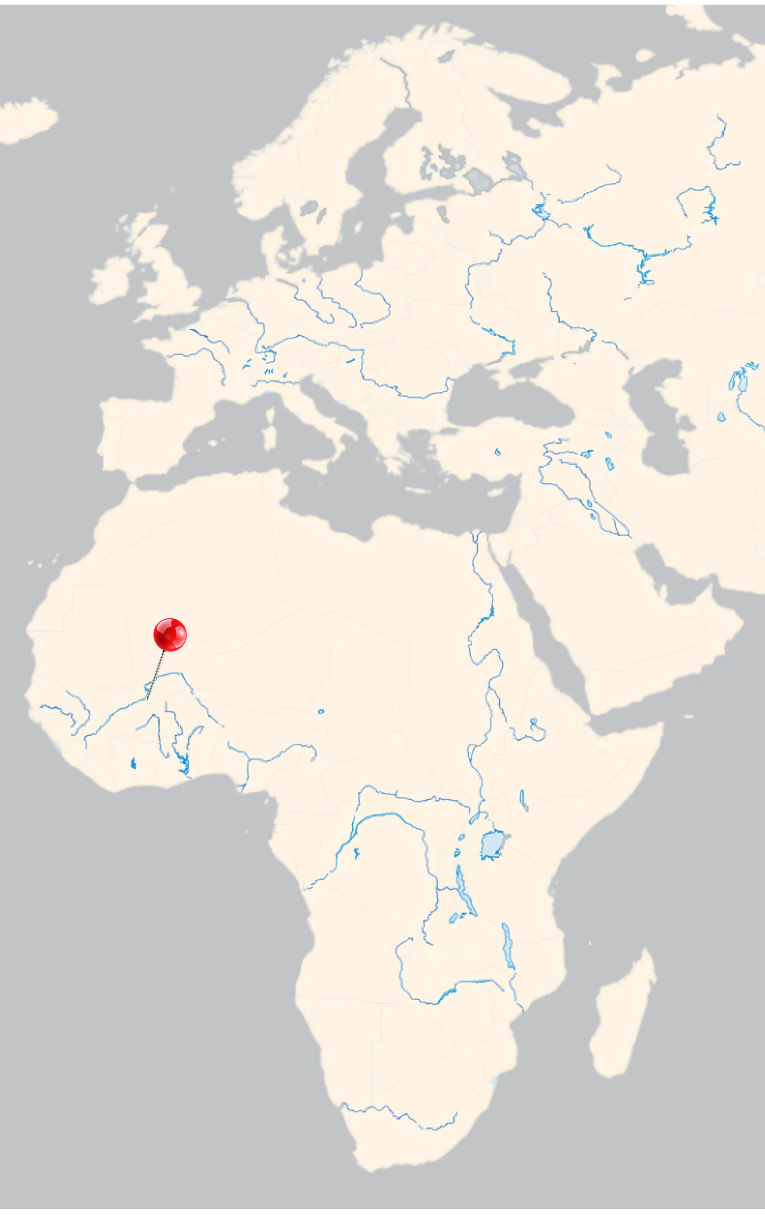
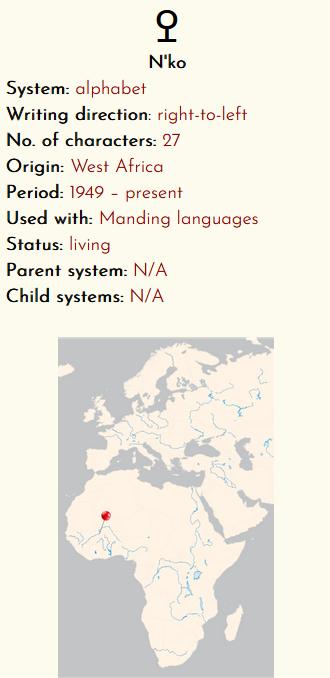
N’Ko
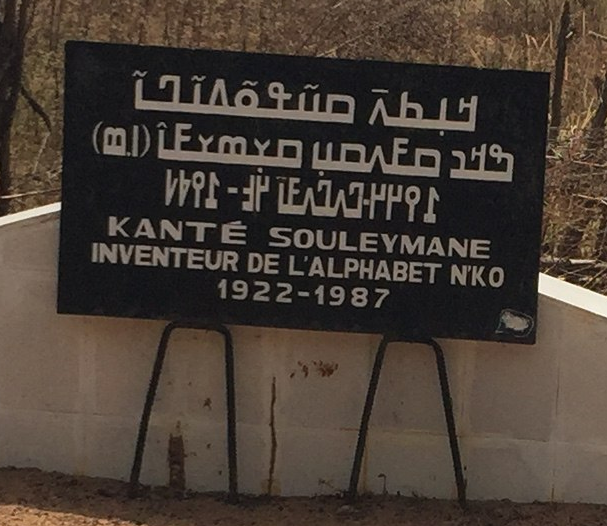
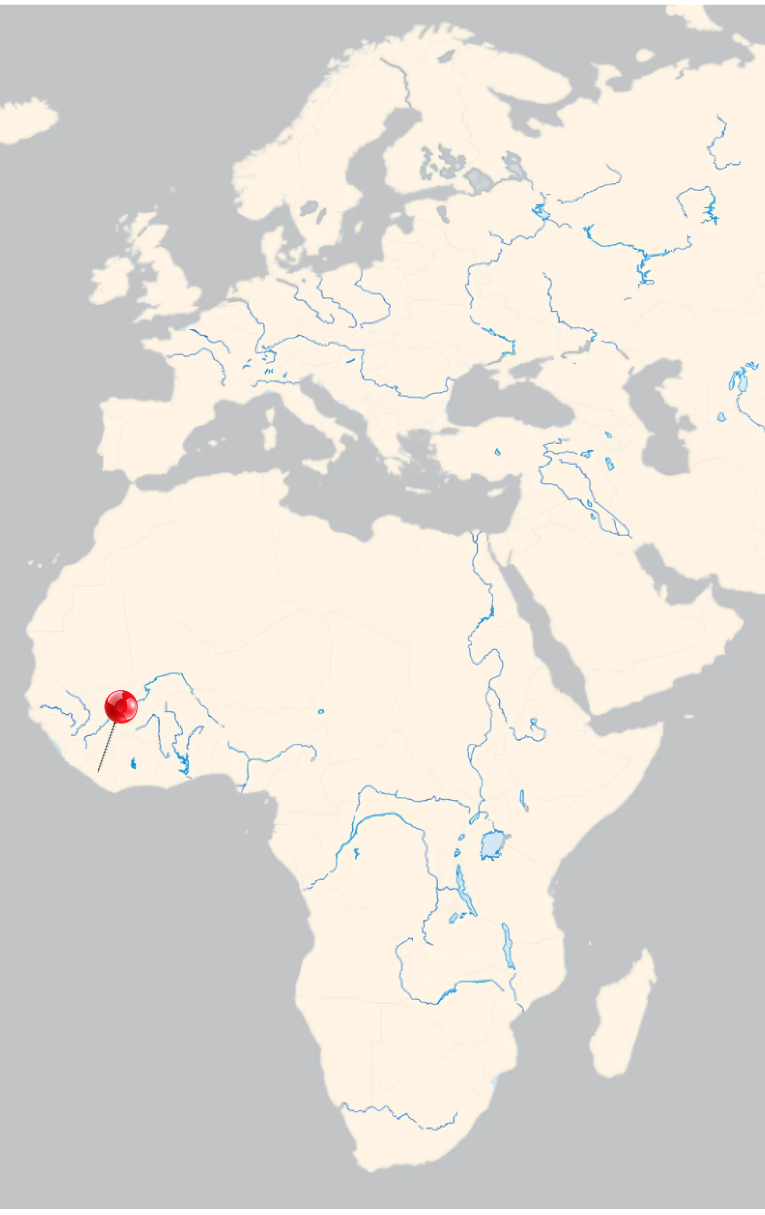
N’Ko is an alphabetic script inspired by Arabic, devised in 1949 by Solomana Kanté for use with the Manding languages of West Africa. It shares Arabic’s right-to-left orientation, cursive nature and use of diacritics, but unlike Arabic it includes vowels. Today it is mostly used in Guinea and the Ivory Coast and like Hangul has its own day of commemoration.¹⁰
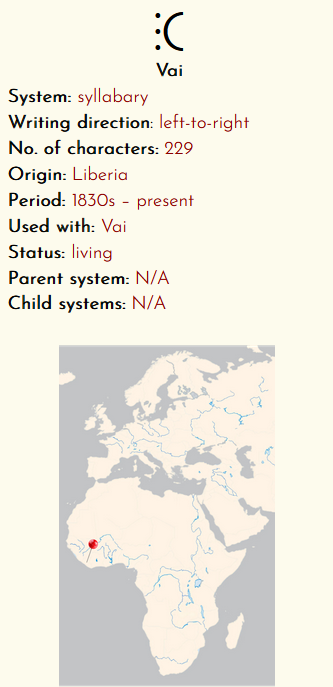
Vai
The Vai syllabary was developed in the 1820s for use with the Vai language of Liberia. It is one of the few African scripts that isn’t derived from Latin or Arabic. It has been theorised that Vai was inspired by the Cherokee syllabary, either through American missionaries or by a Cherokee émigré. Literacy was widespread in the 19th century, but its use has since declined despite revival efforts.¹¹

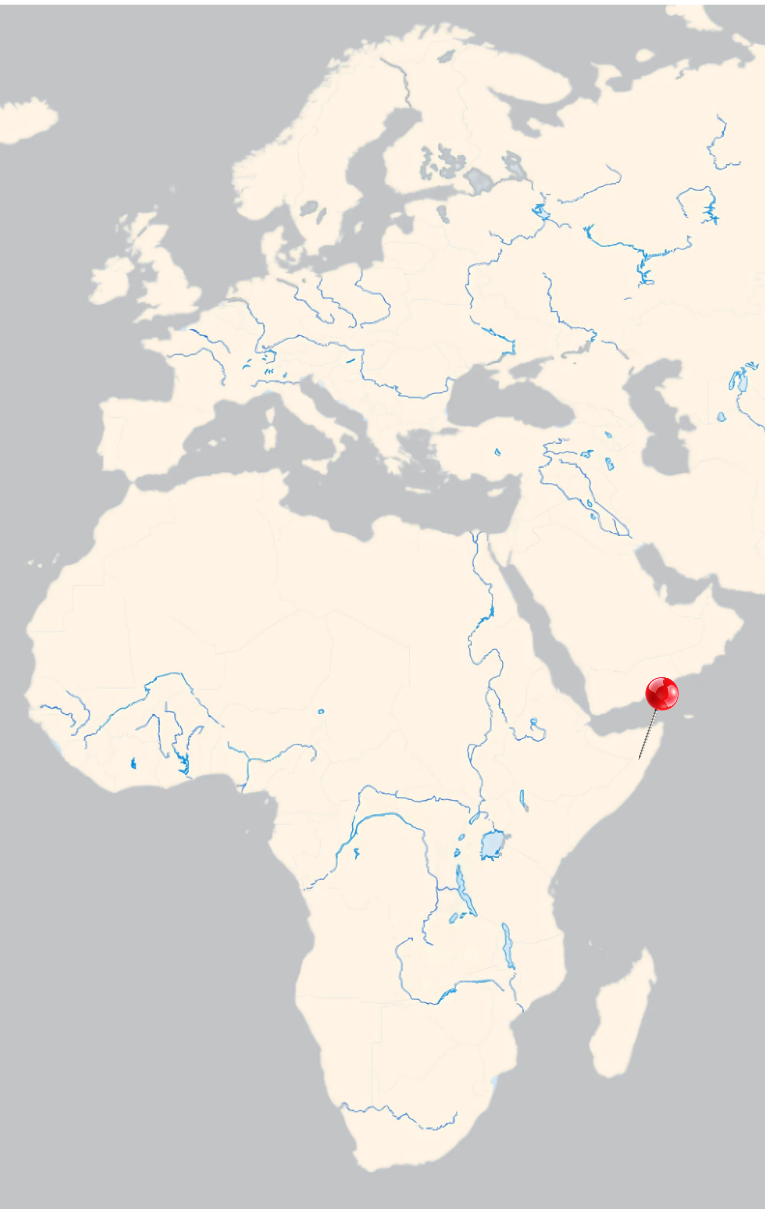
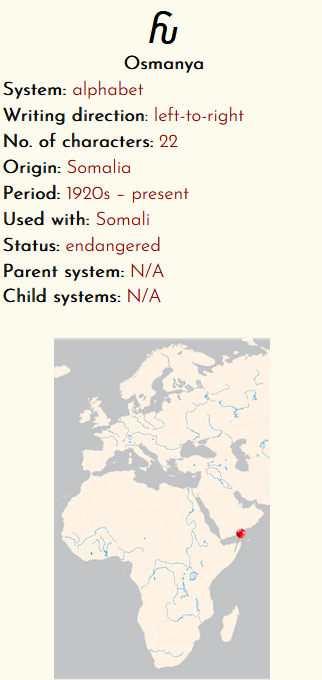
Osmanya
Up until the mid-20th century, Somalia used the Arabic script as its official script. It adopted the Latin script in 1972 as part of modernisation efforts, but there did in fact already exist indigenous Somali scripts at the time that were also considered for the role. One such script was Osmanya, which had been invented in the 1920s by two members of the royal family and which had gained some traction in literate administrative circles. But many people resisted its implementation as a national script, preferring either Arabic or Latin and Latin ultimately won the day.¹²


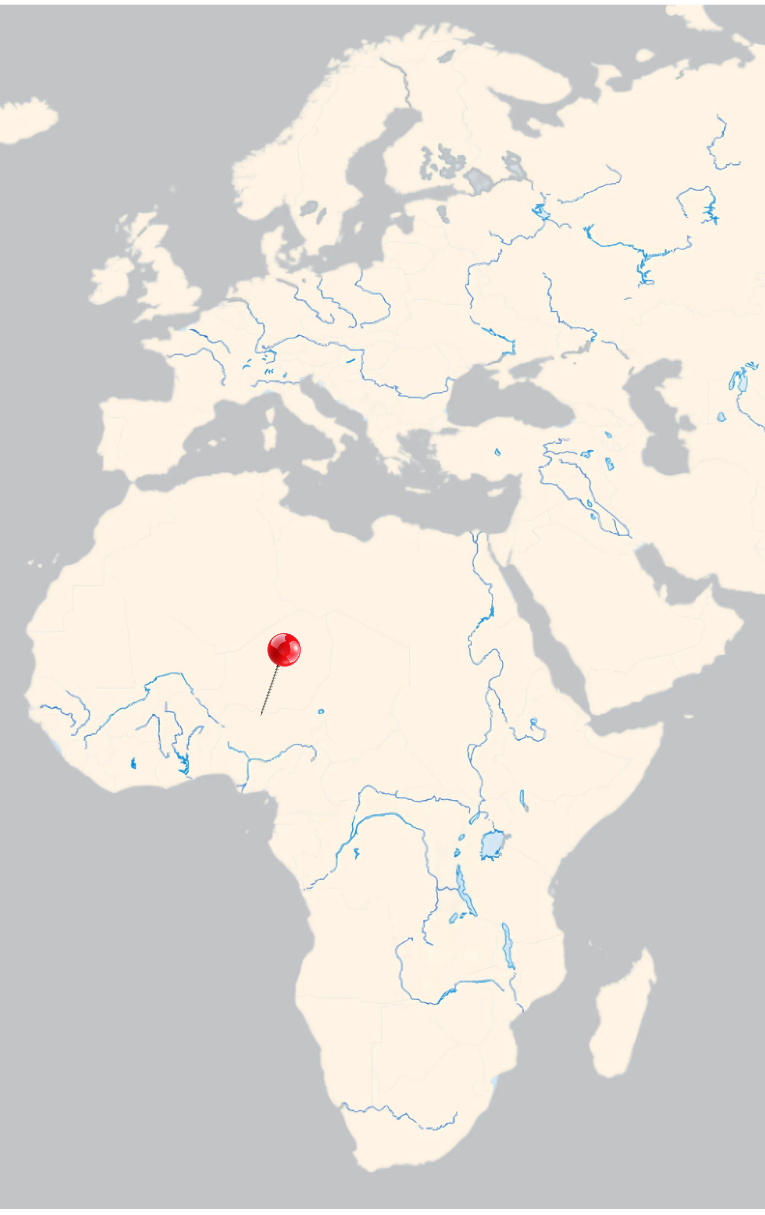
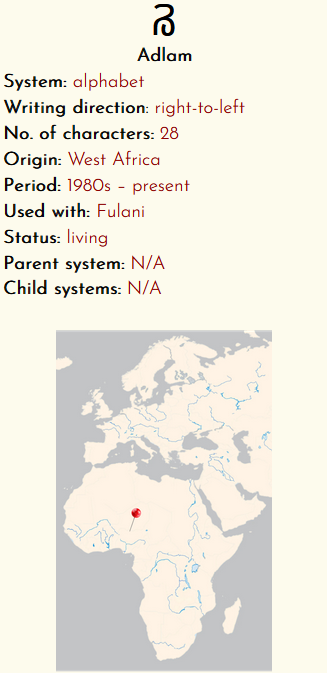
Adlam
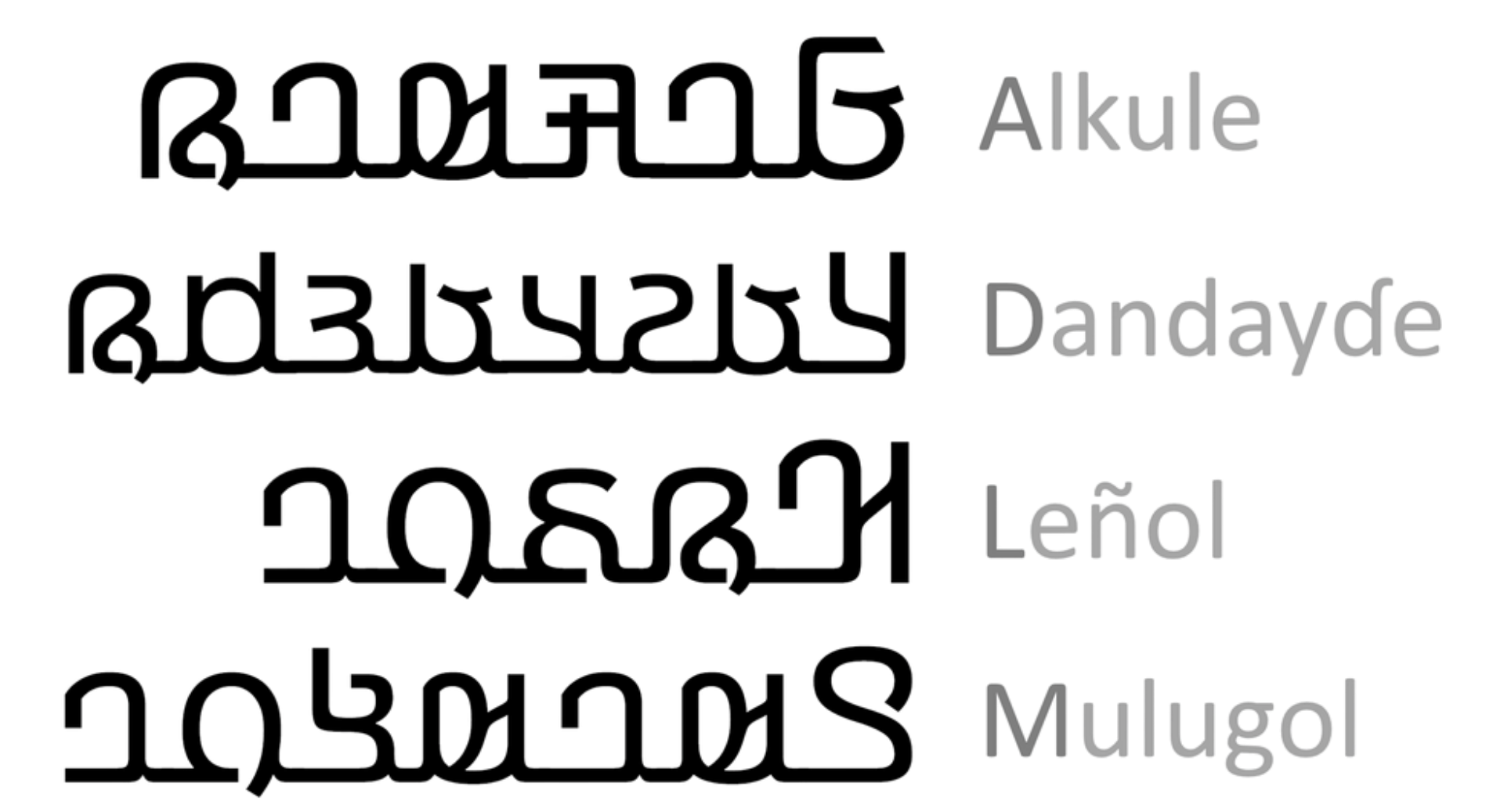
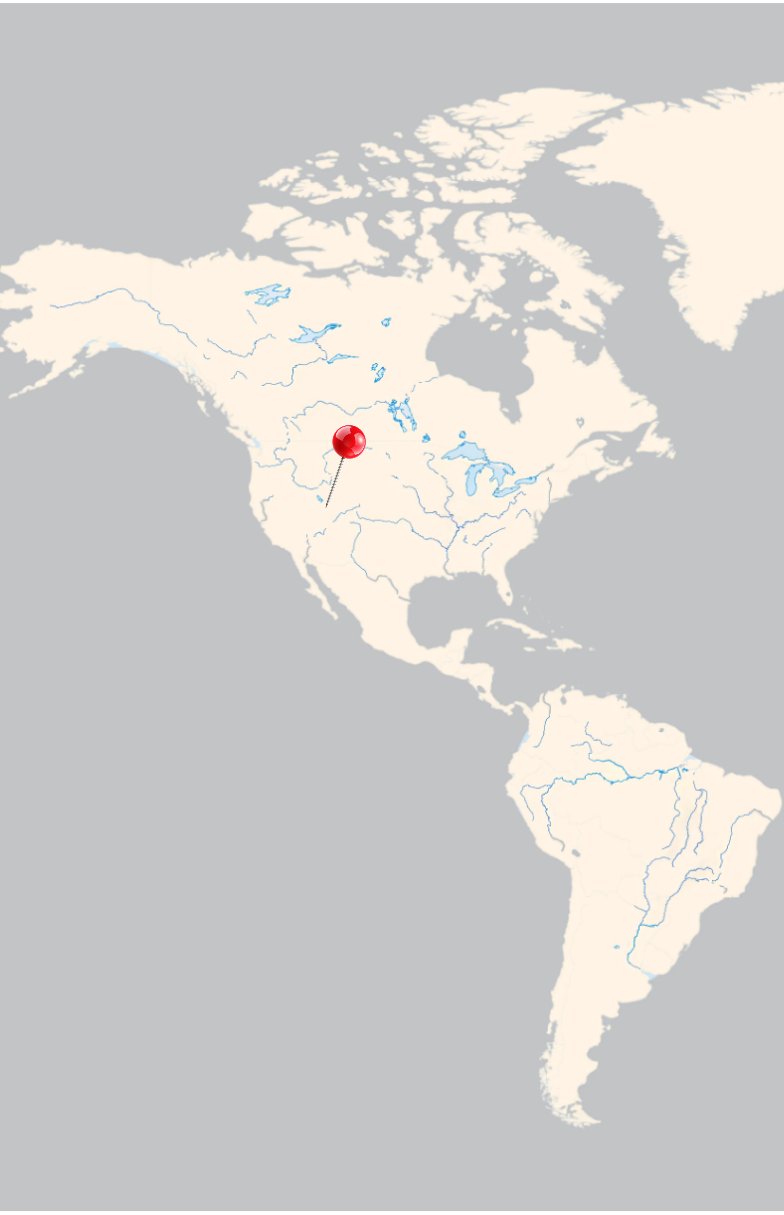
The Adlam script was invented in 1989 for use with the Fulani language of West Africa. The name is an acronym of the Fulani “alkule dandayde leñol mulugol” (“the alphabet that protects the peoples from vanishing”) and subsequently makes up the first four letters of the alphabet (A, D, L, M). It was created by two brothers who wanted to create an indigenous script for their language. To create the characters, they experimented with random doodling, “sensing” symbols for sounds and drawing with their eyes closed; a rare case of arbitrary linguistic invention. But inspired by Arabic, is written right to left and often in a cursive manner (although a block form does also exist).¹³
Watch: Why West Africa Keeps Inventing Writing Systems | NativLang
Click this symbol on the keyboard to change script
↓
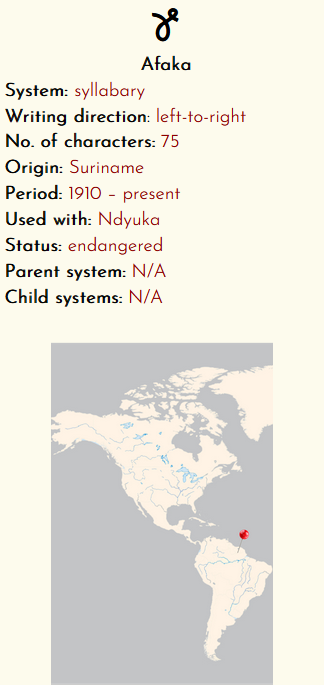
Afaka – the first and only creole script
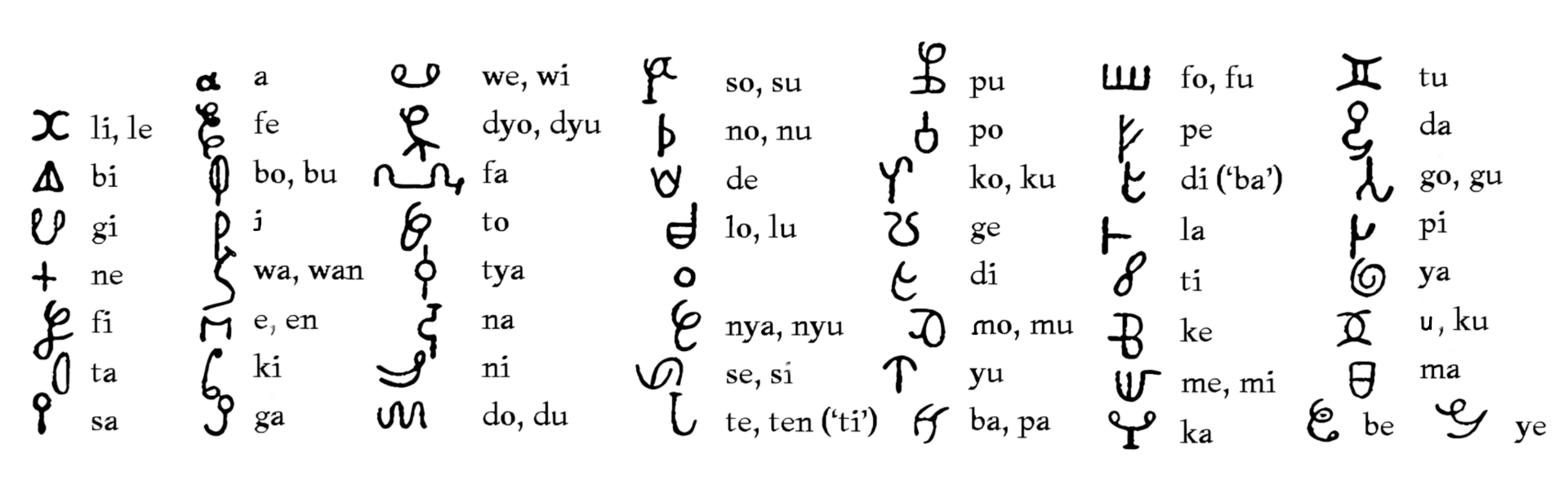
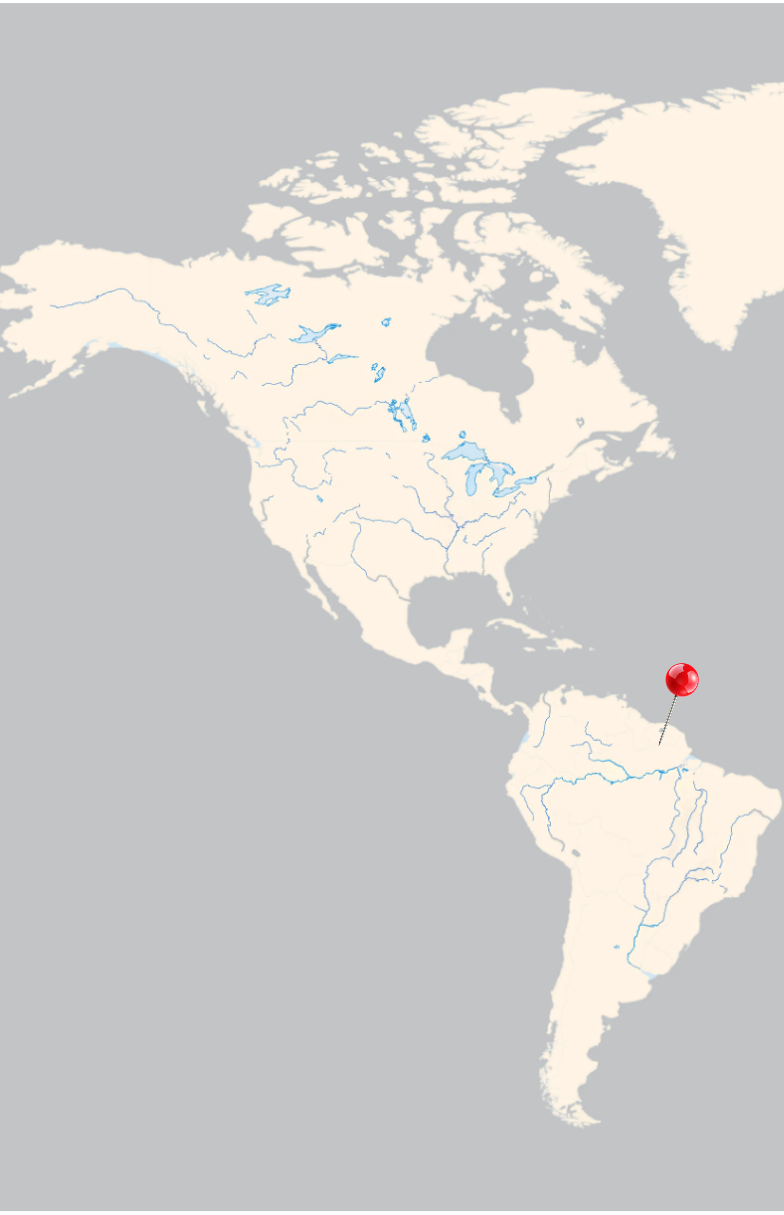
In 1910, the Afaka syllabary or Ndjuka script with 56 letters was invented by Afaka for use by the Ndyuku People – descendants of African slaves in the South American colony of Suriname, who speak an English-based creole language. It is the only script ever invented for a creole language. While it is still used today alongside Latin, it is an endangered script, with low literacy amongst an already very small ethnic group.¹⁴
Constructed scripts for Asia
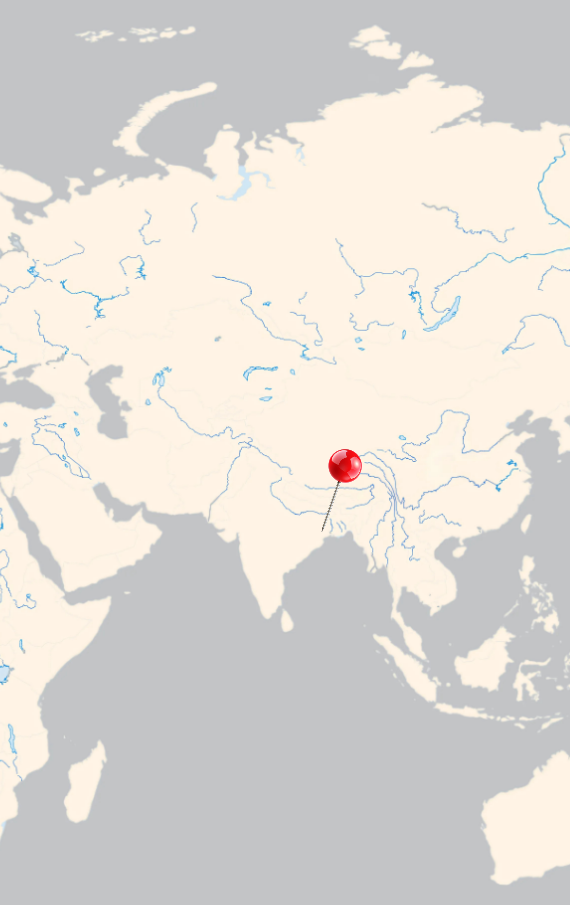
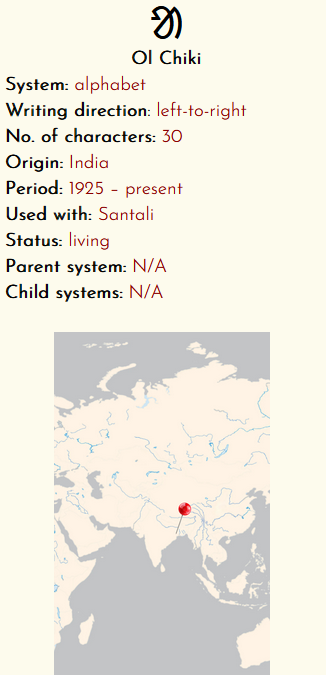
Ol Chiki (Santali) script
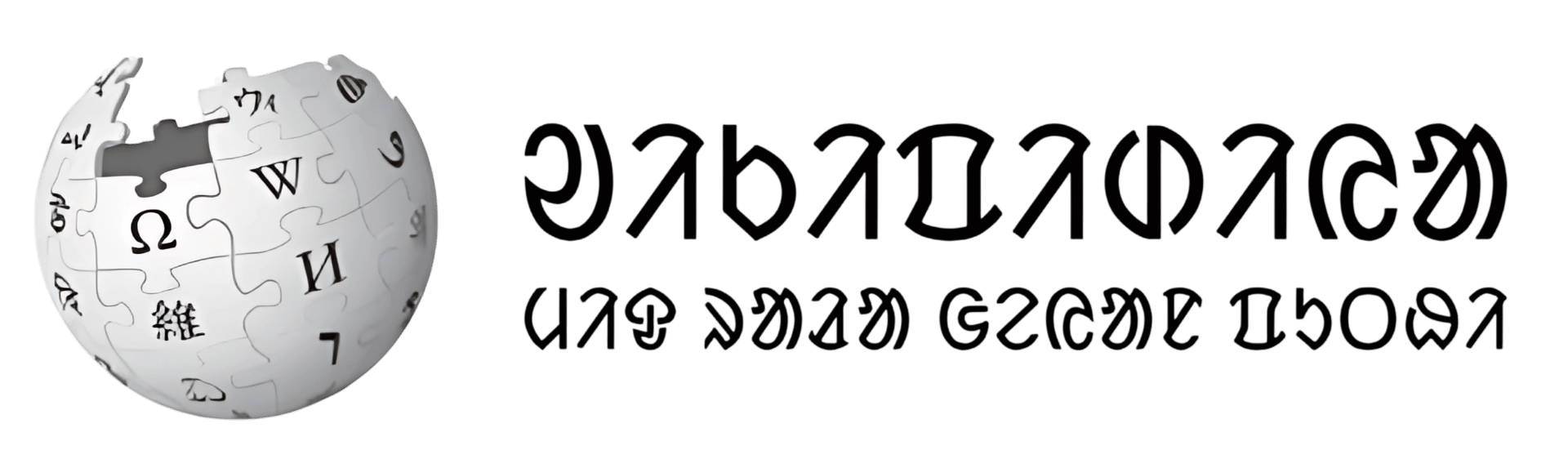
In Asia, the Ol Chiki script was devised in 1925 for use by Santali, an Austronesian language native to India. Unlike the Brahmic abugidas which make up the vast majority of scripts in South and South-East Asia, Ol Chiki is a true alphabet with 30 letters. Santali had been previously written in Latin or the various Indian abugidas but they were insufficient to represent its unique phonology. Curiously, while it borrows most Latin punctuation marks, it does not use the Latin full stop to avoid confusion with a separate mark of similar appearance. Instead, it uses one short danda (‘mucăd’) (᱾) which marks a minor break and a double danda (mucăd) (᱿) which marks a major break.¹⁵
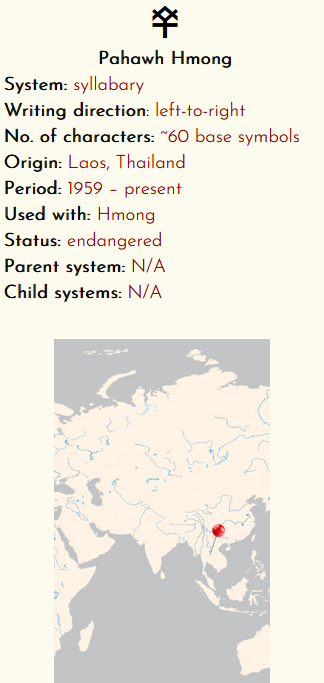
Pahawh Hmong – a "messianic" script
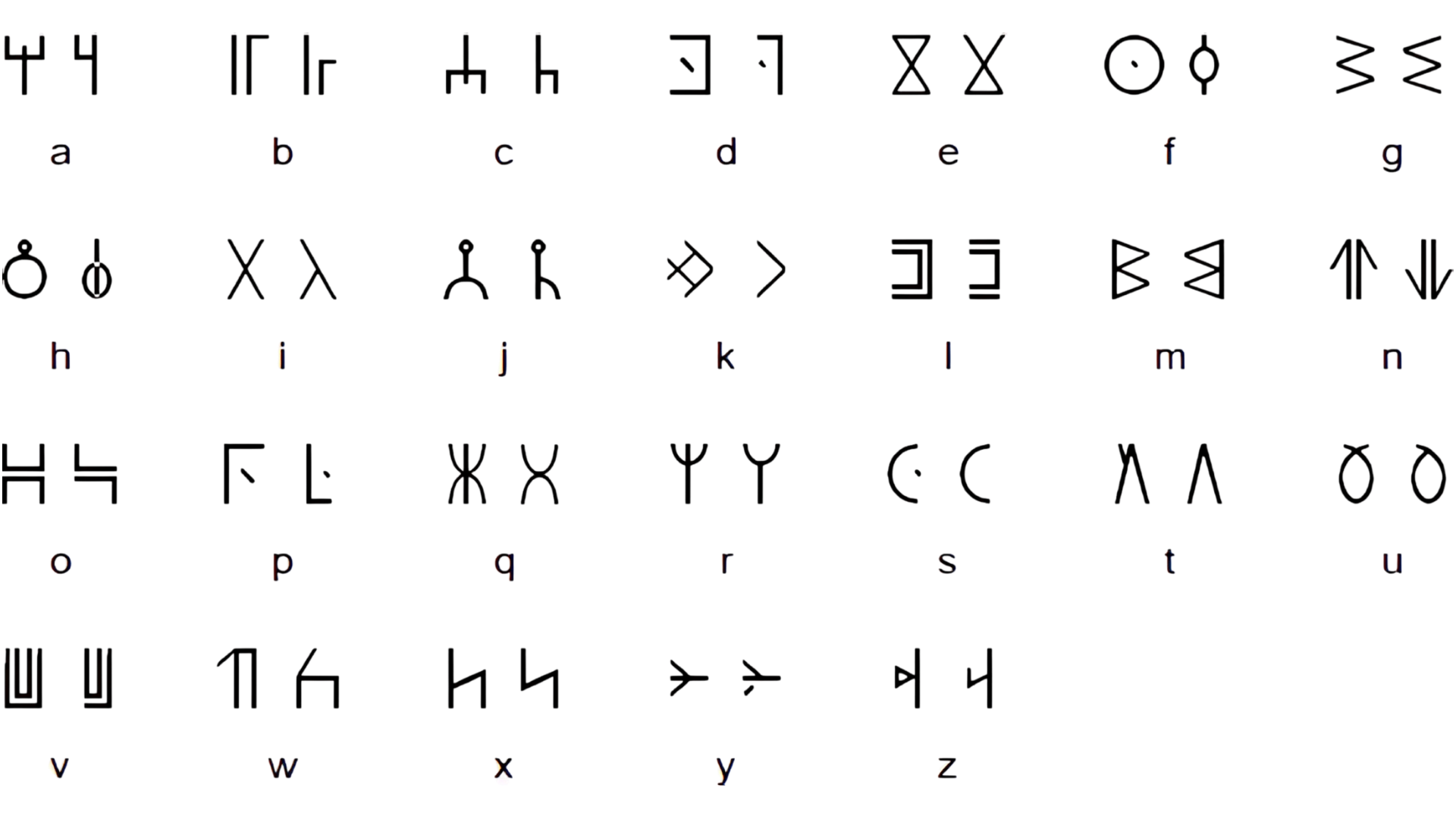
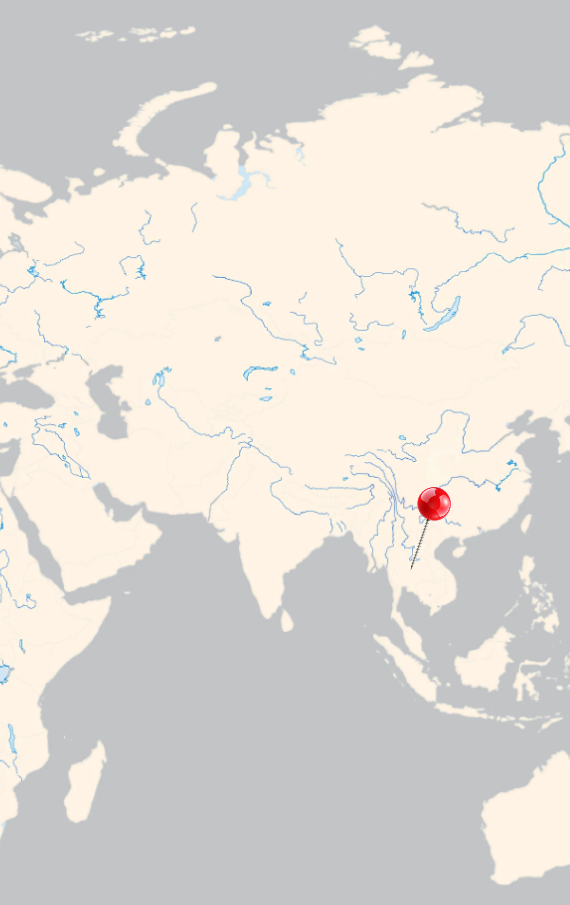
One of the most successful writing inventions in modern times (and certainly one of the strangest) is that of Pahawh Hmong, created for use by the Hmong languages. The Hmong People of northern Thailand, Laos and Vietnam originally migrated from southern China in the 18th century. Their language was mostly oral due to historic persecution with no widely accepted writing system. The Pahawh Hmong script was conceived in 1959 by Shong Lue Yang, a Hmong spiritual leader who claimed to be the Messiah. He believed he had received divine instruction to create a writing system for his people as part of the Hmong cultural revival movement. Despite having initially close ties to the loyalist government, Shong was assassinated by loyalist forces in 1971 who began to feel threatened by his growing power and influence.
The Pawawh Hmong script that Shong created, while influenced by Latin, Lao and Thai, was unique in its own right and phonologically sophisticated, tailored specifically to the tonal and syllabic nature of the Hmong language. Usage of it first gained popularity among Hmong communities in Laos and later in refugee populations abroad fleeing intense persecution by the Pathet Lao communists who took over the country in 1975. Today, while the Romanized Popular Alphabet (RPA) is more widely used for their language, Pahawh Hmong remains a significant cultural symbol of identity and resilience among the Hmong people.¹⁶ Interestingly, the Hmong also have another way to communicate in the language known as ‘birdsong’. This is a whistled language that uses a leaf to make intricate sounds.¹⁷


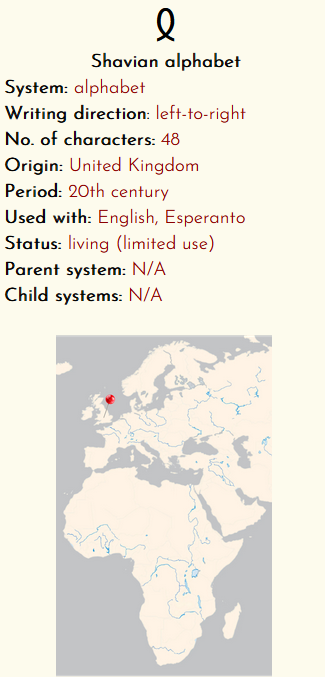
Shavian (Shaw) alphabet & Quickscript (Read alphabet)
The constructed writing systems covered in this chapter so far have been used for languages other than English. After all English already uses the Latin script and most people are quite comfortable doing so. It is important to note, however, that the Latin script evolved to represent the phonemes of Latin, not English. This is why English often has such trouble with spelling conventions and why pronunciation can be so difficult when reading. Why, for example, do we insist on using ‘th’ for the voiced sound /θ/ (as in think) and voiceless sound /ð/ (as in though)? Not only is it redundant using two letters for a phoneme, but its pronunciation can be ambiguous.
Well one man by the name of Ronald Kingsley Read came up with a solution in the 1960s. Named after the Irish playwright George Bernard Shaw, the Shavian alphabet was invented in order to better represent English phonology. Consisting of 40 letters distinct from Latin, Read intended on representing sounds as precisely as possible in a very logical manner. Going back to the example of ‘th’, Read used separate letters for voiced and unvoiced consonants, so that 𐑔 represented /θ/ (as in think) and 𐑞 represented /ð/ (as in though) – the same sign simply rotated. Other examples include 𐑐 for /p/ and 𐑚 for /b/, 𐑑 for /t/ and 𐑛 for /d/ 𐑒 for /k/ and 𐑜 for /g/ and 𐑓 for /f/ and 𐑝 for /v/. It is read left to right like Latin, but is unicameral, mean there is no upper-lower case distinction. Instead, a mid-dot (·) is used before a proper noun. Shavian has also been adapted for use with Esperanto.¹⁸ In 1966, after a comprehensive analysis of Shavian, Read created an improved version which he called Quickscript (often referred to as the Read alphabet).


Click this symbol on the keyboard to change script
↓
Watch: Shavian Alphabet Overview | Shavian Alphabet
Click this symbol on the keyboard to change script
↓
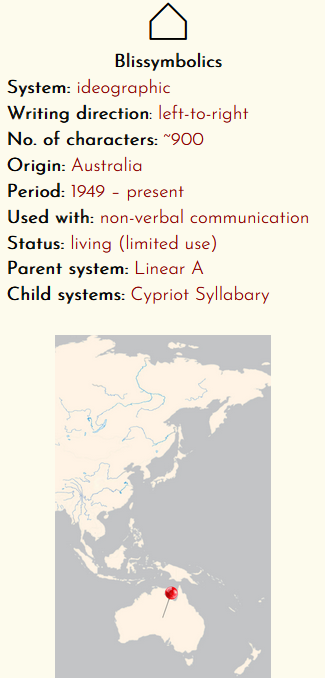
Blissymbolics – a script for humanity?
As I mentioned in the introduction, writing cannot represent language on its own without going through another modality. This is because writing is purely symbolic requiring it to be grounded in some kind of natural language. Some attempts have been made, however, to invent a system that does in fact bypass language, or more accurately, to invent a language that has a written modality only without signs or a phonology. One example is Blissymbolics, invented in 1949 by the linguist Charles K. Bliss as a universal visual language using ideographic symbols known as blissymbols. It works much like the formation of Chinese characters, by combining a set of core symbols to build more complex meanings. Bliss was in fact influenced by Chinese while living in Shanghai as a refugee in the 1930s. His system was originally intended to be used as a universal system of communication to promote unity in much the same vein as the constructed language Esperanto. Nowadays, it is mostly used for people with cognitive impairments. While a very noble endeavour, and innovative in its own right, Blissymbolics fails to fulfil the requirement for either a proper language or a full writing system.¹⁹


See: Blissymbols Dictionary
Fictional scripts
Tolkien’s scripts
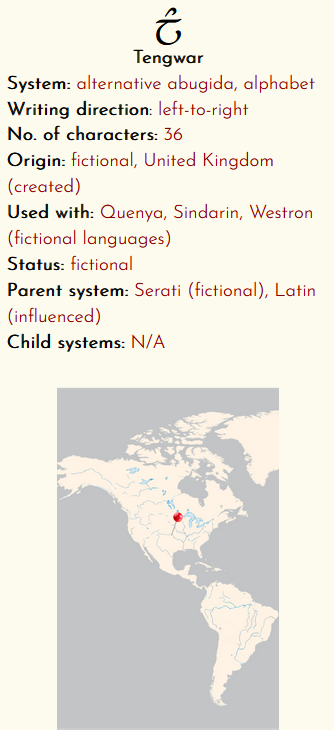
The above examples have all been constructed scripts for use in the real world. However, some scripts have been invented purely for fictional purposes. Some of the most famous of these are those of J.R. Tolkien, which were used to write many of his constructed languages. Tolkien borrowed heavily from real scripts and languages in his legendarium. For example, the Dwarvish runes (Cirth) in the Hobbit are essentially a carbon copy of Anglo-Saxon futhorc runes. His later works like Lord of the Rings included more elaborate inventions such as a new set of invented Dwarvish runes and the Elvish Tengwar script (an abugida) used for the Elvish languages (which borrowed heavily from Finnish grammar and phonology) and the Black Speech of Mordor.²⁰ ²¹


Click this symbol on the keyboard to change script
↓


Wakandan script
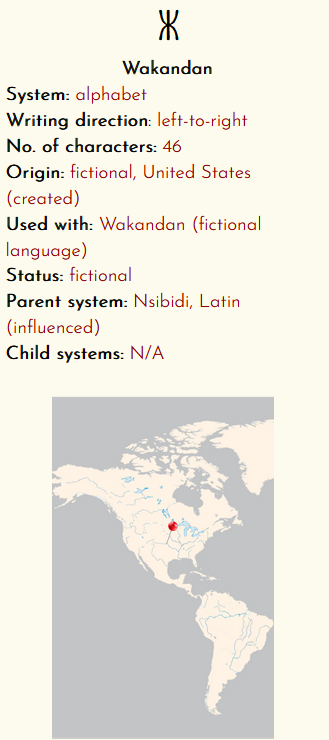
Creators of the Black Panther movies invented a fictional Wakandan language for its universe. The language spoken by the characters in the films is, however, actually South African Xhosa. However, a fictional Wakandan script is depicted in the films, but which is heavily based on the ideographic Nsibidi script from Nigeria.²²
Alien scripts
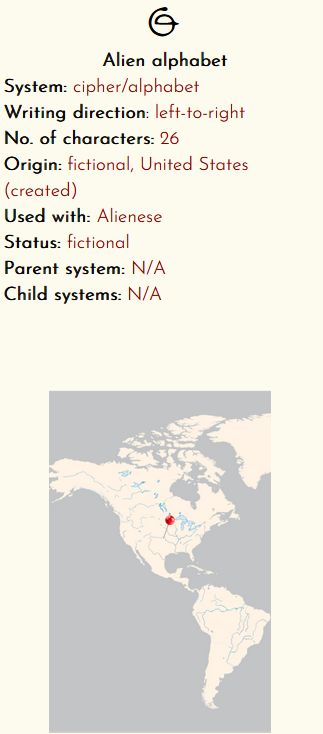
Many works of science fiction feature constructed scripts for alien languages. Two examples of this are Matt Groening’s TV series Futurama and Star Trek. Futurama’s alien alphabet is used for the ‘Alienese’ language, and is mainly seen in the background of scenes.²³ The Klingon alphabet is used for the Klingon language in Star Trek and features much more prominently.²⁴
Watch: Futurama Intro - Alienese @ 0:15 | Media Graveyard
Constructed Scripts
ㅎ
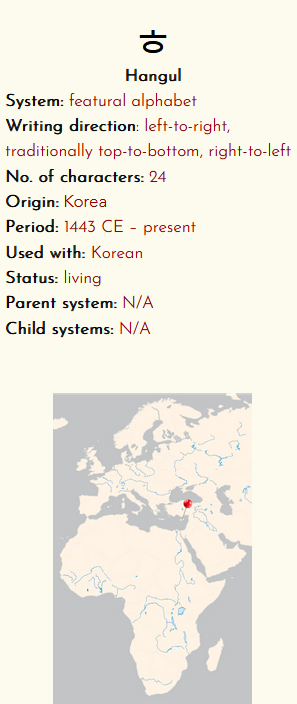
Hangul
System: featural alphabet
Writing direction: left-to-right, traditionally top-to-bottom, right-to-left
No. of characters: 24
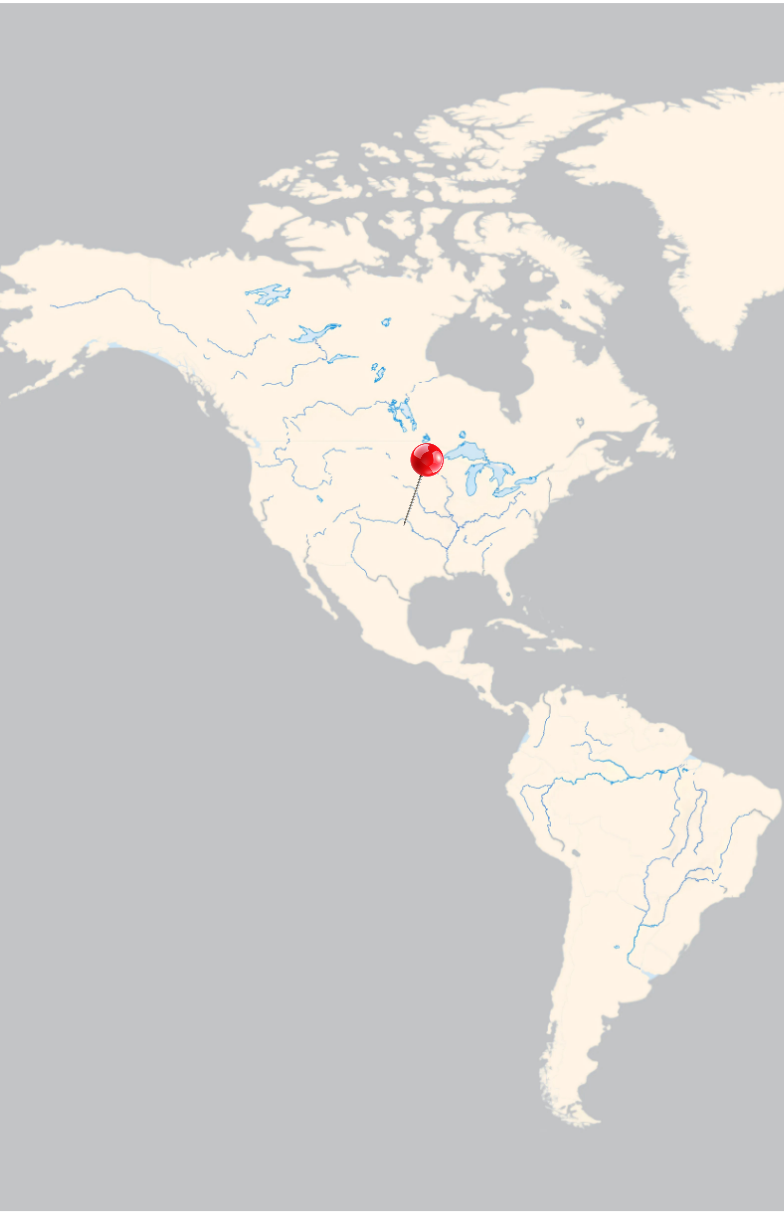
Origin: Korea
Period: 1443 CE – present
Used with: Korean
Status: living
Parent system: N/A
Child systems: N/A
Ꮝ
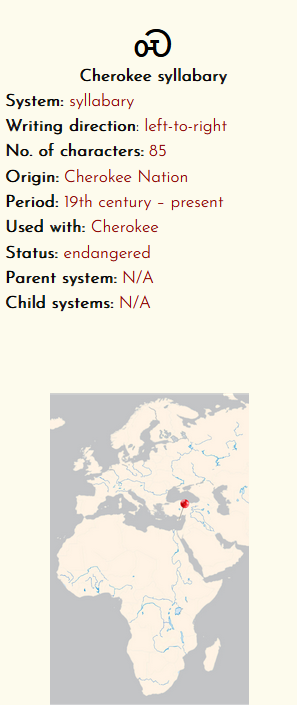
Cherokee syllabary
System: syllabary
Writing direction: left-to-right
No. of characters: 85
Origin: Cherokee Nation
Period: 19th century – present
Used with: Cherokee
Status: endangered
Parent system: N/A
Child systems: N/A
ᐊ
Cree
System: abugida
Writing direction: left-to-right, top-to-bottom
No. of characters: 48
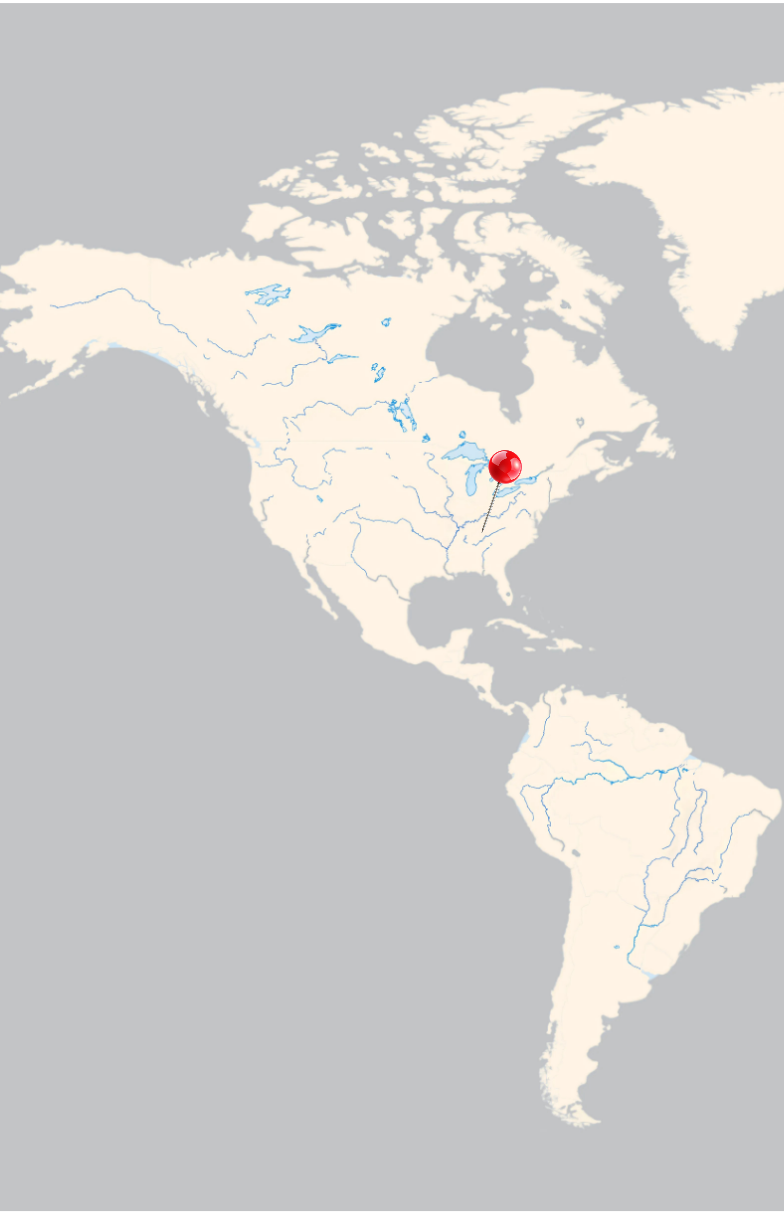
Origin: Canada
Period: 1840s – present
Used with: Cree, Ojibwe
Status: endangered
Parent system: Canadian Aboriginal syllabics
Child systems: N/A
Yugtun
System: syllabary
Writing direction: left-to-right
No. of characters: 24
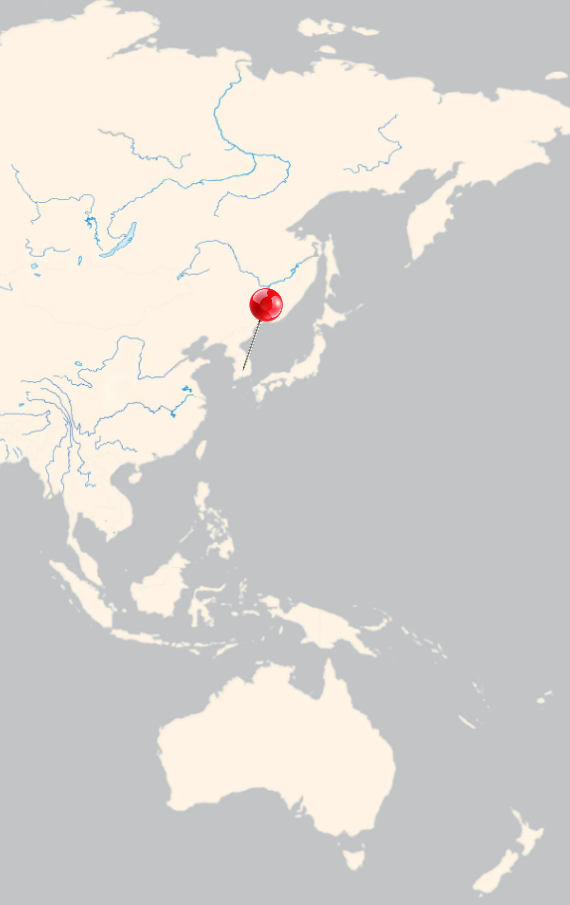
Origin: Alaska
Period: 20th century
Used with: Central Alaskan Yup'ik
Status: critically endangered
Parent system: Latin
Child systems: N/A
𐓋
Osage
System: alphabet
Writing direction: left-to-right
No. of characters: 28
Origin: Osage Nation
Period: 2006 – present
Used with: Osage
Status: endangered
Parent system: Latin
Child systems: N/A
𐑅
Deseret alphabet
System: alphabet
Writing direction: left-to-right
No. of characters: 38
Origin: Utah, USA
Period: 1854 – 1869
Used with: English
Status: functionally extinct
Parent system: Latin (inspired)
Child systems: N/A
ꕿ
Vai
System: syllabary
Writing direction: left-to-right
No. of characters: 229
Origin: Liberia
Period: 1830s – present
Used with: Vai
Status: living
Parent system: N/A
Child systems: N/A
𞥖
Adlam
System: alphabet
Writing direction: right-to-left
No. of characters: 28
Origin: West Africa
Period: 1980s – present
Used with: Fulani
Status: living
Parent system: N/A
Child systems: N/A
𐒅
Osmanya
System: alphabet
Writing direction: left-to-right
No. of characters: 22
Origin: Somalia
Period: 1920s – present
Used with: Somali
Status: endangered
Parent system: N/A
Child systems: N/A
ߐ
N'ko
System: alphabet
Writing direction: right-to-left
No. of characters: 27
Origin: West Africa
Period: 1949 – present
Used with: Manding languages
Status: living
Parent system: N/A
Child systems: N/A
Afaka
System: syllabary
Writing direction: left-to-right
No. of characters: 75
Origin: Suriname
Period: 1910 – present
Used with: Ndyuka
Status: endangered
Parent system: N/A
Child systems: N/A
𖮆
Pahawh Hmong
System: syllabary
Writing direction: left-to-right
No. of characters: ~60 base symbols
Origin: Laos, Thailand
Period: 1959 – present
Used with: Hmong
Status: endangered
Parent system: N/A
Child systems: N/A
ᱟ
Ol Chiki
System: alphabet
Writing direction: left-to-right
No. of characters: 30
Origin: India
Period: 1925 – present
Used with: Santali
Status: living
Parent system: N/A
Child systems: N/A
𐑙
Shavian alphabet
System: alphabet
Writing direction: left-to-right
No. of characters: 48
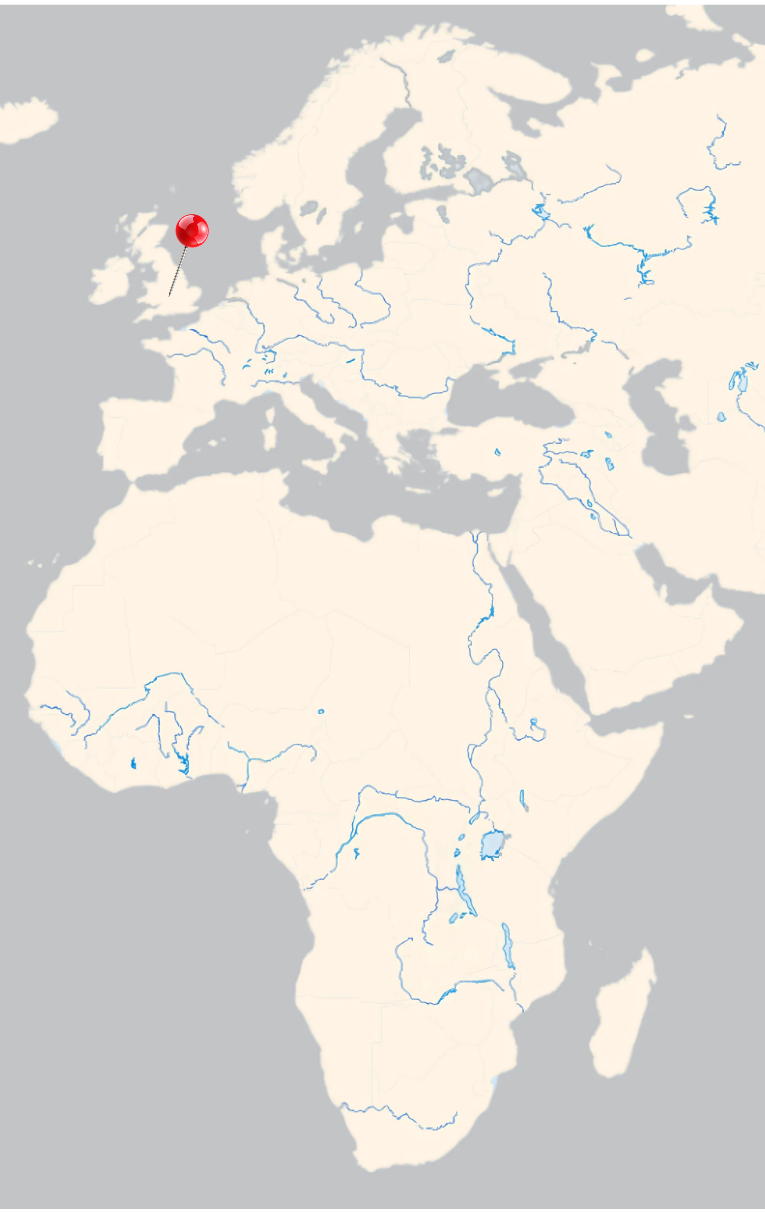
Origin: United Kingdom
Period: 20th century
Used with: English, Esperanto
Status: living (limited use)
Parent system: N/A
Child systems: N/A
Blissymbolics
System: ideographic
Writing direction: left-to-right
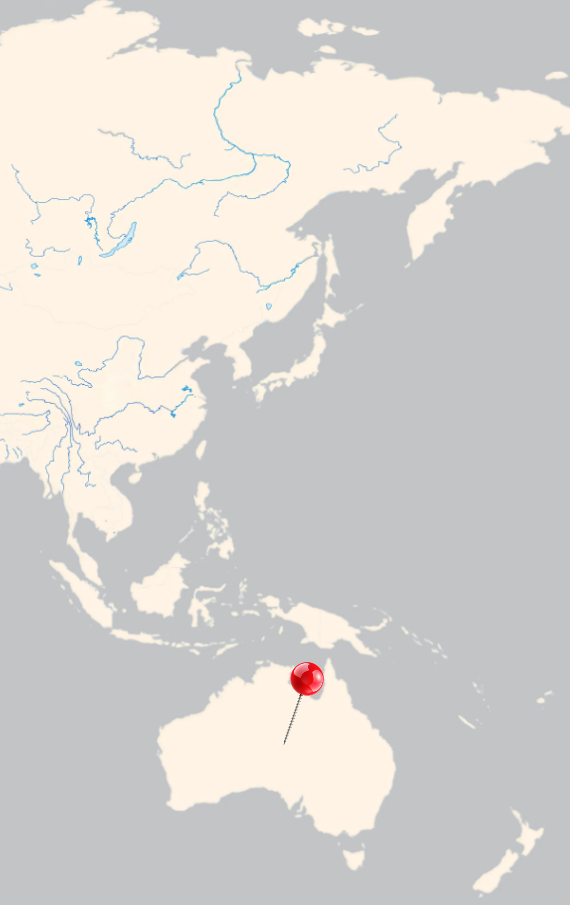
No. of characters: ~900
Origin: Australia
Period: 1949 – present
Used with: non-verbal communication
Status: living (limited use)
Parent system: Linear A
Child systems: Cypriot Syllabary
Tengwar
System: alternative abugida, alphabet
Writing direction: left-to-right
No. of characters: 36
Origin: fictional, United Kingdom (created)
Used with: Quenya, Sindarin, Westron (fictional languages)
Status: fictional
Parent system: Serati (fictional), Latin (influenced)
Child systems: N/A
Wakandan
System: alphabet
Writing direction: left-to-right
No. of characters: 46
Origin: fictional, United States (created)
Used with: Wakandan (fictional language)
Status: fictional
Parent system: Nsibidi, Latin (influenced)
Child systems: N/A
Alien alphabet
System: cipher/alphabet
Writing direction: left-to-right
No. of characters: 26
Origin: fictional, United States (created)
Used with: Alienese
Status: fictional
Parent system: N/A
Child systems: N/A
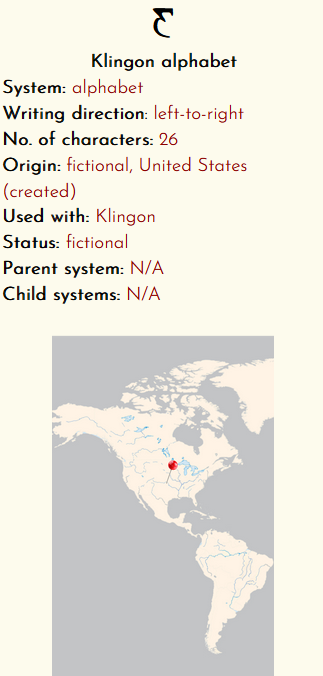
Klingon alphabet
System: alphabet
Writing direction: left-to-right
No. of characters: 26
Origin: fictional, United States (created)
Used with: Klingon
Status: fictional
Parent system: N/A
Child systems: N/A
Continue to Chapter 8 →
Glossary of terms
Chapter 7
Abugida: a writing system where consonant symbols include an inherent vowel, and other vowels are marked with diacritics or modifications
Ex nihilo: from Latin, meaning "from nothing"
Danda: a punctuation mark used in several South Asian scripts to indicate the end of a sentence or verse
Featural alphabet: a writing system in which the shapes of the characters reflect the phonological features of the sounds they represent
Ideographic: relating to symbols that represent ideas or concepts rather than specific sounds or words
Pictogram/Pictograph: a symbol or drawing that represents a physical object or concept, one of the earliest forms of visual communication
Siniform: having the shape or stylistic characteristics of Chinese writing
Syllabary: a writing system in which each symbol represents an entire syllable
Unicameral: a script that uses only one set of letter forms, with no distinction between uppercase and lowercase
Useful Links
Blissymoblics Communication International – Blissymbolics: https://www.blissymbolics.org/
Etela Africa – African Writing Systems: https://etela.africa/african-writing-systems-our-own-alphabet/
Korea 100 - The Origin and Historical Usage of Hangeul: https://dh.aks.ac.kr/Korea100/wiki/index.php?title=Knowledge_is_Power_-_The_Origin_and_Historical_Usage_of_the_Korean_Alphabet,_Hangeul&oldid=3904
Linguaphile Magazine – Canadian Aboriginal Syllabics: https://www.linguaphilemagazine.org/editorial/script-as-a-cultural-lifeline
Neography.info – Constructed Writing Systems: https://neography.info/
Omniglot – Constructed Scripts and Languages: https://www.omniglot.com/conscripts/index.htm
Shavian.org – Shavian Alphabet: https://www.shavian.info/alphabet/
Footnotes
Chapter 7
1. ‘Korean Language’, Encyclopædia Britannica, <https://www.britannica.com/topic/Hangul-Korean-alphabet> [accessed May 2025]
2. Samuel E. Martin, ‘Linguistic Characteristics’, 23 April 2025, in ‘Korean Language’, Encyclopædia Britannica, <https://www.britannica.com/topic/Korean-language/Linguistic-characteristics> [accessed April 2025]
3. ‘Indigenous use Korean letters to Save a Dialect‘, 11 January 2024, ABC Australia, <https://www.abc.net.au/asia/indigenous-indonesians-use-korean-letters-to-save-dialect/103306022> [accessed April 2025]
4. William G. Boltz, ‘Early Chinese Writing’ in Peter T. Daniels and William Bright, The World’s Writing Systems, Oxford University Press, 1996, p. 189
5. Ross King, ‘Korean Writing’, in Peter T. Daniels and William Bright, The World’s Writing Systems, Oxford University Press, 1996, p. 225
6. Janine Scancarelli, ‘Cherokee Writing’ in Peter T. Daniels and William Bright, The World’s Writing Systems, Oxford University Press, 1996, p. 587
7. John D. Nichols, ‘The Cree Syllabary’ in Peter T. Daniels and William Bright, The World’s Writing Systems, Oxford University Press, 1996, p. 599
8. Simon Ager, ‘Osage’, Omniglot, <https://www.omniglot.com/writing/osage.htm> [accessed April 2025]
9. Peter T. Daniels and William Bright, The World’s Writing Systems, Oxford University Press, 1996, p. 584
9b. Simon Ager, 'Deseret', Omniglot, <https://www.omniglot.com/writing/deseret.htm> [accessed August 2025]
10. John Victor Singler, ‘Scripts of West Africa’, in Peter T. Daniels and William Bright, The World’s Writing Systems, Oxford University Press, 1996, p. 593
11. John Victor Singler, ‘Scripts of West Africa’, in Peter T. Daniels and William Bright, The World’s Writing Systems, Oxford University Press, 1996, pp. 593-594
12. ‘Osmanya Alphabet’, Everything Explained Today, <https://everything.explained.today/Osmanya_alphabet/> [accessed May 2025]
13. ‘Adlam’, Atlas of Endangered Alphabets, <https://www.endangeredalphabets.net/alphabets/adlam/> [accessed May 2025]
14. Peter T. Daniels and William Bright, The World’s Writing Systems, Oxford University Press, 1996, p. 584
15. Simon Ager, ‘Ol Chiki’, Omniglot, <https://www.omniglot.com/writing/olchiki.htm> [accessed April 2025]
16. Martha Ratliff, ‘The Pahawh Hmong Script’, in Peter T. Daniels and William Bright, The World’s Writing Systems, Oxford University Press, 1996, p. 619
17. David Robson, ‘The People Who Speak in Whistles’, BBC, <https://www.bbc.com/future/article/20170525-the-people-who-speak-in-whistles> [accessed April 2025]
18. Shavian Alphabet, Shavian, <https://www.shavian.info/alphabet/> [accessed April 2025]
19. Thomas Moore Devlin, ‘The Story Of Blissymbolics: An Attempt At Universal Symbol Language’, Babbel, <https://www.babbel.com/en/magazine/what-is-blissymbolics> [accessed April 2025]
20. Simon Ager, ‘Tengwar’, Omniglot, <https://www.omniglot.com/conscripts/tengwar.htm> [accessed May 2025]
21. Simon Ager, ‘Cirth’, Omniglot, <https://www.omniglot.com/conscripts/cirth.htm> [accessed May 2025]
22.Simon Ager, ‘Wakandan’, Omniglot, <https://www.omniglot.com/conscripts/wakandan.htm>
23. Simon Ager, ‘Futurama Alien Alphabet’, Omniglot, <https://www.omniglot.com/conscripts/futurama.htm> [accessed May 2025]
24. Simon Ager, ‘Klingon’, Omniglot, <https://www.omniglot.com/conscripts/klingon.htm> [accessed May 2025]
Fig. 7.1: Saint Cyril, (background removed), illustration by Sławomir Czyż, Wikimedia Commons, <https://commons.wikimedia.org/wiki/File:Icon_of_Saint_Cyril,_The_Holy_Mount_of_Grabarka.jpg> [GNU Free Documentation License, accessed April 2025]
Fig. 7.2: Lindenschmit, Wilhelm, ‘Wulfila’, in Johannes Scherr, illustration by Fondo Antiguo de la Biblioteca de la Universidad de Sevilla, viewed in Wikimedia Commons, <https://commons.wikimedia.org/wiki/File:Germania,_1882_1020017_(4358323359)_(cropped).jpg> [CC BY 2.0, accessed April 2025]
Fig. 7.3: @Korea.net, Statue of King Sejong the Great, Flickr, <https://www.flickr.com/photos/koreanet/4273003660/in/dateposted/> [CC BY-SA 2.0, accessed May 2025]
Fig. 7.4: Mouth correspondences of Hangul letters, (image enhanced, background removed), in A. E. Gnanadesikan, The Writing Revolution: Cuneiform to the Internet, Wiley-Blackwell, 2009, p. 198, viewed in Ingrid Piller, ‘Happy Hangul Day!’, Language on the Move, <https://www.languageonthemove.com/happy-hangul-day/> [accessed April 2025]
Fig. 7.5: @Vacio, Hangul syllabic blocks, <https://commons.wikimedia.org/wiki/File:Hangeul-hy.svg> [CC BY-SA 3.0, accessed April 2025]
Fig. 7.6: Korean newspaper headline, (ring added), Wikimedia Commons, <https://commons.wikimedia.org/wiki/File:Korean_Association_of_NY_on_the_news_regarding_KAL_007_(1983)_3.jpg> [no known copyright, accessed May 2025]
Fig. 7.7: Bagas Hutagalung, Primary School in Baubau, Wikimedia Commons, <https://commons.wikimedia.org/wiki/File:State_Elementary_School_Karya_Baru.jpg> [CC BY 3.0, accessed May 2025]
Fig. 7.8: Bagas Hutagalung, Cia-Cia in Hangul, Wikimedia Commons, <https://commons.wikimedia.org/wiki/File:Cia-Cia.jpg> [CC BY 3.0, accessed May 2025]
Fig. 7.9: Hunmin Jeongeum, illustration by @Kjoonlee, Wikimedia Commons, <https://commons.wikimedia.org/wiki/File:Hunmin_Jeongeum.svg> [public domain, accessed May 2025]
Fig. 7.10: Baxter, Neil, Cree syllabics, Wikimedia Commons, <https://commons.wikimedia.org/wiki/File:Cree_syllabic.gif> [public domain, accessed April 2025]
Fig. 7.11: Jackson, Clarence, ‘Lord’s Prayer in Cherokee’, Graham County, <https://www.grahamcounty.net/gchistory/01-precountyhistory/cherokeehistory.htm> [accessed April 2025]
Fig. 7.12: Lapointe, Sébastien, Iqaluit stop sign, Wikimedia Commons, <https://commons.wikimedia.org/wiki/File:IqaluitStop.jpg> [CC BY-SA 3.0, accessed April 2025]
Fig. 7.13: Letter in Osage, ‘Osage Script’, Omniglot, <https://www.omniglot.com/writing/osage.htm> [© with permission, accessed April 2025]
Fig. 7.14: Kiatuak, ‘Lord’s Prayer’ (1909), Omniglot, <https://commons.wikimedia.org/wiki/File:%D0%AE%D0%BF%D0%B8%D0%BA%D1%81%D0%BA%D0%BE%D0%B5_%D1%81%D0%BB%D0%BE%D0%B3%D0%BE%D0%B2%D0%BE%D0%B5_%D0%BF%D0%B8%D1%81%D1%8C%D0%BC%D0%BE.jpg> [public domain, accessed April 2025]
Fig. 7.14b: Deseret alphabet, 'Deseret', Omniglot, <https://www.omniglot.com/writing/deseret.htm> [© with permission, accessed August 2025]
Fig. 7.15: @LamineNoracisse, Grave of Solomana Kanté, Omniglot, <https://commons.wikimedia.org/wiki/File:Grave_of_Kant%C3%A9_Soulemane,_inventeur_de_l%27alphabet_N%27Ko.jpg> [CC BY-SA 3.0, accessed May 2025]
Fig. 7.16: Universal Declaration of Human Rights in Vai and English, ‘Vai Languag<e’, Wikipedia, <https://en.wikipedia.org/wiki/Vai_language> [CC BY-SA 4.0, accessed April 2025]
Fig. 7.16b: @RoboRanks, Osmanya script, (image enhanced, background removed), Wikimedia Commons, <https://commons.wikimedia.org/wiki/File:Ciismaniya.jpg> [CC BY-SA 3.0]
Fig. 7.16c: Osmanya typewriter, Wikimedia Commons, <https://commons.wikimedia.org/wiki/File:Typewriter_of_British_Somaliland.jpg> [public domain, accessed May 2025]
Fig. 7.16d: Immanuel Giel, Adlam script, (image cropped, background removed), Wikimedia Commons, <https://commons.wikimedia.org/wiki/File:Adlam_acronym.png> [GNU free licence, accessed May 2025]
Fig. 7.17: Afaka syllabograms, illustration by @kwami, Wikimedia Commons, <https://commons.wikimedia.org/wiki/File:Afaka_1920.png> [public domain, accessed April 2025]
Fig. 7.18: Wikipedia’s Santali logo, Wikipedia, <https://sat.wikipedia.org/wiki/%E1%B1%AF%E1%B1%9F%E1%B1%B9%E1%B1%A8%E1%B1%A3%E1%B1%9F%E1%B1%B9> [CC BY-SA 4.0, accessed April 2025]
Fig. 7.19: Shong Lue Yang, (image cropped and enhanced), illustration by Xou Vang, Wikimedia Commons, <https://commons.wikimedia.org/wiki/File:Soob_Lwj_Yaj.jpg> [CC BY-SA 4.0, accessed April 2025]
Fig. 7.20: @ AlphaLaugh, Phaj Hauj Hmoob, Wikimedia Commons, <https://commons.wikimedia.org/wiki/File:%22Phaj_Hauj_Hmoob%22_in_Pahawh.png> [CC BY-SA 4.0, accessed April 2025]
Fig. 7.21: Snelson, Brian, Hmong women in traditional dress, Wikimedia Commons, <https://commons.wikimedia.org/wiki/File:Hmong_women_at_Coc_Ly_market,_Sapa,_Vietnam.jpg> [CC BY 2.0, accessed April 2025]
Fig. 7.22: Shaw alphabet edition of Alice in Wonderland, Wikimedia Commons, <https://commons.wikimedia.org/wiki/File:Shavian_alphabet_-_Alice%27s_Adventures_in_Wonderland_-_book_cover.jpg> [public domain, accessed May 2025]
Fig. 7.23: Quickscript alphabet, (image cropped, background removed), illustration by Paul Tremblay, Wikimedia Commons, <https://commons.wikimedia.org/wiki/File:Quickscript_alphabet_revised_names.png> [CC BY-SA 3.0, accessed May 2025]
Fig. 7.24: Basic Blissymbols, illustration by Arno Hollosi, Wikimedia Commons, <https://commons.wikimedia.org/wiki/File:Basicsymbols.svg> [CC BY-SA 4.0, accessed April 2025]
Fig. 7.25: Schrader, David, ‘Blissymbols Used on This Website’, (author’s own, 2025), from Blissymbols full set, Blissymbolics, <http://www.blissymbolics.net/BCI-AV_2025-02-15/bliss_svg.zip> [accessed April 2025]
Fig. 7.26: Cirth inscription on King Balin’s tomb, (background removed), ‘Cirth’, Omniglot, <https://www.omniglot.com/conscripts/cirth.htm> [© with permission, accessed April 2025]
Fig. 7.26b: Yost, Peter J, The One Ring, Wikimedia Commons, <https://commons.wikimedia.org/wiki/File:One_Ring_Blender_Render.png> CC BY-SA 4.0, accessed May 2025]
Fig. 7.27: Wakandan script, (background removed), ‘Wakandan’, Omniglot, <https://www.omniglot.com/conscripts/wakandan.htm> [© with permission, accessed May 2025]
Fig. 7.28: Alien alphabet, ‘Futurama Alien Alphabet’, Omniglot, <https://www.omniglot.com/conscripts/futurama.htm>, adapted from The Infosphere, <https://theinfosphere.org/File:AL1_Key-2.png> [© with permission, accessed May 2025]
Fig. 7.29: @Runic_code, Klingon alphabet, Wikimedia Commons, <https://commons.wikimedia.org/wiki/File:Kli_piqad.GIF> [public domain, accessed May 2025]
Share this page
To the
Top
To the
Bottom