

Home
Ideodyssey
a journey in ideas


Contents
Page
Current
Chapter:
9
Number
Systems


Play
TRACK 11
Previous
Chapter
Next
Chapter

rigins
Writing
of

Numbers, numerals & digits
Numbers, like writing, are a technology that is completely taken for granted in our modern lives. But the numbers that dominate the world today were not always so common sense. In fact, number systems, like writing systems, have long, distinct genealogies, “competing” throughout history. Traditional number systems historically developed alongside their constituent writing systems, evolving in much the same way.
It is important here to make a distinction in terminology. While often used interchangeably, the terms ‘number’, ‘numeral’ and ‘digit’ are in fact distinct. A number refers to an abstract conception of quantity or value. While numbers can be expressed through language and writing, they technically exist independently of them. A numeral, on the other hand, is a grapheme (symbol) that represents a number (e.g. 15). A digit meanwhile is an individual character within a numeral (e.g. 1 and 5 in 15).¹ Numerals and digits are semasiographic rather than glottographic, meaning they confer meaning in graphic form, but without the necessary detour through language. Numerical notation refers to the way in which numerals are used to represent numbers as part of a number system, just as letters represent phonemes in phonological notation.²
The first numbers
Very early number systems were basic tally marks resembling human fingers (the first method that humans would have used to count). The earliest tally marks (mostly notches in wood) that we have a record of are over 20,000 years old, long before the advent of writing. These rudimentary tally systems have continued to be used up until modern times in specific contexts and by some illiterate societies.³ The legacy of this tally system can be seen in most ancient number systems including Aegean (Linear A & B), Sumerian cuneiform, Egyptian, Chinese, Brahmi and Roman numerals – all utilising simple strokes for single units (vertical or horizontal) – as well as Mayan which used dots rather than strokes. The earliest of these systems formed larger numerals by accumulating these strokes, while later systems implemented unique, more arbitrary digits for them, particularly above 10. Even the number system used almost universally today maintains a vestige of its tally-based roots in the numeral ‘1’.


Intro
What
Is
Writing?
Birthplace
of
Writing
Children
of
Egypt
Cuneiform:
"Neanderthal
Script"
Oracle
Bones
Extinct
Scripts
Invented
Writing
Punctuation
&
Symbols
Number
Systems
Lessons
From
Writing


Tip: Hover cursor over image to pause slideshow 👆🏻
← Click image to enlarge
↑
Click here to pause slideshow
Sign-value notation
Most ancient number systems were additive or multiplicative using sign-value. This means numbers were formed by either adding (or multiplying) the values of the individual digits. For example, in the ancient Egyptian number system, a lotus flower hieroglyph (𓆼) represented the number 100. To represent 300, you would simply write three lotus flowers together (𓆼𓆼𓆼). In the Chinese number system, you would represent 300 by placing the numeral for 3 (三) before the numeral for 100 (百) i.e. 三百 (三x百). The vast majority of early number systems used sign-value notation, whereas most modern systems use positional or place-value notation where the value of a digit depends on its position in a numeral. Most sign-value systems were in a sense decimal (base 10), although the term is usually reserved for positional systems. This means numbers were built using multiples of ten, This is most likely for the simple fact that humans have ten fingers.
Finger counting
Some cultures did, however, use different methods for finger counting. For example, some Australian Aboriginal groups used a quinary (base 5) system with multiples of five. This method used the first hand to count to five and the fingers on the second hand to record multiples of five. In this way, it is possible to count to 25 with two hands. Another system commonly used in Asia and the Middle East was duodecimal (base 12) using multiples of twelve. This method uses the thumb on one hand to count the 12 knuckles of the main fingers on that hand and the fingers on the other hand to record multiples of 12. In this way, it is possible to count up to 60 with two hands.⁴ Some cultures also made use of vigesimal (base 20) counting systems, using both fingers and toes. Biquinary (base 10 with sub-base 5) numeration was also used by the Greek and Romans, building numbers with multiples of ten and five, and this probably originated from a combination of earlier decimal and quinary counting methods.

Alphabetical numerals
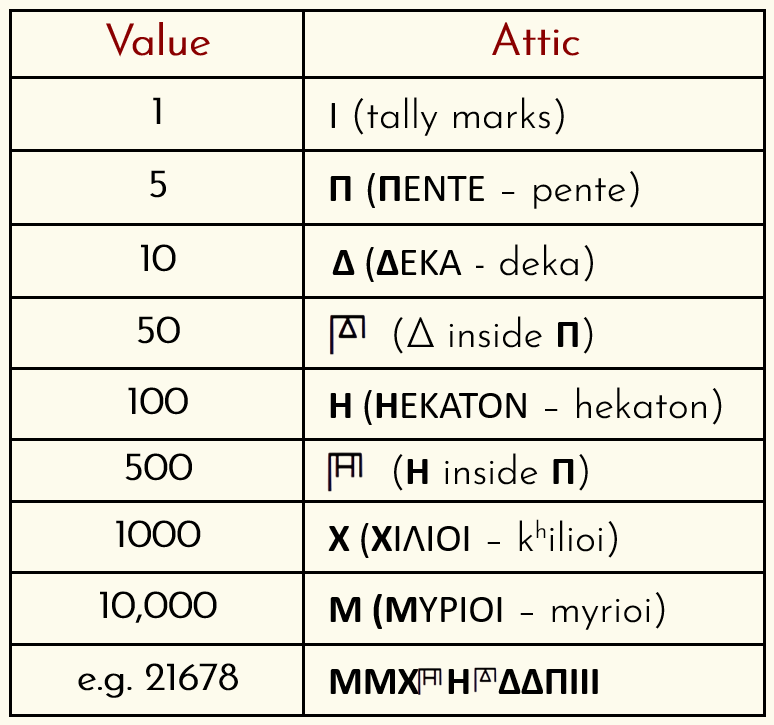
Some early societies, instead of using digits, used alphabetical numerals, achieved by ascribing words or letters of their alphabet to a number value. There are two ways this can be achieved. One way is to simply use the word for the number or by acrophonically ascribing the first letter of that word to that number. So, for example, 1 in English could be written as ‘one’ or simply as ‘O’, while 5 could be written as ‘five’ or as ‘F’, and 10 could be written as ‘ten’ or as ‘T’, and so on. After the Bronze Age collapse, the Greeks lost both their Linear B writing systems and their Aegean number system. Little is known about the system that was used in the interim, but with the re-introduction of writing to Greece via Phoenician by the 8th century BCE, the ancient Greeks began to use an additive decimal system using alphabetical numerals based off their new script. These were known as Attic numerals. The system included tally marks for single units, with acrophonic numerals for 5 (Π), 10 (Δ), 100 (Η) and 1000 (Χ). Multiples of 5 could be achieved by placing these letters within a Π. This system my have influenced Etruscan and by extension Roman numerals, hence the similarities.⁵
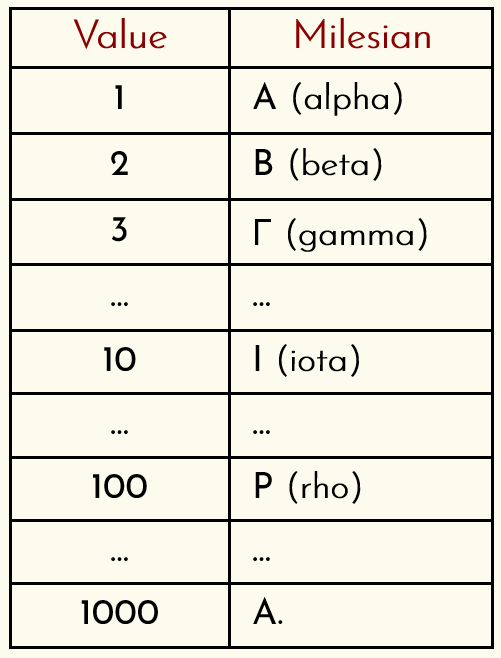
Another way to use alphabetical numerals was to ascribe numbers with letters in alphabetical (or some other arbitrary) order. This method is often termed gematria. So, for example, in Latin, A=1, B=2, C=3, etc. The Greeks eventually replaced Attic numerals with a system of this kind which they referred to as Milesian or Ionian numerals. In this system A=1, B=2, Γ=3, etc (although the Greek letters were in archaic rather than modern forms).⁶ One problem with this type of system is that each alphabet has a different number of letters, meaning they have varying numerical ranges. Ancient Greek, for example, could cover 1-9, 10-90 (in multiples of 10) and 100-900 (in multiples of 100), but required repeating the sequence with decimal markers from 1000 onwards.
Semitic number systems
Early western Semitic peoples such as those that wrote the oldest books of the Bible originally used Egyptian hieratic numerals which likely influenced the smaller set of Phoenician numerals.⁷ Egyptian and Phoenician number systems were additive systems; Egyptian was decimal and Phoenician quasi-decimal, with the addition of a digit for 20 (probably the legacy of vigesimal counting). Like most ancient additive systems, these relied on tedious addition of strokes. So 9, for example, would be written as 𐤖 𐤖 𐤖 𐤖 𐤖 𐤖 𐤖 𐤖 𐤖 in Phoenician and 𓐂 in Egyptian.⁸ Hieratic and Demotic numerals, meanwhile, were slightly more sophisticated with more unique digits requiring less strokes.⁹
Milesian descendants
The Milesian system was eventually inherited by Coptic in Ptolemaic Egypt, which often placed a bar above the letters to signify numerals. Coptic numerals, in turn, made their way to the Horn of Africa. After the Christianisation of the Kingdom of Aksum (modern-day Ethiopia, Sudan and Eritrea) by Frumentius in the 4th century CE, close ties were established between the church in Aksum and the Coptic Church in Alexandria. Through this connection, Coptic numerals were incorporated into the indigenous Ge'ez writing system, albeit with their own unique styling, including bars above and below the numerals. Ge'ez numerals are still used to a limited degree by Ethiopic languages alongside "Western" numerals, notably by the Ethiopian Church and Ethiopian Jewish communities.⁶ᵇ



Hebrew and Arabic Gematria
From at least the 1st century BCE, Semitic languages started replacing Phoenician numerals with systems of gematria influenced by the Greek Milesian system introduced after the conquests of Alexander the Great. Different scripts were used with this system including Aramaic and Syriac and later formalised in Hebrew numerals and Abjad (Arabic) numerals. Arabic, with 28 letters could cover 1-9, 10-90 (in multiples of 10), 100-900 (in multiples of 100) as well as 1000 and then form numbers additively.⁹ᵇ Hebrew on the other hand only had 22 letters, and thus to achieve the range relied on repetition of letters combined with yod (for 11-19), letters in their final forms (for 500-900) and repetition of letters combined with the diacritic geresh from 1000 (just like the Greeks did).⁹ᶜ


Roman Numerals – not quite what they seem!
When you look at Roman numerals, it appears at first glance that it also has alphabetical numerals. Indeed, its most modern form includes the letters V, X, L, C, D and M. But the Roman numeral system is not actually alphanumerical. In fact, these numerals most likely derive from the Etruscan numeral system (which may itself have derived from Attic numerals). In the Etruscan system, 𐌡 represented five (possibly depicting a splayed hand with main fingers together (), half of an X, or from a local tally method). 𐌡 was eventually inverted to V by the Romans. X represented ten (either from two mirrored Vs or from a local tally method). L in fact, comes from 𐌣 (50) (perhaps from the lower half of , which was eventually inverted by the Romans () and the arrow flattened (⊥) before finally being abbreviated to look like an L. C comes from (100), eventually evolving into ↃIC, before being abbreviated as Ↄ or C, which coincidentally also matched the Latin word centum (hundred), hence this variant won out. The original symbol for 1000 was a circled X (⊗) or circled + (⊕), later resembling the Greek letter Φ and the symbol ↀ. ↀ evolved into , then ⋈ and later M in the Middle Ages, helped by the fact that it is the first letter of the Latin word mille (thousand). D (500) probably comes from the right half of one of these early figures (ↀ or ⊕) hence why it's often shown with a line (Đ). The Romans had various systems for writing large numbers such as using apostrophes or brackets to multiply by 10 or 1000 and later using horizontal bars (vinculum) over numerals to multiply them by 1000 (e.g. C̅ for 10,000) A common myth is that the Romans always used subtractive notation where for example 9 was represented as IX (1 less than 10), but this system wasn’t in fact standardised until the Middle-Ages. In Roman times, 9 could just as easily be written additively as VIIII.¹⁰ ¹¹ ¹²


Watch: The Origin of Roman Numerals | Latin Tutorial
Click here →
Chinese numbers
Chinese has three indigenous numeral systems. The first is derived from Oracle Bone numerals, and referred to as traditional numerals. This system is also used in Japan. The second system is known as official writing or as capital/upper-case numerals and is used for more official or financial purposes. This system was developed in the 5th century CE to avoid forgeries of traditional numerals which had much simpler strokes that could easily be manipulated to make larger numbers. Both of these systems are additive/multiplicative decimal systems and are still used today in China, Taiwan and Japan beside so called ‘Western’ numerals (a misnomer as we’ll see). Various cursive forms of these numerals also evolved in parallel to their standard forms. Zero was only added to these systems much later through exposure to foreign mathematical sources.¹³


Positional (place value) numbers
As mentioned above, early number systems were mostly sign-value. But these systems became more abstract over time with the development of place-value or positional notation, which most modern number systems use today. This means that the value of a digit is based on its position in a numeral rather than just the value of the symbol. For example, the value of the digit ‘1’ in the number ‘101’ depends on which position in the numeral it occupies.
All about that base
Most sign-value systems were decimal, but positional systems had many different bases, and in fact the earliest known ones were not decimal. The Sumerians were the first on the scene, using a sexagesimal (base 60) positional system, probably originating from duodecimal counting systems using knuckles. The Mayans, meanwhile, later conceived of a vigesimal (base 20) positional system, probably originating from a counting method using fingers and toes. The decimal (base 10) positional system that we mostly use today didn’t come onto the scene until much later.¹⁴
Let’s talk about nothing
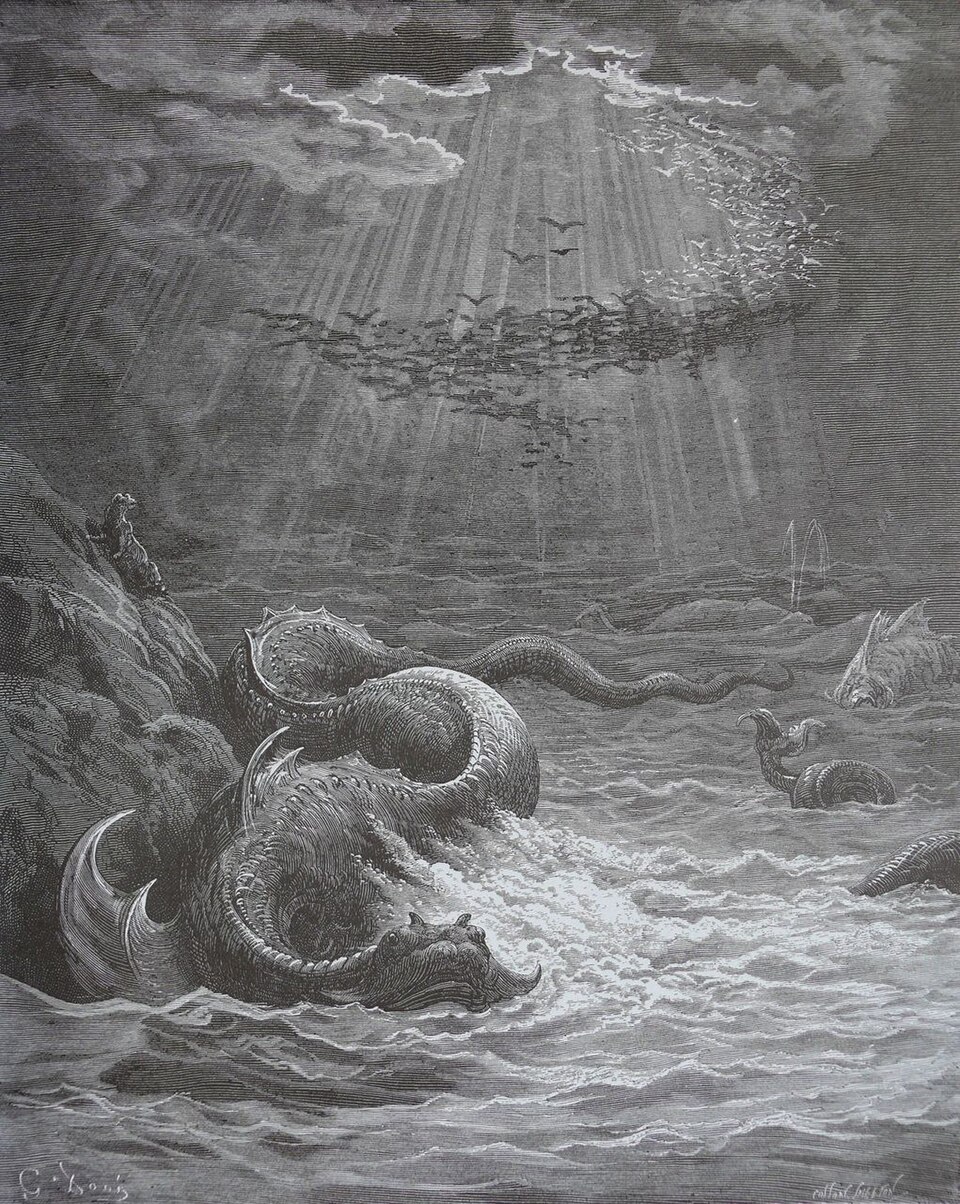
Because sign-value notation formed numerals by adding or multiplying, they needed a greater set of digits and numbers ended up being incredibly long. They were, therefore, not very efficient for counting large numbers or processing complex mathematics. But they also had no need for a zero. The concept of zero as a number evolved in positional systems which used it firstly as an empty placeholder when there was no value in a position of a number (e.g. 0 in 101). It only later developed into a real number. That doesn’t mean that ancient thinkers didn’t explore the idea of zero or ‘nothing’ as a concept, but many ancient peoples were wary of the idea and hesitant to pursue it due to philosophical or religious conflicts. The concept of ‘nothingness’, or the void, negated many of their fundamental principles.¹⁵ ¹⁶ Euclid and Pythagoras avoided zero in geometry, while the Aristotelian tradition was based on substance and potentiality. To them, zero negated being. In a religious sense, most ancient peoples saw the concept of nothing or the void as the manifestation of primordial chaos and disorder; something to be discouraged. Some early Christian figures likewise disparaged the idea.¹⁷
Babylon’s ‘fake’ zero
The earliest known positional number system was the Babylonian sexagesimal (base-60) system (with some decimal remnants), which was likely an adaptation of the Sumerian system. Babylonian cuneiform numerals were written additively from 1-59 with a single stroke for single units (𒁹) and a unique digit for ten (𒌋). But the numeral for 60 (𒁹) – its base – was the same as that of 1 (𒁹). Distinguishing its value then, depended on its position. So, for example, 𒐖 would represent two, while 𒁹 𒁹 would represent 61, 𒐗 three, and 𒁹 𒁹 𒁹 3631, etc. Because they didn’t yet have a zero as a placeholder like modern numbers do, a space was used instead. The Babylonians did later develop a special diagonal double wedge character (𒑊) to indicate a medial placeholder, but this was still not considered a number as such. They also did not use it as a trailing zero, meaning the difference between just one (𒁹), 60 (𒁹) or even 3600 (𒁹) could be ambiguous, and had to be discerned from context.¹⁸


Watch: Cuneiform Numbers | Numberphile
Duodecimal and sexagesimal timekeeping
So why were Babylonian numbers base-60 instead of base-10? As mentioned previously, most early additive number systems were base-10 systems due to the number of fingers we possess, as counting using hands. In fact, Babylonian shows its historical decimal roots with the use a separate symbol for 10. But apart from the fact that 60 has more numbers that divide into it than 10, making it much more versatile for complex number crunching, it may have been related to an earlier duodecimal (base 12) counting system (12x5 = 60). Twelve has also more factors than 10 making it more practical for most intents and purposes. Our system of timekeeping for example is a mix of duodecimal and sexagesimal systems. The concept the 24-hour solar day comes from an Egyptian base 12 system (12 hrs for day and 12 hours for night) and the 12-month calendar was used by many ancient civilisations, including the Babylonians due to 12 lunar cycles fitting into a solar year. The Babylonians, meanwhile, were masterful mathematicians and astronomers, using their base-60 system for geometry (60x6 = 360) and for mapping the night sky. Our modern minutes (60 seconds) and hours (60 minutes) are also derived from this system.¹⁹ Interestingly, there have been efforts to incorporate decimal time in the past, most notably with the modernisation efforts of the French Republic at the end of the 18th century. They introduced a ten-hour day (twenty-hour solar day), but the new system never really caught on and the project was abandoned after around a decade.


Watch: Who Decided to Put 60 Seconds in a Minute? | Smithsonian
A real zero?
So, the Babylonians had a positional number system without a real zero. Meanwhile, on the other side of the world in Meso-America, The Mayans had developed a positional vigesimal (base-20) number system with a zero placeholder by around the 1st century BCE. The system was additive from 1-19 with dots for single units and a line for 5. For numbers larger than 19, a vertical positional system was used to multiply numbers by powers of its base (20), working from the bottom up. When there were no units in position, a zero () could be used, including as a trailing placeholder (in position 1), which the Babylonian placeholder could not do. But the Mayan zero still wasn’t considered fully-fledged member of the number family; it was still only used as a placeholder.²⁰


Watch: The Mayan Number System | MathIsPower4U
“Western” numbers
So where do modern Latin or “Western” numerals actually come from, given that they clearly don’t originate from Roman numerals? Well the term “Western” is a misnomer here, because while in their modern form they appear to have been a European creation, their true origins lie in the official name for the system: Hindu-Arabic numerals (often simply called Arabic numerals). They in fact originate from Indian Brahmi numerals which emerged in the 3rd century BCE along with the Brahmi script. Like most traditional numbers, they were originally additive. But Brahmi evolved into many variants over the centuries, spread out across the Indian subcontinent, and sometime around the 6th c. CE, Indian mathematicians began using them in positional notation with the eventual addition of a tiny dot as a placeholder. This positional system was consistently used by Indian mathematicians and astronomers such as Aryabhata and Brahmagupta by the 7th century CE. It was during this period that the concept of a positional system was fully codified with the tiny dot placeholder evolving into a larger, hollow circle. By the 9th century CE, this ‘zero’ was considered to be a real number.²¹ ²²


Indian positional numbers later spread to the Muslim world, particularly Persia, with typological modifications being made along the way. Here they took on the early form of Hindu-Arabic numerals. Largely thanks to mathematicians such as the Persian Al Khwarizmi, the father of Algebra, Hindu-Arabic numerals along with number zero spread to Christendom within their works, promoted by mathematicians such as Fibonacci. In fact the word zero derives from the Arabic word ṣifr (صِفْر) meaning 'nothing', itself derived from the Sanskrit word for 'void' or 'nothingness' - śūnya. Their typography again changed once they arrived in Europe. The system thus split into two variants: Western (used throughout Europe) and Eastern (used throughout the Islamic world).²³ Hindu-Arabic numerals have today been almost universally adopted around the world due to the mathematical efficiency of its positional notation and also Europe’s cultural domination. While some traditional number systems such as Chinese do still operate, this is usually in tandem with Hindu-Arabic numerals.


Watch: The Fascinating History of Arabic Numerals | SciShow
Chinese positional system
The Chinese invented a third, mathematical number system also developed from Oracle Bone numerals, known as rod numerals. It was a positional system with numerals 1-9 of two types: ‘zongs’ (vertical) and ‘hengs’ (horizontal). It originally included a quasi-0 (in the form of a space). Rod numerals later evolved into a simplified form known as Suzhou numerals with a real 0, likely borrowed from Hindu-Arabic numerals. This intricate counting system worked similarly to an abacus. It was originally used in China, Korea, Japan and Vietnam, but is no longer used.²⁴


A Brief History of Numerical Systems | Alessandra King - TEDed
Numbers without writing
It’s hard to think of numbers without the concept of either speech or numerals, but such systems did exist. One such system involved the use of knotted ropes to keep records. Perhaps the most famous of these was that developed by the Incans known as ‘Quipu’ or ‘Khipu’. The Incans never developed a proper system of writing, so the quipu was essentially a surrogate for written numbers. The system involved a series of different-coloured knotted strings encoding information and figures by details such as string colour, distance between strings, direction of strand lay, types of knots, the direction the knot is tied and the positions of knots on the string. It was a decimal place-value system with some binary elements. Place value was determined by the relative placement of knots, with spaces as a placeholder. There are some scholars who believe the quipu may have even been able to encode language in a sort of quasi-writing, but this is yet to be proved.²⁵ The Incans also had a counting system called a Yupana which worked similarly to an abacus or Chinese rod numeral. using pebbles on different tiers indicating place value.²⁶ ²⁷


Watch: Inca Knot Numbers | Numberphile
Continue to Chapter 10 →
Glossary of terms
Chapter 9
Abacus: a manual counting device using beads or stones on rods or grooves to perform calculations
Acrophonic: using the initial sound of a word to represent a number, especially in ancient numeral systems
Additive notation: a system where values are combined by addition of symbols to express numbers
Biquinary: a numeral system combining base-2 and base-5 elements, often used in ancient counting tools
Centum: Latin for “hundred”, used as a numeral term or base reference
Decimal: a base-10 numeral system using ten symbols (0–9), also called the denary system
Digit: a single numerical symbol used to represent quantity in a numeral system
Duodecimal: a base-12 numeral system
Gematria: a system assigning numerical values to letters, words, or phrases, especially in Hebrew texts
Glottographic: a type of writing system that represents spoken language directly, often using symbols for sounds (phonemes, syllables) or words
Hengs: vertical marks used in traditional Chinese counting systems to represent numeric units
Mille: Latin for “thousand”, used in numeral terms like millennium
Multiplicative notation: a system in which a base unit is multiplied by a coefficient to form numbers
Notation: a system of symbols used to represent information, often in music, math, or linguistics, but not necessarily tied to spoken language
Number: an abstract concept representing quantity, order, or position
Numeral: a written or spoken symbol or group of symbols that represents a number
Placeholder: a symbol used to maintain positional structure in a numeral system, such as zero in decimal notation
Place-value / positional notation: a numeral system in which the value of a digit depends on its position within the number
Quinary: a base-5 numeral system
Quipu: a system of knotted strings used by the Inca to record numbers and other data
Semasiographic: a system of communication using symbols to convey meaning directly, without representing spoken language (e.g. emojis)
Sexagesimal: a base-60 numeral system, notably used in ancient Mesopotamia
Sign-value notation: a system where the value of each symbol is fixed, regardless of position, and repeated to indicate multiples
Subtractive notation: a numeral format where a smaller value precedes a larger one to indicate subtraction
Trailing zero: one or more zeros appearing after the last non-zero digit in a number, often indicating scale or precision
Vigesimal: a base-20 numeral system
Vincula: Latin for "bond" or "fetter", used to refer to horizontal bars over Roman numerals to multiply by 1000
Yupana: an Inca counting board, possibly used for base-10 or base-40 calculations
Zongs: horizontal tally marks used in traditional Chinese counting systems
Useful Links
Ancient Civilizations World - Ancient Civilizations Numeral Systems: https://ancientcivilizationsworld.com/number-systems/
Gematria Lab - Jewish Gematria Table: https://gematrialab.com/jewish-gematria-table
History Cooperative - Who Invented Numbers?: https://historycooperative.org/who-invented-numbers/
Mathematical Explorations - Exploring the Fascinating Evolution and Discovery of Number Systems Throughout History: https://mathematicalexplorations.co.in/discovery-of-number-systems/#A_Arabic_Numerals_in_Europe
Uloom – Abjad Numerals: https://www.uloom.com/stable/161121501?title=abjad%20numerals
World History Edu - History and Major Facts about the Hindu-Arabic Numerals: https://worldhistoryedu.com/history-and-major-facts-about-the-hindu-arabic-numerals/
World History Encyclopedia – Quipu: https://www.worldhistory.org/Quipu/
Footnotes
Chapter 9
1. ‘Number vs Numeral’, Grammarist, <https://grammarist.com/usage/number-vs-numeral/> [accessed April 2025]
2. ‘Numbers’, Math Only Math, <https://www.math-only-math.com/Numbers.html> [accessed April 2025]
3. John Sören Pettersson, ‘Numerical Notation’ in Daniels, Peter T. and Bright, William, The World’s Writing Systems, Oxford University Press, 1996, p. 789
4. Georges Ifrah, From One to Zero: A Universal History of Numbers, Penguin Books, 1987, pp. 32, 36, 65
5. John Sören Pettersson, ‘Numerical Notation’ in Daniels, Peter T. and Bright, William, The World’s Writing Systems, Oxford University Press, 1996, p. 803
6. Leslie Threatte, ‘The Greek Alphabet’ in Peter T. Daniels and William Bright, The World’s Writing Systems, Oxford University Press, 1996, p. 278
6b. 'A Look at Ethiopic Numerals', ge'ez.org, <https://www.geez.org/Numerals/> [accessed September 2025]
7. Georges Ifrah, From One to Zero: A Universal History of Numbers, Penguin Books, 1987, p. 276
8. ‘The Phoenicians: Language, Writing, Numbers’, Anticopedie, <https://anticopedie.fr/mondes/mondes-gb/phenicie-langue.html> [accessed May 2025]
9. Georges Ifrah, From One to Zero: A Universal History of Numbers, Penguin Books, 1987, p. 242
9b. Mft. M. Saifur Rahman Nawhami, ‘Abjad Numerals’, Uloom, <https://www.uloom.com/stable/161121501?title=abjad%20numerals> [accessed June 2025]
9c. Jewish Gematria Table, GematriaLab, <https://gematrialab.com/jewish-gematria-table> [accessed June 2025]
10. Isaac Asimov, Asimov on Numbers, Pocket Books, 1977, p. 9
11. ‘Roman Numerals: Their Origins, Impact, and Limitations’, Encyclopedia, <https://www.encyclopedia.com/science/encyclopedias-almanacs-transcripts-and-maps/roman-numerals-their-origins-impact-and-limitations> [accessed April 2025]
12. Paul Keyser, ‘The Origin of the Latin Numerals 1 to 1000’, American Journal of Archaeology, vol. 92, no. 4, 1988, <https://doi.org/10.2307/505248>
13. Georges Ifrah, From One to Zero: A Universal History of Numbers, Penguin Books, 1987, pp. 263-296
14. idib, pp. 34-35, 49-50
15. Mariellen Ward, ‘India’s Impressive Concept About Nothing’, BBC, 9 August 2018, <https://www.bbc.com/travel/article/20180807-how-india-gave-us-the-zero> [accessed April 2025]
16. ‘The Origins of the Zero’, Encyclopedia, <https://www.encyclopedia.com/science/encyclopedias-almanacs-transcripts-and-maps/origins-zero> [accessed April 2025]
17. Matt Seife, Zero: the Biography of a Dangerous Idea, Penguin, 2000, pp. 19-25
18. ‘Babylonian Numbers’, The Edkins, <https://www.theedkins.co.uk/jo/numbers/babylon/index.htm> [accessed April 2025]
19. ‘Why Are There 24 Hours In A Day And 60 Minutes In An Hour?’, Science ABC, 19 October 2023, <https://www.scienceabc.com/eyeopeners/why-are-there-24-hours-in-a-day-and-60-minutes-in-an-hour.html> [accessed April 2025]
20. Georges Ifrah, From One to Zero: A Universal History of Numbers, Penguin Books, 1987, pp. 297-322
21. idib, pp. 551-561
22. J. J. O'Connor and E. F. Robertson, ‘Indian Numerals’, Maths History, <https://mathshistory.st-andrews.ac.uk/HistTopics/Indian_numerals/?utm.com> [accessed April 2025]
23. ‘The Hindu—Arabic Number System and Roman Numerals’, Lumen Learning, <https://courses.lumenlearning.com/waymakermath4libarts/chapter/the-hindu-arabic-number-system/?utm> [accessed April 2025]
24. Georges Ifrah, From One to Zero: A Universal History of Numbers, Penguin Books, 1987, pp. 263-296
25. ‘Khipu, Quipu’, Peru Visit, <https://peruvisit.com/peruscope/khipu_quipu/> [accessed April 2025]
26. ‘Yupanas’, Maths From the Past, <https://maths-from-the-past.org/yupanas/> [accessed April 2025]
27. Georges Ifrah, From One to Zero: A Universal History of Numbers, Penguin Books, 1987, pp. 543
Fig. 9.1: David Schrader, ‘Historical Number One’, (© author’s own, 2025
Fig. 9.2: David Schrader, ‘Cuneiform Numerals‘, (© author’s own, 2025)
Fig. 9.2b: David Schrader, ‘Hieroglyphic Numerals, (© author’s own, 2025)
Fig. 9.3: David Schrader, ‘Roman Numerals’, (© author’s own, 2025)
Fig. 9.4: David Schrader, ‘Brahmi Numerals’, (© author’s own, 2025)
Fig. 9.5: Bryan Derksen, Mayan numerals, Wikimedia Commons, <https://commons.wikimedia.org/wiki/File:Maya.svg> [CC BY-SA 3.0, accessed April 2025]
Fig. 9.6: @Gisling, Oracle Bone Numerals, (background removed), Wikimedia Commons, <https://commons.wikimedia.org/wiki/File:Shang_numerals.jpg> [CC BY-SA 3.0, accessed April 2025]
Fig. 9.7: David Schrader, ‘Aegean Numerals’, (© author’s own, 2025)
Fig. 9.8: David Schrader, ‘Duodecimal Counting’, (© author’s own, 2025), based on @Marcosticks, hand illustration, Wikimedia Commons, <https://commons.wikimedia.org/wiki/File:Marcosticks-Human_hand-Wide-open_Flat_Palm.png> [CC BY-SA 4.0, accessed May 2025]
Fig. 9.9: David Schrader, ‘Attic Numerals’, (© author’s own, 2025)
Fig. 9.9b: David Schrader, ‘Milesian Numerals’, (© author’s own, 2025)
Fig. 9.9c: David Schrader, 'Milesian Descendants', (© author's own, 2025)
Fig. 9.10: David Schrader, ‘Phoenician Numerals’, (© author’s own, 2025)
Fig. 9.11: Kurt Sethe, Egyptian numerals table, (image cropped, highlighting added), Wikimedia Commons, <https://commons.wikimedia.org/wiki/File:A_History_Of_Mathematical_Notations_Vol_I_-_Egyptian_numerals._Hieroglyphic,_hieratic,_and_demotic_numeral_symbols._(This_table,_was_compiled_by_Kurt_Sethe.).png> [public domain, accessed May 2025]
Fig. 9.12: David Schrader, ‘Hebrew Gematria’, (© author’s own, 2025)
Fig. 9.13: David Schrader, ‘Abjad Numerals’, (© author’s own, 2025)
Fig. 9.14: David Schrader, ‘Roman Numerals Evolution’, (© author’s own, 2025)
Fig. 9.15: Steve Fareham, church clockface , Wikimedia Commons, <https://commons.wikimedia.org/wiki/File:Darfield_All_Saints_Church_clock_face_-_geograph.org.uk_-_934144.jpg> [CC BY-SA 2.0, accessed May 2025]Fig. 9.16: Schrader, David, ‘Chinese Numerals’, (© author’s own, 2025)
Fig. 9.17: Gustave Doré, ‘Leviathan, Waters of Chaos’ in John Milton, , 1866, accessed in Wikimedia Commons, <https://commons.wikimedia.org/wiki/File:Paradise_Lost_31.jpg> [accessed April 2025]
Fig. 9.18: David Schrader, ‘Babylonian Numbers’, (© author’s own, 2025)
Fig. 9.19: Jacek Halicki, alarm clock, (background removed), Wikimedia Commons, <https://commons.wikimedia.org/wiki/File:2023_Budzik_Perfect.jpg> [CC BY-SA 4.0]
Fig. 9.20: Ed Stevenhagen, ‘Compass rose’, Wikimedia Commons, <https://commons.wikimedia.org/wiki/File:Kompassrose.svg> [public domain, accessed May 2025]
Fig. 9.21: Decimal Clock, (background removed), Wikimedia Commons, <https://commons.wikimedia.org/wiki/File:Horloge-republicaine1.jpg> [public domain, accessed April 2025]
Fig. 9.22: David Schrader, ‘Mayan Numbers’, (© author’s own, 2025)
Fig. 9.23: Bakhshali manuscript, (background removed, ring added), illustration by National Geographic, Wikimedia Commons, <https://commons.wikimedia.org/wiki/File:Bakhshali_manuscript.jpg> [public domain, accessed May 2025]
Fig. 9.24: David Schrader, ‘Evolution of Brahmi Numerals‘, (© author’s own, 2025)
Fig. 9.25: David Schrader, ‘Hindu-Arabic Numbers‘, (© author’s own, 2025)
Fig. 9.26: @Innocentbunny, Nepalese number plate – Devanagari, Wikimedia Commons, <https://commons.wikimedia.org/wiki/File:Devanagari_Vehicle_Number_plate.jpg> [CC BY-SA 3.0]
Fig. 9.26b: @BasilLeaf, Nepalese number plate – Arabic, Wikimedia Commons, <https://commons.wikimedia.org/wiki/File:Nepal_License_Plate_-_3-Wheeler.png> [public domain, accessed May 2025]
Fig. 9.27: Evolution of Hindu-Arabic numerals, (image edited, background removed), illustration by Tobus, Wikimedia Commons, <https://commons.wikimedia.org/wiki/File:The_Brahmi_numeral_system_and_its_descendants.png> [public domain, accessed May 2025]
Fig. 9.28: Saudia Arabian speed sign, (image cropped, colour adjusted). ‘Al Hada – Oder Baboons im Nebel’, Overland Travel, <https://overlandtravel.eu/al-hada-oder-baboons-im-nebel/> [accessed May 2025]
Fig. 9.29: Nima Farid, Saudi number plate, Wikimedia Commons, <https://commons.wikimedia.org/wiki/File:Saudi_Arabia_KSA_-_License_Plate_-_Private_-_550x110mm.png> [CC BY-SA 4.0, accessed May 2025]
Fig. 9.30: @Ajfweb, Cairo clock, Wikimedia Commons, <https://commons.wikimedia.org/wiki/File:Clock-in-cairo-with-eastern-arabic-numerals.jpg> [GNU free license, accessed May 2025]
Fig. 9.31: @Gisling, Rod numerals, (detail added), Wikimedia Commons, <https://commons.wikimedia.org/wiki/File:Chounumerals.jpg> [CC BY-SA 3.0, accessed May 2025]
Fig. 9.32: @Voidvector, Suzhou numerals, Wikimedia Commons, <https://commons.wikimedia.org/wiki/File:Huama_numerals.svg> [public domain, accessed May 2025]
Fig. 9.33: Claus Ableiter, Quipu, Wikimiedia Commons, Wikimedia Commons, <https://commons.wikimedia.org/wiki/File:Inca_Quipu.jpg> [CC BY-SA 3.0, accessed May 2025]
Fig. 9.34: Drawing of knot-tying methods, (image cropped, background removed) in L. Leland Locke, The Ancient Quipu or Peruvian Knot Record, 1923, from ‘Fig. 1’, American Museum of Natural History, New York, sourced in Kylie E. Quave, ‘The Inka Khipu’, Libre Texts – Humanities, Libre Texts, <https://human.libretexts.org/Bookshelves/Art/SmartHistory_of_Art_2e/SmartHistory_of_Art_XIa_-_The_Americas_before_1500/04:_South_America_before_c._1500/4.02:_Peru_and_Bolivia/4.2.13:_Inka/4.2.13.03:_The_Inka_khipu> [accessed May 2025]
Fig. 9.34b: Quipu example, (background removed, figured added), ‘Communication Tied Up in Knots’, Miscellaneous Details, <https://miscellaneousdetailstm.wordpress.com/2018/06/20/communication-tied-up-in-knots/> [accessed May 2025]
Fig. 9.35: Yupana in A. Aimi, ‘Le culture del Perù da Chavin agli Inca’ (background removed), , Silvana Editoriale Milano, 2004, p. 132, accessed from Wikimedia Commons, <https://commons.wikimedia.org/wiki/File:Raccolte_Extraeuropee_-_PAM01349_-_Per%C3%B9_-_Cultura_Chim%C3%BA_-_Inca%3F.jpg> [CC BY-SA 3.0, accessed May 2025]
Share this page
To the
Top
To the
Bottom