

Home
Ideodyssey
a journey in ideas


Contents
Page
Current
Chapter:
1
What
is
Writing?


Play
TRACK 3
Previous
Chapter
Next
Chapter

rigins
Writing
of

A cultural technology
Of all the technologies that humanity has possessed, writing is undoubtedly one of the most consequential. By the time it emerged more than five thousand years ago, the unique ability for speech in our species had already given us an enormous evolutionary advantage by allowing superior oral communication beyond rudimentary sounds. It allowed the unique expression of language. Writing then allowed us for the first time to record that language beyond the use of speech; to freeze communication in time and space and detach it from human memory. It allowed the passing down of knowledge intergenerationally.
Today we take this ‘cultural technology’ (as Meletis calls it) entirely for granted.¹ And yet without it, human civilisation as we know it today would never have come to pass. World Writing Systems estimates that at least 293 unique writing systems are known to have existed throughout human history. Today around 140 of them are still used to represent the roughly 7000 living languages.² Each one is a fascinating cultural tapestry with a unique genealogy. Suffice to say, I will only be covering a small fraction of them in this work.
𑁧
What is writing?

← Click image to enlarge
Writing vs language vs speech
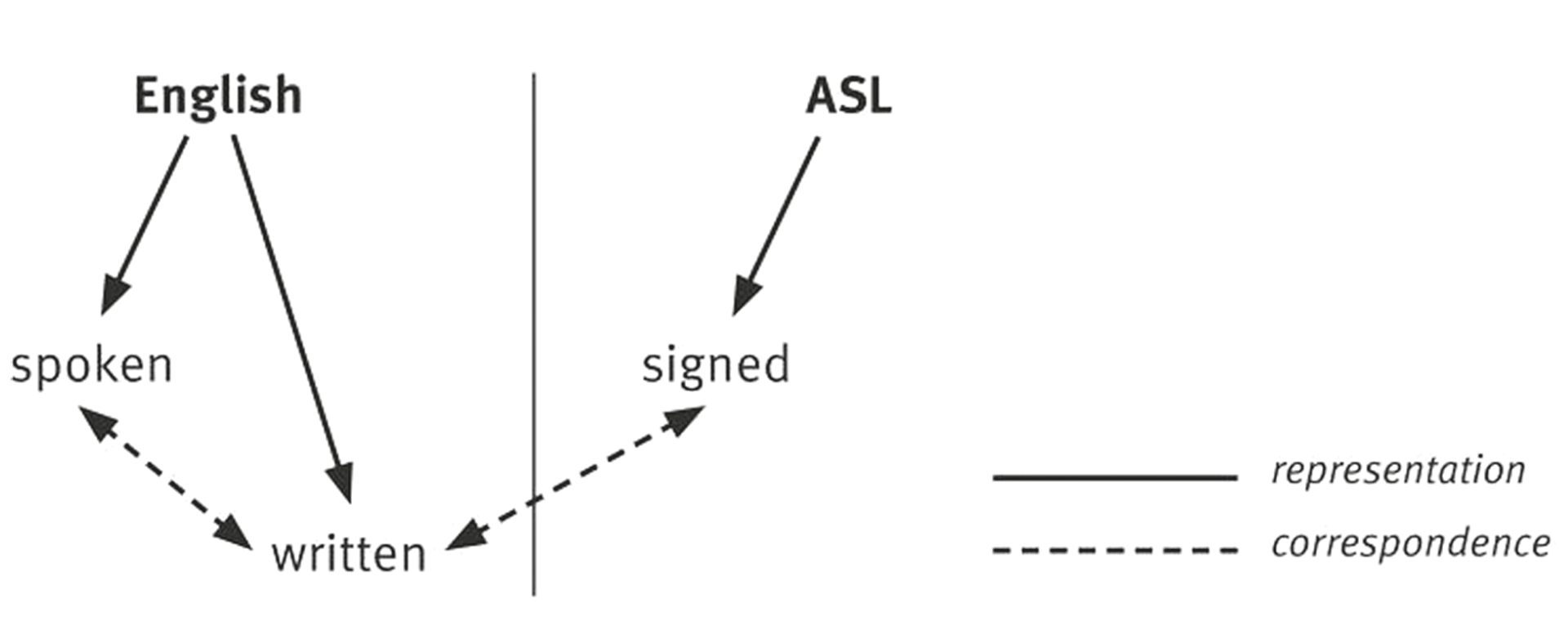
It is important at this point to make another distinction between the terms ‘language’, ‘writing’ and ‘speech’. Meletis defines language as an abstract system composed of sub-systems such as grammar, phonology (sounds), morphology (units of meaning), and syntax (sentence structure).³ Language, while not tied to any single form of expression (or modality), does need at least one to be expressed. Speech is one such modality, expressed through sound. A second modality of language is signing, used by signed languages like American Sign Language (ASL). Writing is another modality — a visual or tactile (e.g. braille) representation of language using marks. While writing can and often does correspond to speech, it can also correspond to the signed modality of a signed language, and thus it is not simply written speech.
Writing as a modality
Spoken, written, and signed modalities can represent the same language system but are structurally distinct from one another. However, writing is unique among the other two in that it cannot exist independently — it must be tied to another modality. This is because spoken and signed languages are natural languages – evolved forms of instinctual communication universal to all human cultures. Writing, by contrast, is a non-universal human-made concept, designed as a secondary, symbolic representation of language without intrinsic meaning. It is therefore essentially impossible to have a writing system that is entirely detached from a pre-existing natural language (although modern attempts have been made) and why a single spoken language can be represented by more than one writing system (for example Serbian or Mongolian).
Writing as a notational system
Writing is considered a notational system – a system that uses a set of graphic marks to represent information. Other notational systems include numerical, mathematical and musical notation. True writing represents systems of language rather than just ideas. Thus, they are termed ‘glottographic’ (literally ‘language writing’). It is however, still possible to visually communicate ideas in other ways. For example, cave paintings, street signs, emojis and numbers all visually communicate ideas without going through language. These signs are thus termed 'semasiographic' (‘designation writing’).⁴ In fact, this is where the story of writing begins.
Genesis of writing
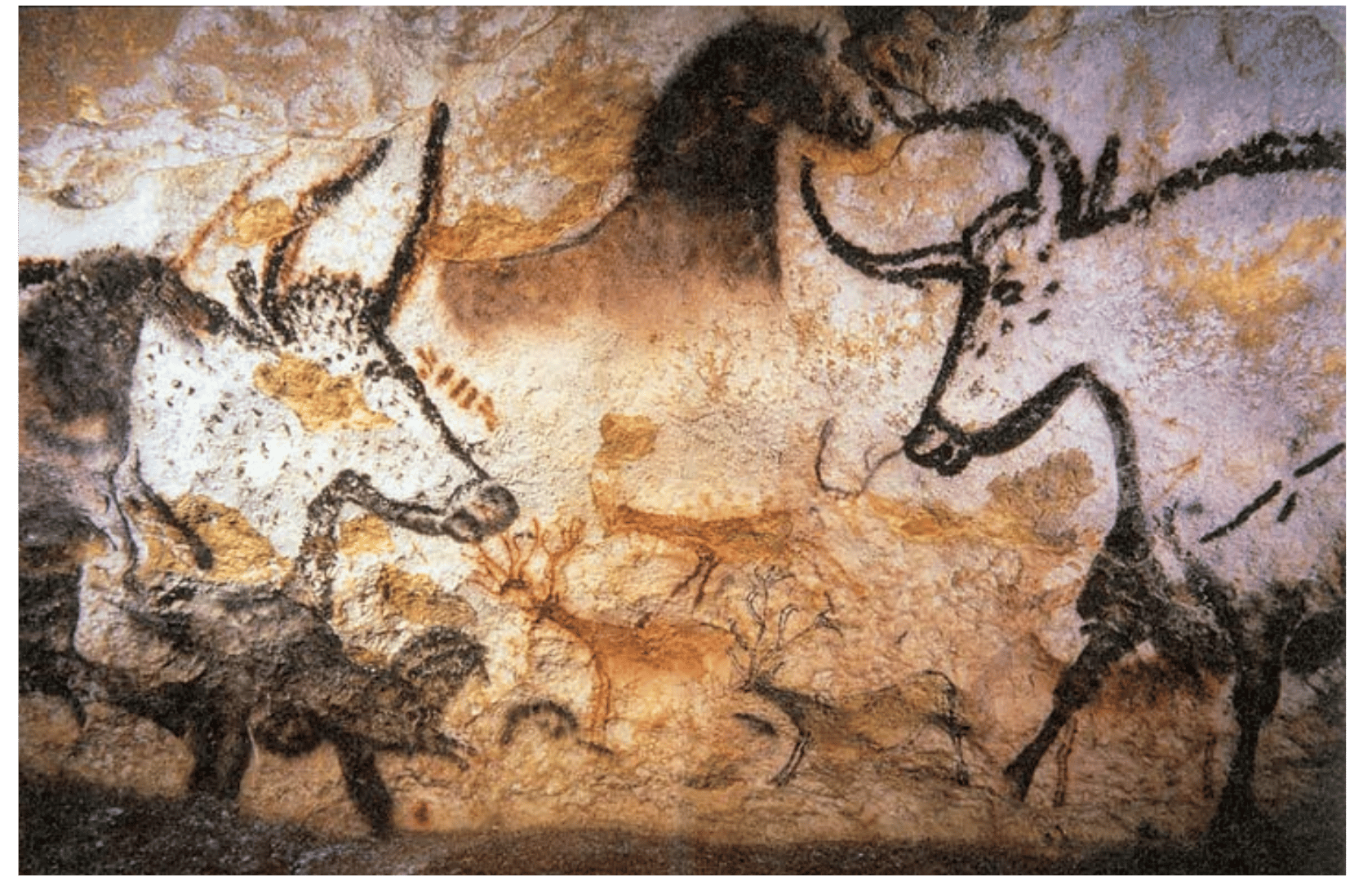
The oldest figurative representations of the world by humans were neolithic cave paintings, the oldest of which are at least 40,000 years old.⁵ And it possibly wasn’t just homo sapiens doing this. Some of the oldest cave paintings are believed by some researchers to have been made by our cousins the Neanderthals and Denisovans. The figurative representation of the world later expanded when artistic depictions began to be used to directly confer information, taking them from the realm of art to the realm of communication, in the form of proto-writing. These early symbols are commonly referred to as pictograms (or pictographs). They can represent objects, ideas or numbers, but they are considered proto-writing because they represent meaning that is detached from a specific language, and universally understood. In other words, they are semasiographic. For example, the following pictogram (☀) would be universally understood to communicate the sun regardless of language or culture.
Watch: Cave Art 101 | National Geographic
Click here →
Breakthroughs in writing
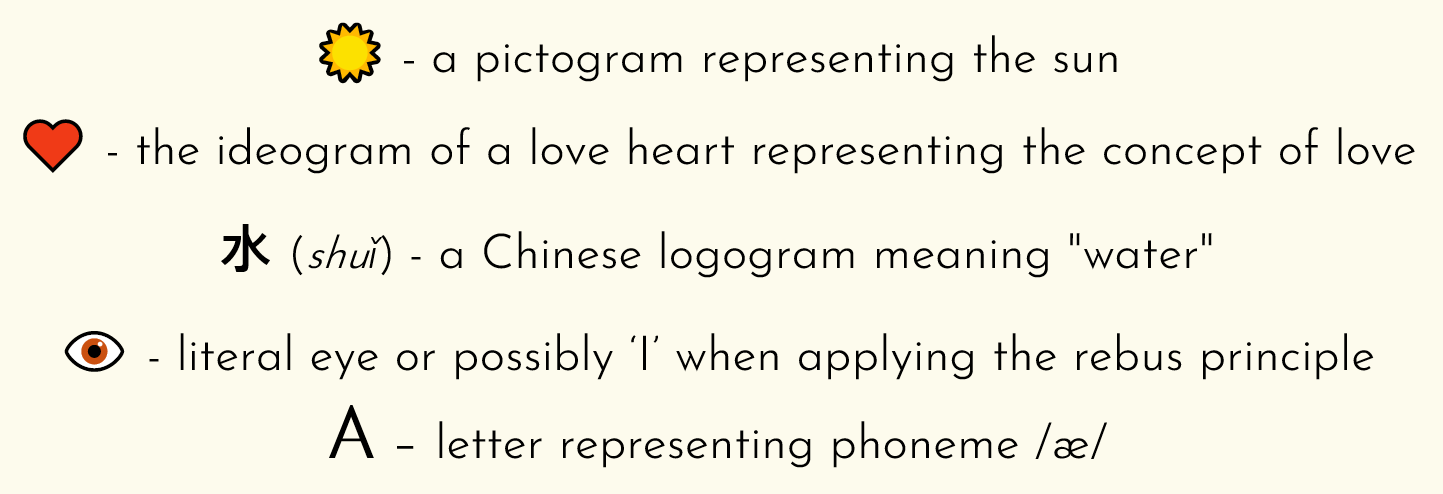
These systems of proto-writing later evolved in a series of major breakthroughs. The first was when symbols could represent whole ideas (referred to as ideograms) and words (referred to as logograms). A modern example of an ideogram would be the love heart (♥) representing the concept of love. An example of a logogram would be this Chinese character (水) which represents the Chinese word ‘shuǐ’ (or ‘water’ in English). But a full writing system requires the ability to not only represent ideas or words, but a language as a whole. This means it needs to be able to represent its phonology (its sounds) – e.g. syllables or phonemes (individual units of sound) – and its rules – e.g. grammar, syntax, etc. The first step toward full writing was the symbolic representation of sound. This happened through something termed the ‘rebus principle’. This is where symbols can represent sounds of the words they depict. For example, the pictogram of an eye (👁) could represent the sound /ai/ as in the word ‘I’. Think “👁 am happy.” Or perhaps you take the symbol 𓆙 and use it to represent the first sound of the word ‘snake’ (/s/). Combine the two together as 👁𓆙 and you get the syllable /ais/ or the word ‘ice’. This is how phonetic writing developed.⁶
Later, phonetic scripts which used letters to represent phonemes only, evolved when logograms developed their phonetic function through the rebus principle and dropped their original logographic function. Hence (as we’ll see), the typography of the letters in all alphabets today can be traced to ancestor logograms and ideograms (and pictograms before that), although you wouldn’t know it because they have simplified and abstracted over time to the point that they are mostly unrecognisable. Philologists, by painstakingly tracing the genealogies of these letters, have concluded that the majority of scripts that we use today, from Latin in the West to Balinese in the East, are in fact derived from one single set of pictograms.
Why here and not there?
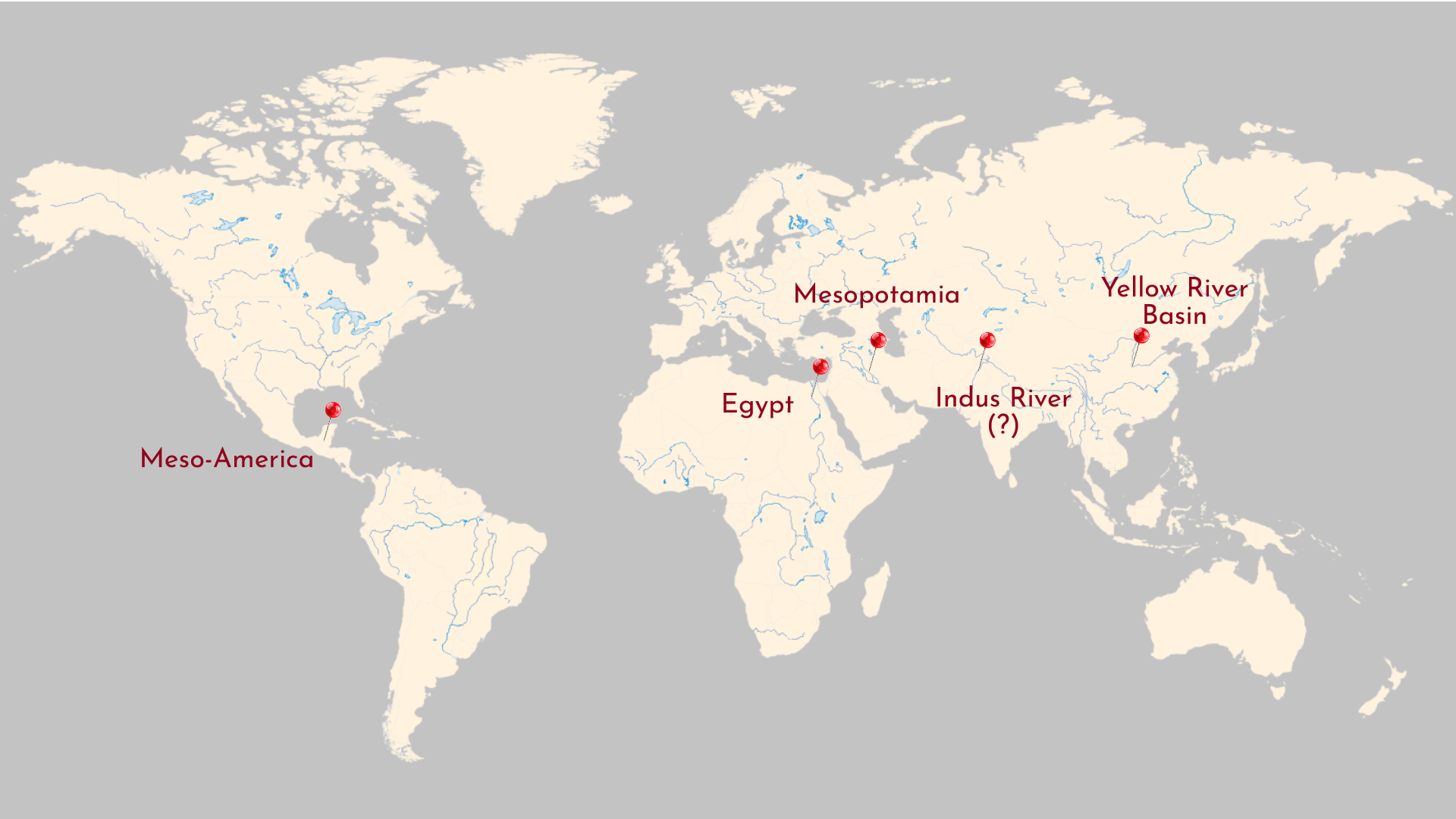
But why did writing develop in some places as early the 4th millennium BCE while in others not even a rudimentary form of writing emerged? The answer lies in both capability and necessity. If we look at the civilisations where pristine writing emerged, we can see that they are all located within a narrow range of latitude. This not a coincidence, but rather an explanation. These civilisations all had developed agriculture with the help of warm climates and usually fertile river systems. This led to permanent settlements growing to large urban centres and resulting in the need for increasingly centralised bureaucracies and recordkeeping. This combination of factors both necessitated and facilitated the development of writing and together constitute what we now broadly term ‘civilisation’.⁷ Daniels & Bright further argue that the rebus principle was more successful in languages whose words are mostly made of single syllables – notably, Sumerian, Chinese and Mayan (languages of three of the four civilisations where writing emerged).⁸ This may help to explain why some early civilisations (e.g. the Incans) didn’t manage to develop full writing.
Record-keeping
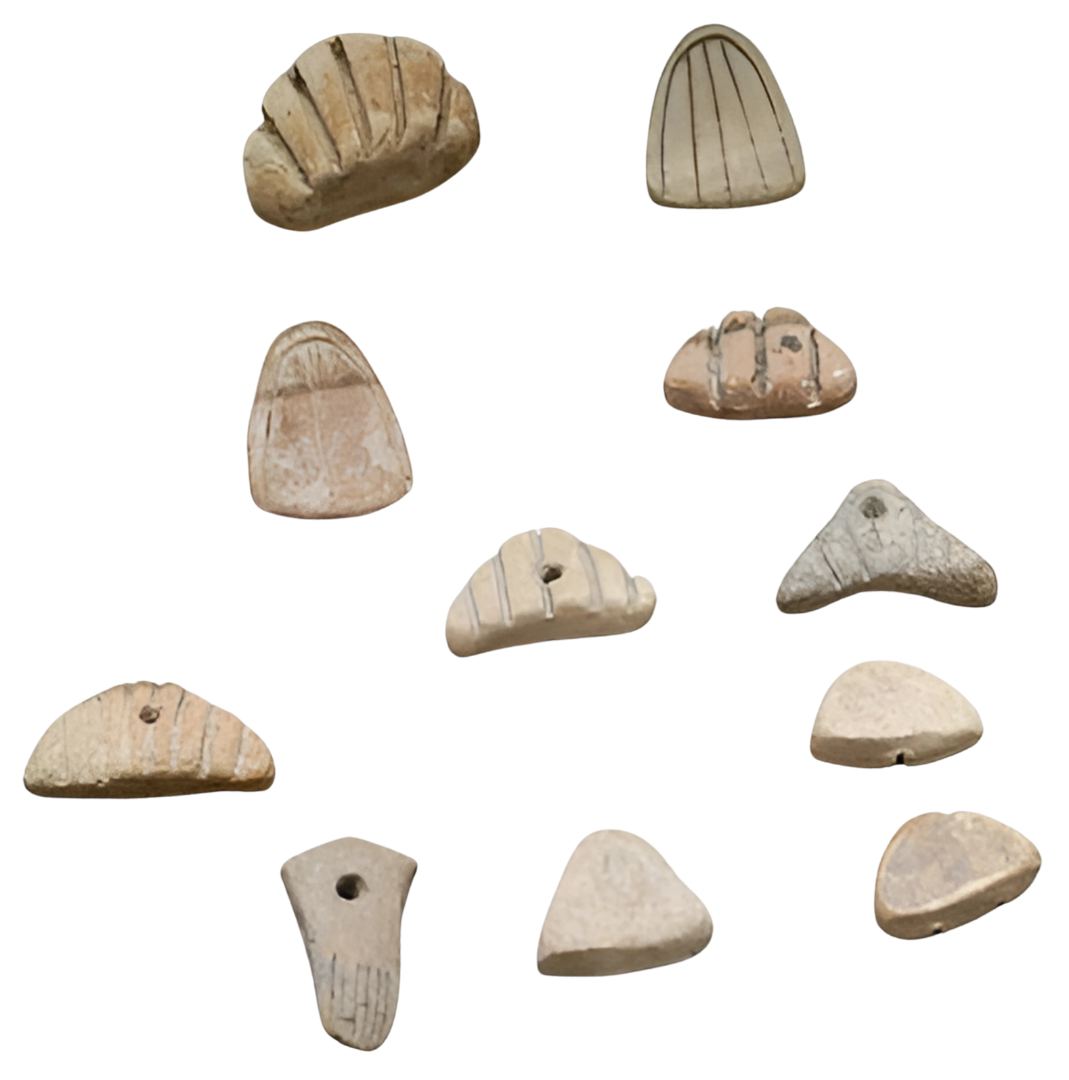
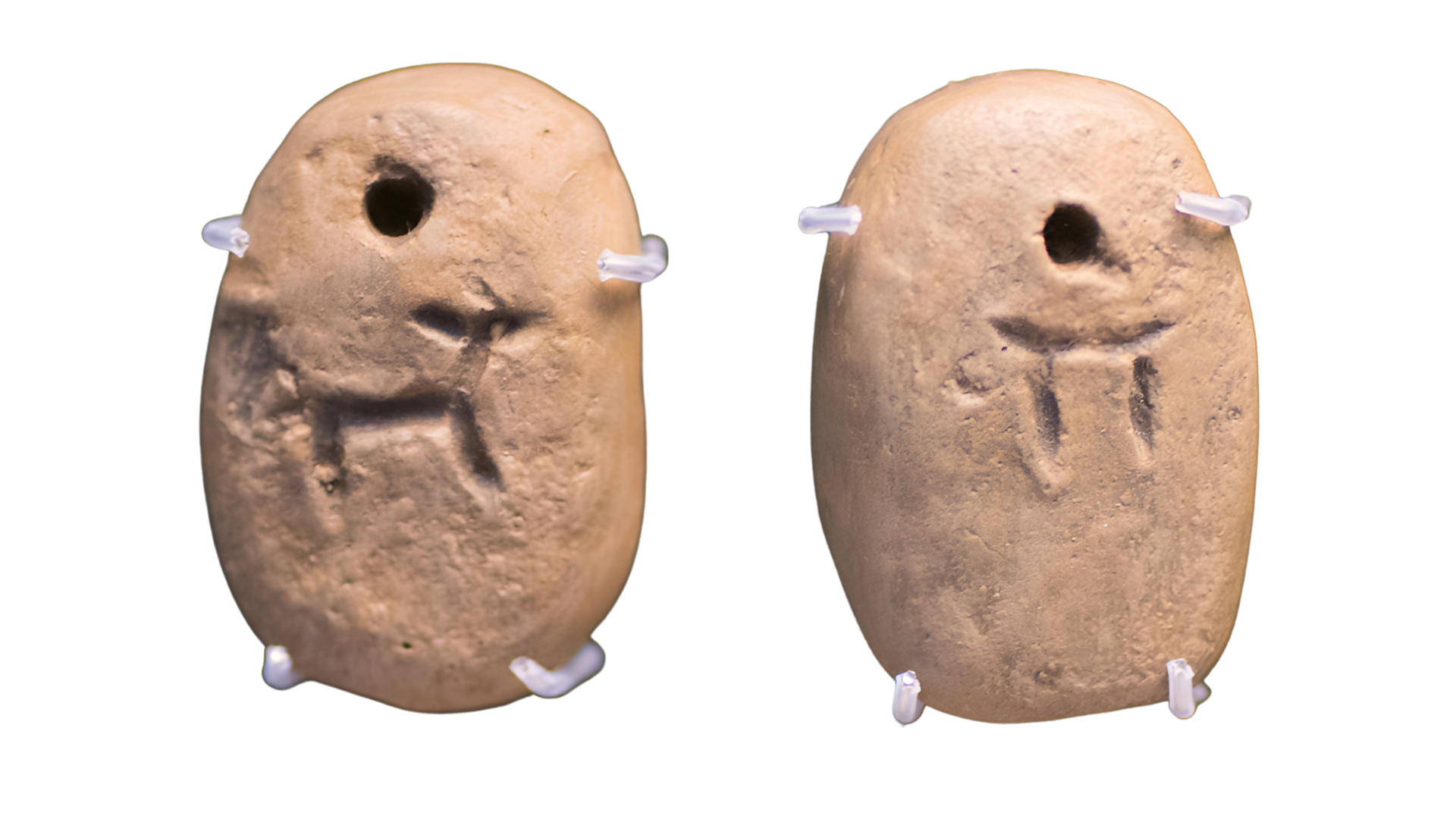
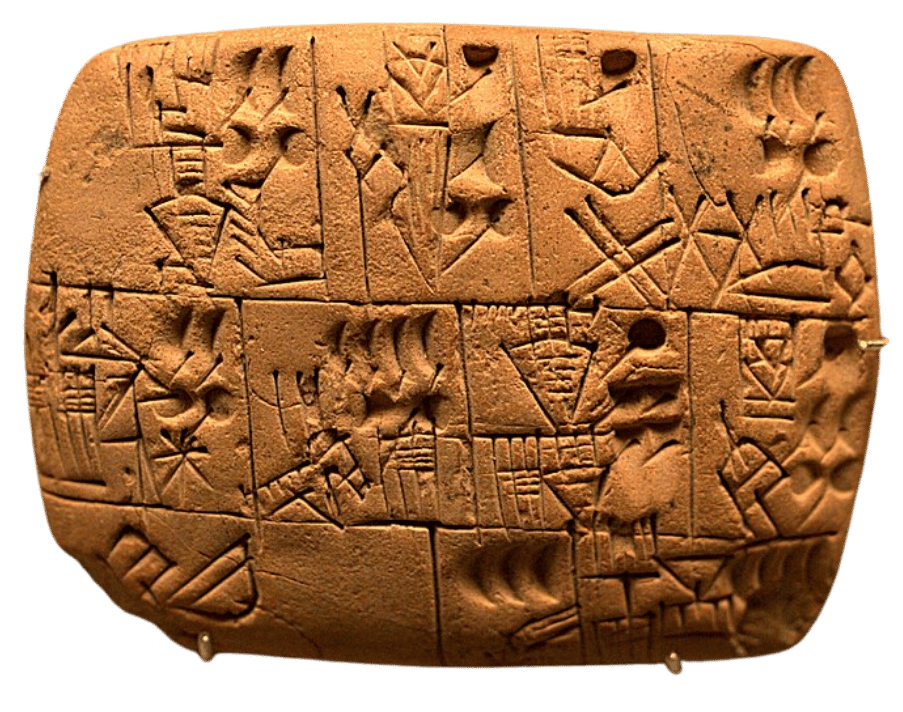
The previous hunter-gather lifestyles which homo sapiens relied on for most of prehistory was dependent on availability in wild plants and animals. Humans were thus mostly nomadic, moving with fluctuations in nature. The introduction of agriculture in fertile regions, however, meant that humans could settle in more permanent communities. Unlike in hunter-gatherer societies where the majority of one’s time and energy was dedicated to subsistence, in agricultural societies, the surplus in food production meant that a division of labour was both possible and necessary. Infrastructure was needed and systems of government to manage it. In this kind of society, record keeping was crucial. Sumerian cuneiform, one of the oldest writing systems in the world, was preceded by a token system used to record transactions of livestock and grain, which used tokens labelled with pictograms sealed by clay balls or ‘bullae’.⁹ The first coherent proto-cuneiform text from around 3100 BCE was of course a record of beer allocations.¹⁰ These kinds of systems later evolved to be used to record things like important dates, royal bloodlines, laws, astrological phenomena and religious doctrines and royal proclamations.
↑
Click here to pause slideshow
Tip: Hover cursor over image to pause slideshow 👆🏻
Watch: Sumer Clay Tablets | Jay MacMichael
Intro
What
Is
Writing?
Birthplace
of
Writing
Children
of
Egypt
Cuneiform:
"Neanderthal
Script"
Oracle
Bones
Extinct
Scripts
Invented
Writing
Punctuation
&
Symbols
Number
Systems
Lessons
From
Writing


Continue to Chapter 2 →
Glossary of terms
Chapter 1
Bulla: a sealed clay envelope used in ancient Mesopotamia to enclose and authenticate tokens representing goods or transactions
Civilisation: a complex human society marked by the development of cities, organized governments, social classes, and often systems of writing and recordkeeping
Full writing system: a writing system capable of representing all the elements of a language, including grammar, vocabulary, and syntax, typically using phonetic symbols
Glottographic: a type of writing system that represents spoken language directly, often using symbols for sounds (phonemes, syllables) or words
Ideogram: a graphic symbol that represents an abstract idea or concept rather than a specific word or sound (e.g., a symbol for “peace” or “danger”)
Language: a structured system of communication using sounds, gestures, or symbols, governed by rules (grammar) and used for human expression and interaction
Logogram: a written character that represents a whole word rather than a single sound or syllable
Modality: the physical or sensory channel through which language is expressed, such as speech, writing, or signing
Morphology: the branch of linguistics that studies the structure and formation of words
Natural language: a language that has developed organically among humans over time, as opposed to constructed or artificial languages
Neolithic: a prehistoric period (beginning around 10,000 BCE) marked by the development of agriculture, permanent settlements, and early symbolic systems
Notation: a system of symbols used to represent information, often in music, math, or linguistics, but not necessarily tied to spoken language
Phoneme: the smallest unit of sound in a language that can distinguish meaning (e.g., /p/ vs. /b/ in "pat" vs. "bat")
Phonology: the study of the sound systems and patterns within a language
Pictogram/Pictograph: a symbol or drawing that represents a physical object or concept, one of the earliest forms of visual communication
Proto-writing: early systems of visual symbols used to convey limited information before the development of full writing systems
Rebus principle: the use of pictures to represent sounds or syllables rather than whole words, often as a step toward phonetic writing
Semasiographic: a system of communication using symbols to convey meaning directly, without representing spoken language (e.g. emojis)
Signing: a form of communication using hand gestures, facial expressions, and body language, typically used in sign languages like ASL
Speech: the vocalized form of language, produced through the coordination of breath, vocal cords, and articulators like the tongue and lips
Syntax: the rules and principles that govern how words are combined to form phrases and sentences in a language
Syllable: a unit of pronunciation typically consisting of a vowel sound alone or with surrounding consonants
Writing: a system of visual symbols used to represent language, typically for communication across space and time
Useful Links
Omniglot - Types of Writing Systems: https://www.omniglot.com/writing/types.htm
OpenEd - Modalities of Language: https://pressbooks.openedmb.ca/wordandsentencestructures/chapter/language-modality/
UCLA - History of the Book, Chapter 2: https://hob.gseis.ucla.edu/HoBCoursebook_Ch_2.html
Footnotes
Chapter 1
1. Dimitrios Meletis and Christina Dürscheid, ‘Writing Systems and Their Use’ in Chiara Gianollo, and Daniel Van Olmen (eds), Trends in Linguistics Studies and Monographs, vol. 369 (Walter de Gruyter GmbH & Co KG 2022), p. 1
2. Rebecca Metcalf, ‘How Many Writing Systems Are There?’, Rubric, 27 June 2024, <https://rubric.com/en-us/how-many-writing-systems> [accessed April 2025]
3. Dimitrios Meletis and Christina Dürscheid, ‘Writing Systems and Their Use’ in Chiara Gianollo and Daniel Van Olmen (eds), Trends in Linguistics Studies and Monographs, vol. 369 (Walter de Gruyter GmbH & Co KG 2022), <https://dx.doi.org/10.1515/9783110757835-006> pp. 14-17
4. Idib, pp. 14-17
5. ‘Rock Art’, Encyclopædia Britannica, 22 April 2025, <https://www.britannica.com/art/rock-art> [accessed April 2025]
6. Christopher Woods, Visible Language: Inventions of Writing in the Ancient Middle East and Beyond, Oriental Institute of the University of Chicago eBooks, 2010, pp. 20-21
7. Brian Fagan and Chris Scarre, Ancient Civilizations, Routledge, 20152015, p. 11
8. Peter T. Daniels, ‘The Invention of Writing’, in Peter T. Daniels and William Bright, The World’s Writing Systems, Oxford University Press, 1996, p. 585
9. Peter T. Daniels, and William Bright, The World’s Writing Systems, Oxford University Press, 1996, pp. 21-23
10. ‘Tablet’, British Museum, <https://www.britishmuseum.org/collection/object/W_1989-0130-4> [accessed April 2025]
Fig. 1.1: Nick Shanks, ‘World alphabets & writing systems’ (2014), Wikimedia Commons, <https://commons.wikimedia.org/wiki/File:World_alphabets_%26_writing_systems.svg> [CC-BY-SA-3, accessed April 2025]
Fig 1.3: ‘Relationship between the three modalities (spoken, signed, written) of language’, (image adjusted, background removed), in Meletis, Dimitrios and Dürscheid, Christina, ‘Writing Systems and Their Use’ in Gianollo, Chiara and Van Olmen, Daniel (eds), Trends in Linguistics Studies and Monographs, vol. 369 (Walter de Gruyter GmbH & Co KG 2022), <https://dx.doi.org/10.1515/9783110757835-006>, accessed from <https://commons.wikimedia.org/wiki/File:Diagram_of_the_spoken,_written,_and_signed_modalities_of_language.svg> [public domain, accessed April 2025]
Fig. 1.4: Lascaux Painting, illustration by @EUX, Wikimedia Commons, <https://upload.wikimedia.org/wikipedia/commons/1/1e/Lascaux_painting.jpg> [public domain, accessed April 2025]
Fig. 1.5: David Schrader, ‘Breakthroughs in Writing’ (© author’s own, 2025)
Fig. 1.6: David Schrader, ‘Sources of Pristine Writing’, based on @Ding Zhiren, blank map world rivers, Wikimedia Commons, <https://commons.wikimedia.org/wiki/File:Blank_map_world_rivers.svg> [CC BY-SA 4.0, accessed May 2025]
Fig. 1.7: Clay Accounting Tokens Susa Louvre, illustration by Nguyen, Marie-Lan, Wikimedia Commons, <https://commons.wikimedia.org/wiki/File:Clay_accounting_tokens_Susa_Louvre_n2.jpg> [CC BY 2.0, accessed April 2025]
Fig. 1.8: Pre-Cuneiform Tags, Susa, illustration by Hudson, Paul, Wikimedia Commons, <https://commons.wikimedia.org/wiki/File:Pre-cuneiform_tags,_Sumer.jpg> [CC BY 2.0, accessed April 2025]
Fig. 1.9: Pictographs recording the allocation of beer, illustration by Kuhn, Jim, Wikimedia Commons, image, <https://commons.wikimedia.org/wiki/File:Pictographs_Recording_the_Allocation_of_Beer_(London,_England).jpg> [CC BY 2.0, accessed April 2025]
Share this page
To the
Top
To the
Bottom