

Home
Ideodyssey
a journey in ideas


Contents
Page
Current
Chapter:
5
Oracle


Play
TRACK 7
Previous
Chapter
Next
Chapter

rigins
Writing
of

Genesis
In another of the world’s cradles of civilisation, the Yellow River Basin (in modern day China), there developed another pristine writing system; what is now commonly referred to as oracle bone script. Based on earlier pictograms, it is the ancestor of modern Chinese characters or ‘Hanzi’ as the system is called in Chinese. Oracle bone script was discovered in the late 19th century when scholars realized that so-called "dragon bones" being sold as medicine were actually turtle shells and animal bones inscribed with ancient logograms dating back to at least the 13th c. BCE. These were used in ancient rituals of divination. Another set of symbols pre-dating these by several millennia are known as the Jiahu symbols. But while they show some similarities to oracle bone inscriptions, it is unlikely that they represented a proper writing system and were most likely pictographic.¹
𑁫
Oracle Bones


Watch: 3000 Year-old ‘Oracle Bone’ | Smithsonian
Click here →
Intro
What
Is
Writing?
Birthplace
of
Writing
Children
of
Egypt
Cuneiform:
"Neanderthal
Script"
Oracle
Bones
Extinct
Scripts
Invented
Writing
Punctuation
&
Symbols
Number
Systems
Lessons
From
Writing


Tip: Hover cursor over image to pause slideshow 👆🏻
← Click image to enlarge
↑
Click here to pause slideshow
According to Chinese myth, Emperor Huangdi (known as the Yellow Emperor) commissioned his historian Cangjie (who according to legend had four eyes) to invent a script to make government records. Cangjie created a series of characters inspired by the footprints of animals and other natural phenomena, which became oracle bone script. It is said that grain rained from the sky, symbolising the knowledge that would nourish civilisation, but the gods and spirits cried, fearing that divine secrets would be revealed to man.²


Discovery
In 1899, Wang Yirong recognized the oracle bone markings as early Chinese writing, leading to further study by scholars like Luo Zhenyu and Wang Guowei. They compared the inscriptions to later Chinese scripts, identifying recurring symbols and linking them to modern characters. By analysing the structure of the texts, which recorded Shang Dynasty divinations, researchers deciphered many characters and uncovered early Chinese grammar, although some symbols remain undeciphered.³


Evolution
Oracle bone script followed the same evolutionary process as Egyptian hieroglyphs and cuneiform, notably starting as pictograms and becoming more abstract over time, with the addition of phonetic components. Its first child system was bronze script, a style used from around 1250 BCE, which was either impressed into clay moulds used to cast bronze ornaments, or simply engraved into them. A further descendant system was seal script, a more intricate style used from around 700 BCE. Characters could be built with a semantic component (often referred to as a radical) alluding to meaning and a phonetic component suggesting pronunciation. This is similar to how determinatives were used in Egyptian hieroglyphs and cuneiform.
Seal script eventually evolved into modern Chinese characters, or regular script as it’s often referred to.⁴ Chinese characters at all stages were typically written vertically, right to left, until the 20th century when it began to be oriented horizontally, left to right as part of modernisation efforts. Vertical writing was originally better suited to writing on bones and later bamboo strips. Modern Chinese writing today is an incredibly complex system with around ten thousand unique characters. However, efforts were made by the Communist government to simplify it in the 1950s with a set of characters referred to as Simplified Chinese, which is used alongside Traditional Chinese characters. Today, the average Chinese speaker has a working knowledge of between four and five thousand unique characters!⁵


Watch: The secret of how Chinese characters work | Gina Marie Elia - Ted-ed
Various forms
Nüshu
A now extinct cousin of modern Chinese characters is the Nüshu syllabary used by Yao women in the Southern province of Hunan from around the 12th century CE. Using a more cursive set of syllabic characters as a cryptic means of communicating among themselves and expressing their social grievances. Its usage was heavily suppressed by the Chinese Communist Party in the 20th century and by the 21st century was functionally extinct despite later efforts to revive it.⁶
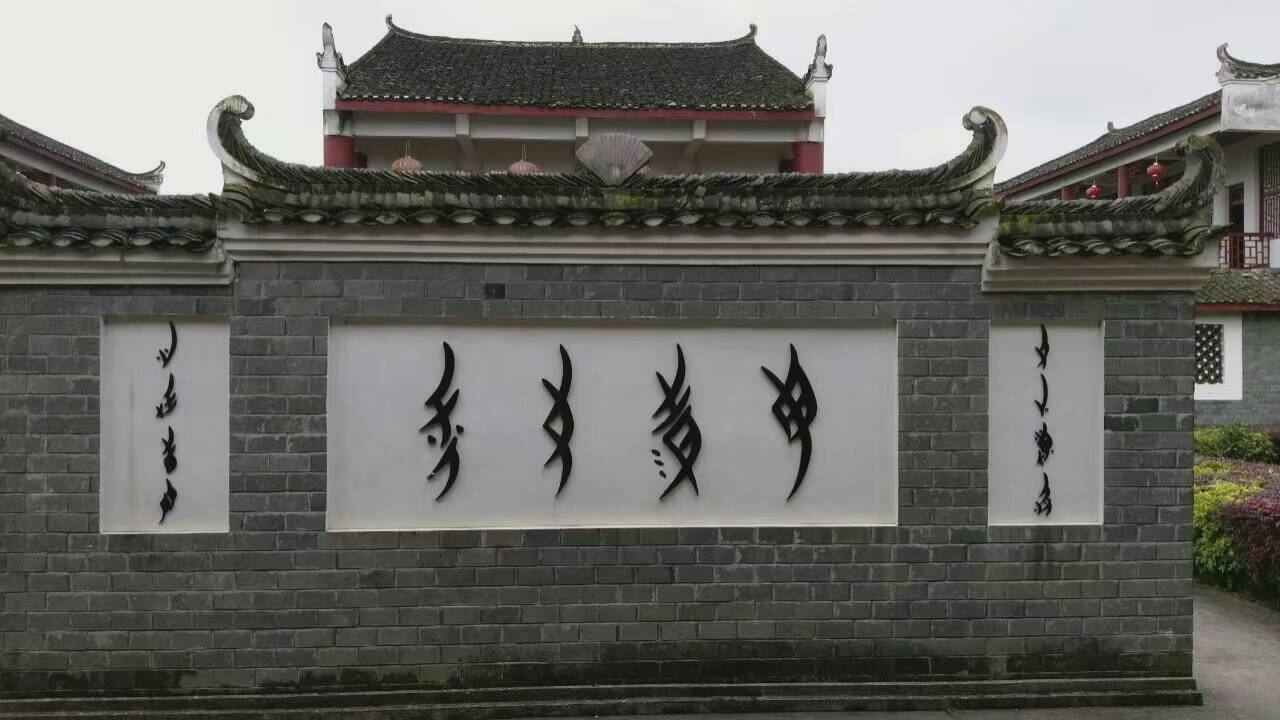
Watch: China’s secret, female-only language | South China Morning Post
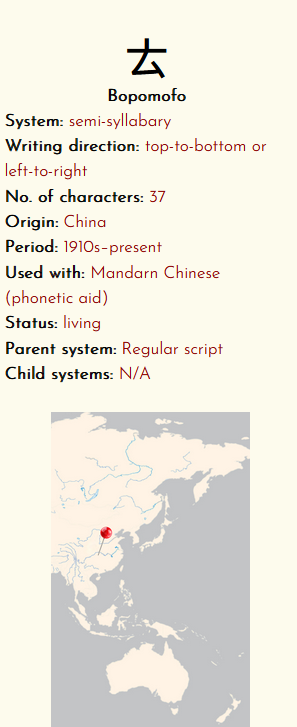
Bopomofo (Zhuyin)
In the early 20th century a phonetic system for transliterating Chinese known as Bopomofo (or Zhuyin) was developed to teach the pronunciation of Mandarin and other Sinitic languages. A semi-syllabary, it consists of phonetic symbols resembling simplified Hanzi symbols with tonal diacritics. Today it is only used to a limited extent (mostly in Taiwan). In mainland China, its use has mostly been replaced by Pinyin (Romanised Chinese).⁷
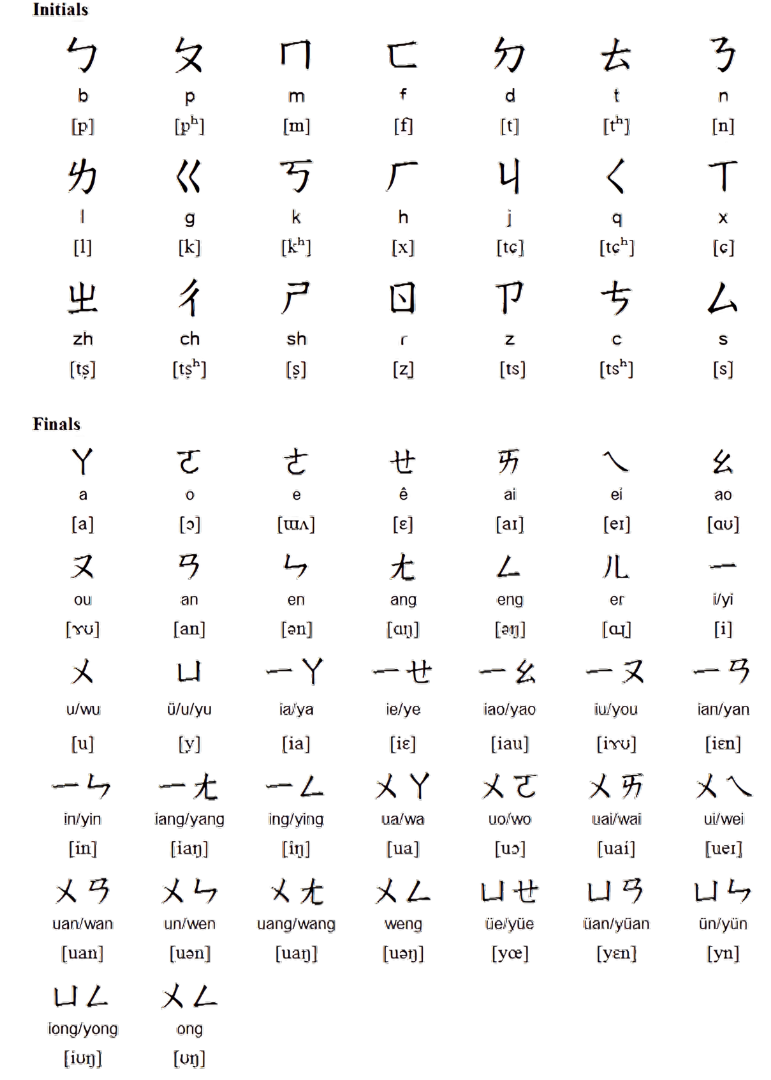
Watch: An Introduction to Zhuyin | Skritter
Spread of Chinese
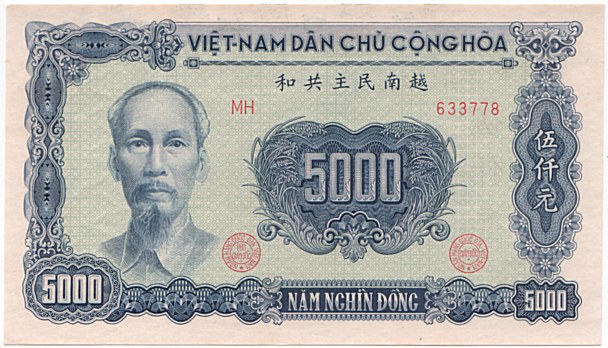
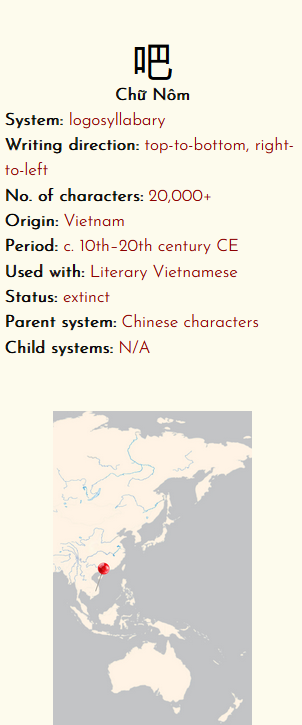
Some of China’s neighbours eventually adopted Chinese writing. By the 1st c. BCE it had spread to Korea (Hanja) and Vietnam (Chữ Hán) and by the 5th c. CE to Japan (Kanji). But many of China’s neighbouring cultures like the Tibetans and Mongolians, eventually opted for simpler and more efficient phonetic scripts descended from Aramaic or Brahmi or invented their own indigenous systems (e.g. Hangul & Kana). A Vietnamese variation of Chinese characters known as Chữ Nôm emerged in the 13th c. CE and lasted until the early 20th century when it was officially replaced by the Latin-based Vietnamese alphabet (Chữ Quốc ngữ), developed by Portuguese missionaries in the 16th century.⁸
Chinese inspiration for Japanese Kana
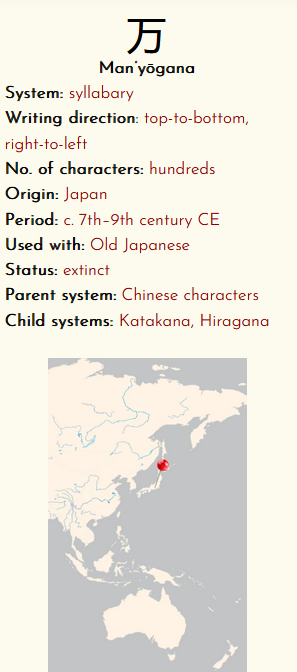
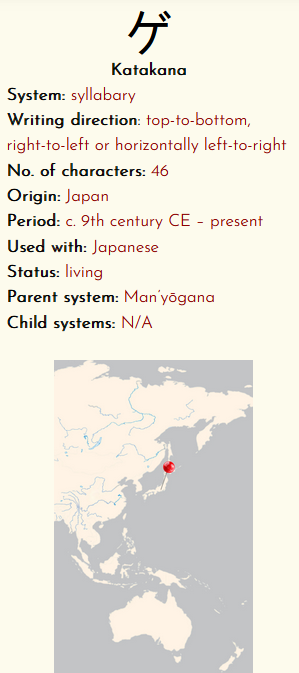
Two systems still in use today that trace their origins directly to Chinese characters are the Japanese Kana systems hiragana and katakana. They evolved (with some intention) from man’yōgana, an early syllabary developed in the 7th century CE that used Chinese characters to represent Japanese sounds. By the 9th century, Buddhist monks and scholars simplified these characters to create katakana, which was used for annotations and foreign words. Around the same time, hiragana emerged as a more fluid and cursive script, originally used by women for literature and personal writing, but is now the standard phonetic script for Japanese with katakana mostly reserved for foreign words. Both kana systems are syllabaries with 46 characters each that mostly follow a consonant-vowel structure (with some exceptions). Kanji (Chinese characters used for Japanese) is still used alongside the kana systems, providing semantic context, while kana indicates pronunciation and grammatical structure. As with Chinese, the Japanese systems were traditionally written vertically right-to-left, but today are more often written horizontally left-to-write to fit more modern, Western conventions.⁹


Watch: Japanese - The Hardest Writing System | NativLang
See: Chart of Chinese Characters
Chinese Descendants
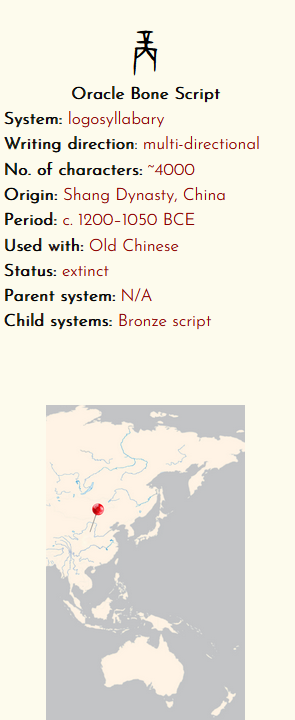
Oracle Bone Script
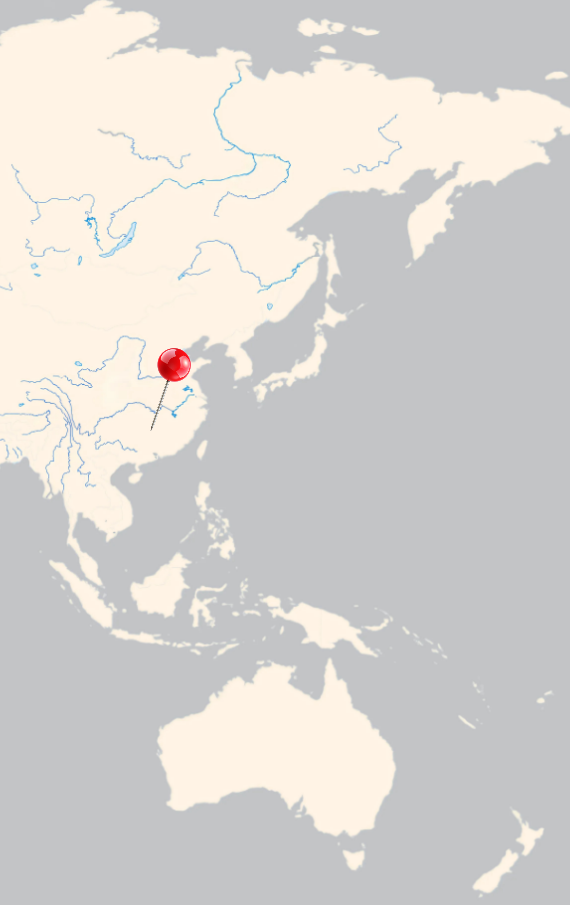
System: logosyllabary
Writing direction: multi-directional
No. of characters: ~4000
Origin: Shang Dynasty, China
Period: c. 1200–1050 BCE
Used with: Old Chinese
Status: extinct
Parent system: N/A
Child systems: Bronze script
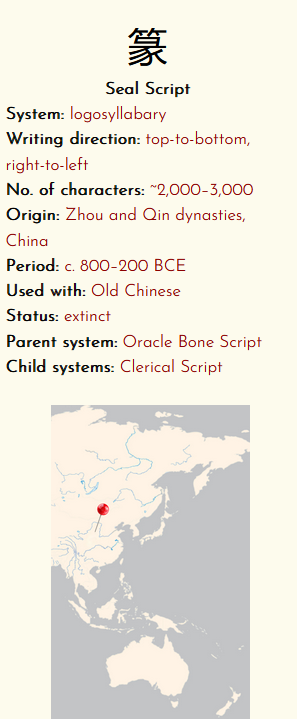
篆
Seal Script
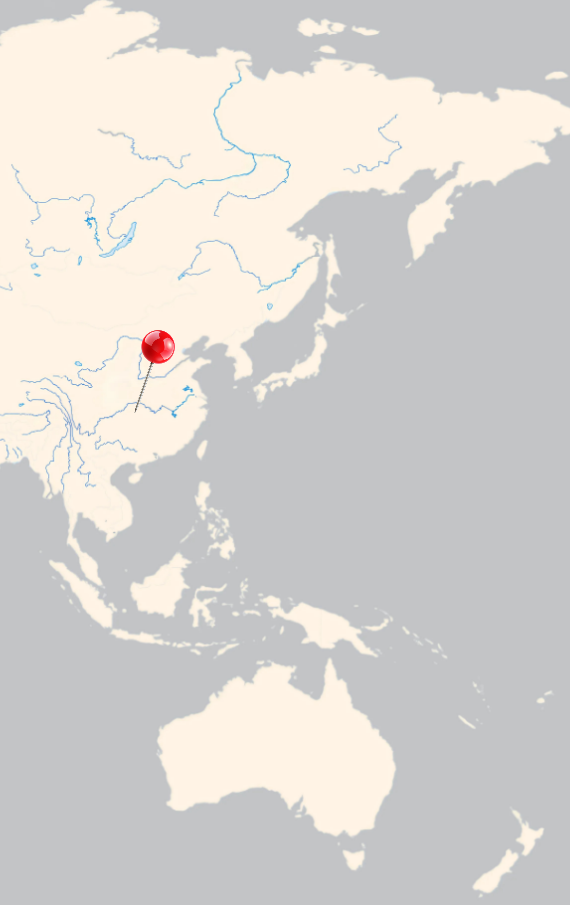
System: logosyllabary
Writing direction: top-to-bottom, right-to-left
No. of characters: ~2,000–3,000
Origin: Zhou and Qin dynasties, China
Period: c. 800–200 BCE
Used with: Old Chinese
Status: extinct
Parent system: Oracle Bone Script
Child systems: Clerical Script
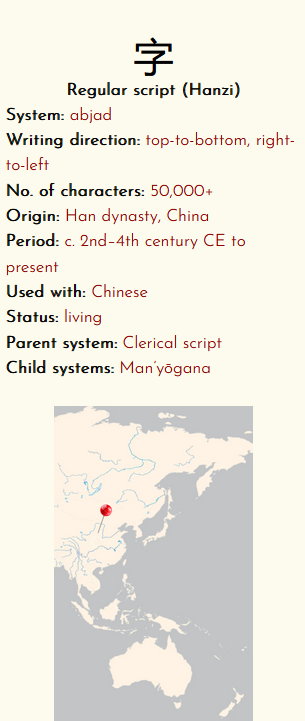
字
Regular script (Hanzi)
System: abjad
Writing direction: top-to-bottom, right-to-left
No. of characters: 50,000+
Origin: Han dynasty, China
Period: c. 2nd–4th century CE to present
Used with: Chinese
Status: living
Parent system: Clerical script
Child systems: Man’yōgana
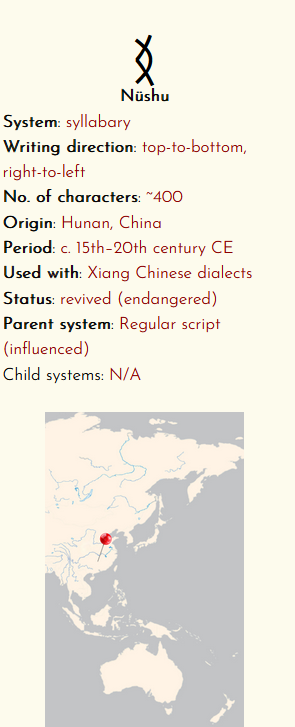
𛆁
Nüshu
System: syllabary
Writing direction: top-to-bottom, right-to-left
No. of characters: ~400
Origin: Hunan, China
Period: c. 15th–20th century CE
Used with: Xiang Chinese dialects
Status: revived (endangered)
Parent system: Regular script (influenced)
Child systems: N/A
ㄊ
Bopomofo
System: semi-syllabary
Writing direction: top-to-bottom or left-to-right
No. of characters: 37
Origin: China
Period: 1910s–present
Used with: Mandarn Chinese (phonetic aid)
Status: living
Parent system: Regular script
Child systems: N/A
吧
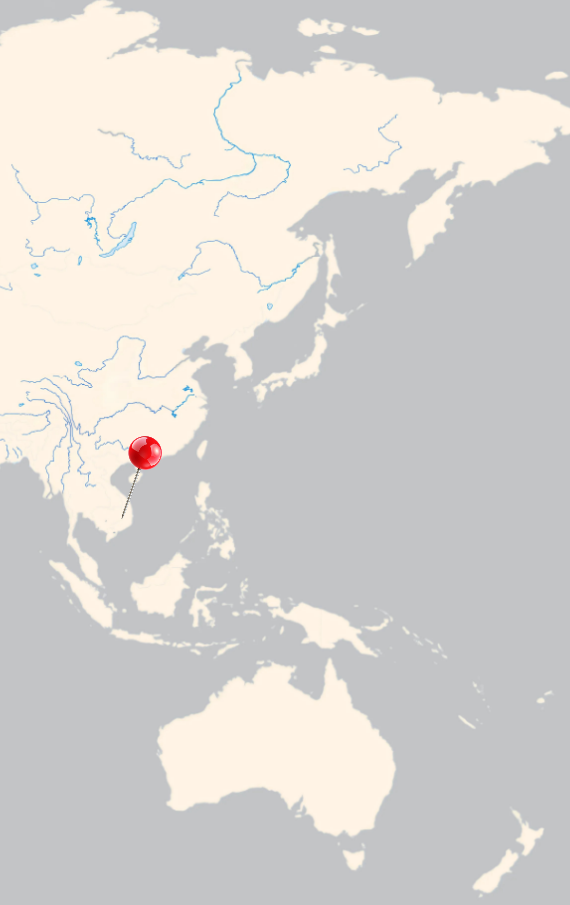
Chữ Nôm
System: logosyllabary
Writing direction: top-to-bottom, right-to-left
No. of characters: 20,000+
Origin: Vietnam
Period: c. 10th–20th century CE
Used with: Literary Vietnamese
Status: extinct
Parent system: Chinese characters
Child systems: N/A
万
Man’yōgana
System: syllabary
Writing direction: top-to-bottom, right-to-left
No. of characters: hundreds
Origin: Japan
Period: c. 7th–9th century CE
Used with: Old Japanese
Status: extinct
Parent system: Chinese characters
Child systems: Katakana, Hiragana
ゲ
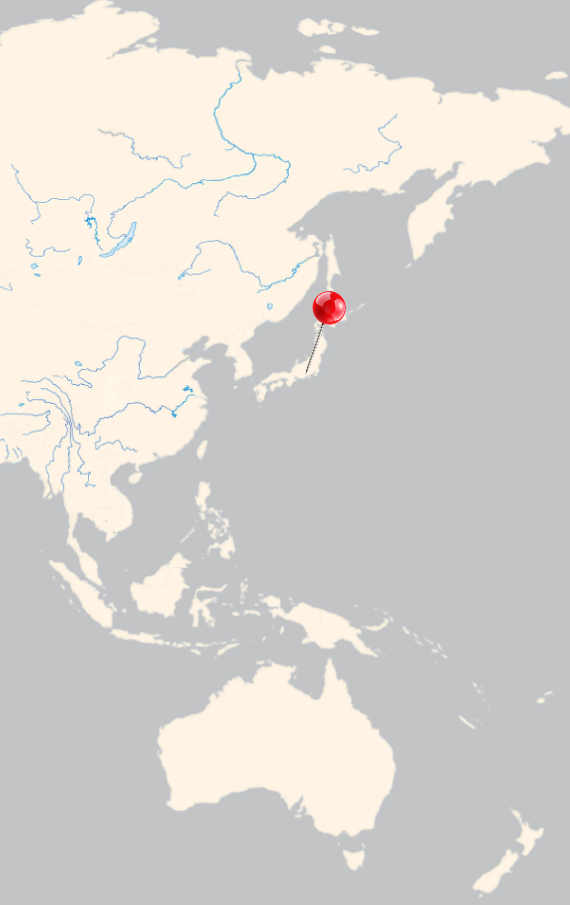
Katakana
System: syllabary
Writing direction: top-to-bottom, right-to-left or horizontally left-to-right
No. of characters: 46
Origin: Japan
Period: c. 9th century CE – present
Used with: Japanese
Status: living
Parent system: Man’yōgana
Child systems: N/A
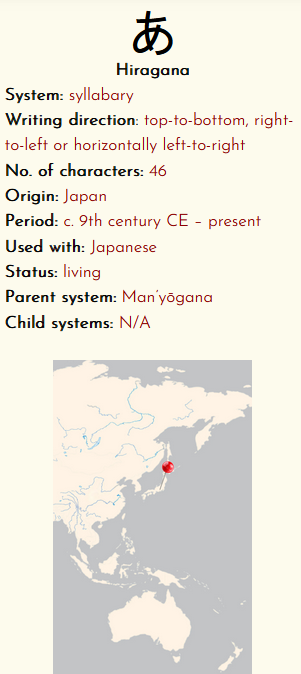
あ
Hiragana
System: syllabary
Writing direction: top-to-bottom, right-to-left or horizontally left-to-right
No. of characters: 46
Origin: Japan
Period: c. 9th century CE – present
Used with: Japanese
Status: living
Parent system: Man’yōgana
Child systems: N/A

Click this symbol on the keyboard to change script
↓
Continue to Chapter 6 →
Glossary of terms
Chapter 5
Radical: a graphical component of a character, especially in logographic systems, used for classification or conveying meaning
Semi-syllabary: a writing system in which some signs represent syllables and others represent individual sounds
Tonal diacritics: marks added to letters to indicate differences in pitch or tone in tonal language
Useful Links
EBSCO – Kana Syllabary: https://www.ebsco.com/research-starters/history/kana-syllabary
Laoshi – Write Your Name in Chinese Characters: https://laoshi.io/name/
Magnifissance – The Story of Chinese Characters: https://magnifissance.com/arts/the-story-of-chinese-characters/
World History – Chinese Writing: https://www.worldhistory.org/Chinese_Writing/
A Simple Explanation of Chinese Characters: https://blog.tutorabcchinese.com/chinese-learning-tips/how-do-chinese-characters-work
Footnotes
Chapter 5
1. William G. Boltz, ‘Early Chinese Writing’ in Peter T. Daniels and William Bright, The World’s Writing Systems, Oxford University Press, 1996, p. 191
2. Mae Hamilton, ‘Cangjie’, Mythopedia, <https://mythopedia.com/topics/cangjie> [accessed April 2025]
3. Geremie R. Barmé, ‘Oracle Bones, That Dangerous Supplement’, China Heritage, <https://chinaheritage.net/journal/oracle-bones-that-dangerous-supplement/> [accessed April 2025]
4. William G. Boltz, ‘The Origin and Early Development of the Chinese Writing System’ in American Oriental Series, vol. 78, American Oriental Society, 1994, p. 68
5. Icy Hu, ‘How Many Chinese Characters Do the Chinese Know on Average?’, Chinese Skill Blog, 29 December 2020, <https://blog.chineseskill.com/2020/12/29/how-many-chinese-characters-do-the-chinese-know-on-average/> [accessed May 2025]
6. Simon Ager, ‘Nushu’, Omniglot, <https://www.omniglot.com/writing/nushu.htm> [accessed April 2025]
7. Zoe Stephens, ‘Bopomofo - What Is It & How Do I Use It?’, LTL Language School, <https://ltl-taiwan.com/bopomofo/> [accessed April 2025]
8. William G. Boltz, ‘Early Chinese Writing’ in Peter T. Daniels and William Bright, The World’s Writing Systems, Oxford University Press, 1996, p. 189
9. Janet S. Smith, ‘Japanese Writing’, in Peter T. Daniels and William Bright, The World’s Writing Systems, Oxford University Press, 1996, pg. 210-212
Fig. 5.1: Jiahu symbol on turtle shell, (background removed, ring added), illustration by @Kcx36, Wikimedia Commons, <https://commons.wikimedia.org/wiki/File:%E6%B2%B3%E5%8D%97%E8%88%9E%E9%98%B3%E8%B4%BE%E6%B9%96%E9%81%97%E5%9D%80-%E5%88%BB%E7%AC%A6%E9%BE%9F%E7%94%B2-%E8%A3%B4%E6%9D%8E%E5%B2%97%E6%96%87%E5%8C%96-%E6%B2%B3%E5%8D%97%E5%8D%9A%E7%89%A9%E9%99%A2.jpg> [CC BY-SA 4.0, accessed April 2025]
Fig. 5.2: Jiahu symbol on turtle shell, (background removed), illustration by @Kcx36, Wikimedia Commons, <https://commons.wikimedia.org/wiki/File:Shang_Inscribed_Ox_Scapula_(for_divination).jpg> [CC BY-SA 4.0, accessed April 2025]
Fig. 5.3: Huangdi, Wikimedia Commons, <https://commons.wikimedia.org/wiki/File:Yellow_Emperor.jpg> [public domain, accessed April 2025]
Fig. 5.3b: Cangjie, Wikimedia Commons, <https://commons.wikimedia.org/wiki/File:Cangjie2.jpg> [public domain, accessed April 2025]
Fig. 5.3c: Wang Yirong, (image enhanced), Wikimedia Commons, <https://commons.wikimedia.org/wiki/File:Wang_Yirong.jpg> [public domain, accessed June 2025]
Fig. 5.3d: Luo Zhenyu, (image enhanced), Wikimedia Commons, <https://commons.wikimedia.org/wiki/File:Luo_Zhenyu1.JPG> [public domain, accessed June 2025]
Fig. 5.4: Seal Script, illustration by @Gsklee, Wikimedia Commons, <https://commons.wikimedia.org/wiki/File:XiaozhuanQinquan_sized.jpg> [public domain, accessed April 2025]
Fig. 5.5: ‘Figure 1’, (background removed), in Yu Tzu Wu, Eric Fujiwara and Carlos Kenichi Suzuki, ‘Image-Based Radical Identification in Chinese Characters’, in vol. 13, no. 4, 2023, <https://doi.org/10.3390/app13042163> [CC BY 4.0, accessed April 2025]
Fig. 5.6: @Bustamante.tung, Nushu Script Museum, Hunan, China, , Wikimedia Commons, <https://commons.wikimedia.org/wiki/File:Nvshu_script_museum.jpg> [CC BY 4.0, accessed April 2025]
Fig. 5.7: Bopomofo Letters, (background removed), ‘Zhuyin Fuhao/Bopomofo’, Wikimedia Commons, <https://www.omniglot.com/writing/zhuyin.htm> [© with permission, accessed April 2025]
Fig. 5.8: 5000 dong banknote, Wikimedia Commons, <https://commons.wikimedia.org/wiki/File:Vietnam_5000_Dong_1953_Averse.jpg> [public domain, accessed May 2025]
Fig. 5.9: Hiragana, (image cropped and enhanced, background removed), Wikimedia Commons, <https://commons.wikimedia.org/wiki/File:%E5%B9%B3%E5%81%87%E5%90%8D%E6%B8%85%E9%9F%B3%E4%B8%80%E8%A6%BD.jpg> [public domain, accessed May 2025]
Fig. 5.10: Katakana, (image cropped and enhanced, background removed), Wikimedia Commons, <https://commons.wikimedia.org/wiki/File:%E7%89%87%E5%81%87%E5%90%8D%E6%B8%85%E9%9F%B3%E4%B8%80%E8%A6%BD.jpg> [public domain, accessed May 2025]
Fig. 5.11: Katakana and Man’yōgana, (image enhanced), Wikimedia Commons, <https://commons.wikimedia.org/wiki/File:Katakana_origine.png> [CC BY-SA 3.0, accessed April 2025]
Fig. 5.12: Schrader, David, ‘Japanese translation’ (© author’s own, 2025), Google Translate, <https://translate.google.com>
Share this page
To the
Top
To the
Bottom