


Flags Pt. 1
- David Schrader
- Aug 26, 2025
- 15 min read

Updated: 20 minutes ago
Contents

Introduction

As you curve your way around the Avenue de la Paix (Avenue of Peace) from Lake Geneva, looking to your right, you will witness a brilliant display - 193 national flags neatly lined along a beautifully manicured lawn leading to the entrance of the headquarters of the United Nations, each flag representing one of its member states. Using pieces of patterned cloth to represent nations is an idea we take completely for granted nowadays. And while this modern conception of the flag isn't as old as you might think, today, flags serve many purposes that go far beyond defining nations. They are used to represent everything about our identities, from our faith to our politics, and even our sexuality. Flags are powerful tools of communication that have the power to both unify and divide. So come on this fascinating journey to explore the idea of the flag.
Origins
Long before the concept of making flags from cloth, societies often used so-called ‘vexilloids’ as symbolic representations. From the Latin vexillum, referring to a Roman military banner, vexiloids are essentially objects other than a flag that serve a similar function. Ancient civilisations such as the Egyptians, Akkadians and Persians, for example, often used decorative staffs to represent their regions, empires or gods in battles or processions. Cloth was later implemented on military banners to designate different formations and locate important figures. This started with the Chinese and was later adopted by empires in the West. One of the most famous of these is the Roman 'vexillum' or 'standard', carried by Roman legions into battle. The word vexillum itself derives from the Latin velum, meaning ‘little sail’, due to its resemblance to the sails on a ship.

Heraldry

It was only in the Middle Ages that flags in the form that we understand them today began to emerge in Europe. They were influenced by medieval heraldry, where symbols were used to identify nobility and royal houses. These symbols were then used on the flags or banners of duchies, kingdoms, and sometimes empires. But not every banner at the time was based on heraldry. For example, the raven banner of the Norse (Vikings) featured pagan iconography. In fact, the English word flag may itself derive from the Norse word flaka, meaning to ‘flutter’ or ‘flap’.
Medieval banners


Early European Flags
The modern flag representing nation-states emerged with the rise of nationalism in Europe from the 17th century onwards. States were increasingly forming based not on a nobleman’s territorial boundaries, but on nations - collections of people unified by a shared identity in language, culture, history, etc. These new nation-states thus needed symbols that reflected nationhood. Some of these symbols had deep historic roots, for example the flag of Denmark (Dannebrog), the oldest continuously used national flag in the world. According to legend, it fell from the sky during the Battle of Lindanise in 1219 between the Danes and Estonians, and was subsequently adopted as their national symbol. Whatever the real origin is, the cross on the flag symbolises the Christianisation of the Danes, and was made the official flag of the State of Denmark in 1625.


Another early national flag is the English flag, officially adopted in 1552. It features the St. George’s Cross, which had been a common symbol for English soldiers for centuries, who wore it on their armour and flew it as a naval ensign while on crusade from the 12th century onwards.
Europe's oldest continually used flags


The oldest tricolour flag in continuous use is the Dutch flag, adopted in 1575. It was based on The Prince's Flag of Dutch revolutionaries who supported Prince William of Orange in his revolt against the Habsburg rulers. It originally featured an orange stripe rather than the current red. The Prince’s Flag also went on to inspire the flag of the Orange Free State (Boer Republic, dissolved in 1902) and Apartheid-era South Africa (abolished in 1994). Today the Prince's flag is associated with far-right movements in both the Netherlands and South Africa.
Derivatives of the Prince's Flag

Thank the French (merci!)

Many of Europe’s younger flags were the result of the nationalist and liberal revolutions that swept the continent in the 18th and 19th centuries. These movements needed simple flags representing their populist sentiment. The main inspiration for them was the French flag, which replaced the banner of the House of Bourbon in 1794 after the monarchy was abolished during the French Revolution. The three stripes supposedly originally represented the people of Paris (red and blue) and the monarchy (white) before its abolition, although the colours are now often used to represent the national motto of liberté, équalité, fraternité.

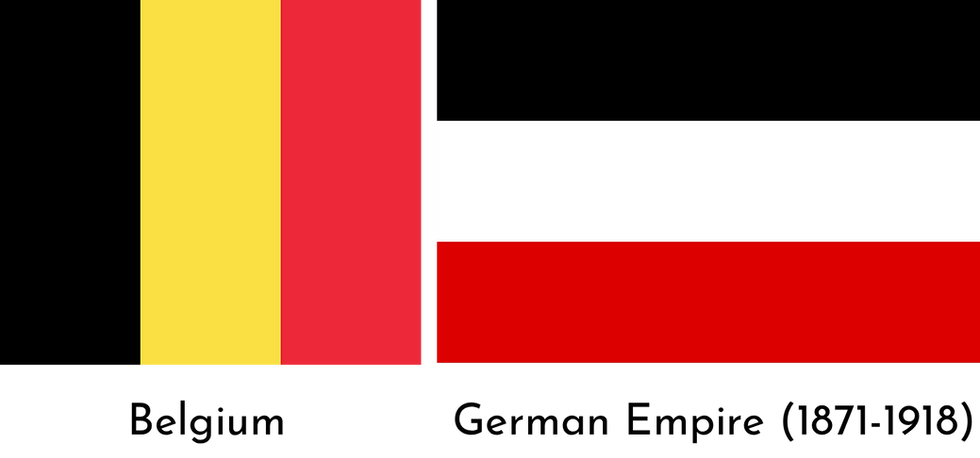
The flag was, however, ultimately inspired by the Dutch tricolour flag, being a literal rotation of it. Other European states, such as Belgium, later followed the French example, with their own vertical tricolours. Others followed the Dutch example, adopting horizontal tricolours, for example, Germany (originally white, black and red). These simple European flag patterns later went on to inspire the flags of a swathe of the world’s nations establishing their independence and statehood for the first time in the 19th and 20th centuries.
Influence
The designs of many flags have been inspired by those of neighbouring countries or those that have strong cultural influences.
Pan-Slavic Flags
As we previously learnt, the Dutch flag influenced the French tricolore, but another flag that it influenced was the Russian flag - the oldest Slavic flag. It was adopted by Peter the Great in 1696, who had spent a long sojourn in the Netherlands and was heavily influenced by Dutch society. So he thought he might claim the flag for his own empire, simply switching the place of the colours. The Russian flag then went on to influence the colour scheme of many other Slavic countries, with the colours red, white and blue being adopted as the pan-Slavic colours by the Pan-Slavic Congress in 1848. Ironically, at that time, Russia was seen as the protector of the Slavic peoples in Eastern Europe.

Nordic Brotherhood
You may have also noticed that all the Nordic countries, from Iceland to Finland, share the same style cross (referred to as the ‘Nordic Cross’). That’s because they were all inspired by the Danish flag (Denmark once being the region's hegemon), and like Denmark, wanted their flags to reflect their conversion from paganism to Christianity. Remnants of this Nordic influence can also be seen in the local flags of former Nordic colonies such as the Shetland and Orkney Islands (now part of Scotland).


Pan-Arab Flags

Have you ever wondered why so many countries in the Middle East use the combination of black, white, green, and red? Well, it's because these are the pan-Arab colours, which go back to the Arab revolt of 1916 against the Ottomans. The colours they used were inspired by the colours associated with three major historical caliphates - Abbasid (black), Umayyad (white), and Fatimid (green). A red triangle was used to represent the revolters themselves and to an extent, sympathetic Ottomans.
Flags of Communist/Socialist States

The flags of communist and socialist countries, both current and defunct, share many features that were ultimately inspired by the flag of the now-dissolved Soviet Union. These include heavy use of the colour red (the colour of socialism), a star representing the ruling party and in the Soviet sphere of influence, the hammer and sickle. The only current exception to this is the flag of Laos, which features a moon rather than a star. In former socialist states, displaying non-socialist national flags was illegal and severely punished as they were associated with independence and democratic movements.
Union Flag/Union Jack

If you look at a map chart, you’ll also notice that many feature the British flag, often referred to as the Union Flag or Union Jack. The first Union Flag was formed by the combination of the flags of the English (St. George’s Cross) and Scottish (St. Andrew’s Cross) with the union between England and Scotland in the 17th century. The flag of the Irish (St. Patrick’s Cross) was later added after the Acts of Union of 1800 merged the Kingdoms of Great Britain with the Kingdom of Ireland. You may be wondering why the crosses on the Scottish and Irish flags were diagonal (known as a saltire). Well, this is because St. Andrew and St. Patrick, like many martyrs, were supposedly crucified on this type of cross. The Welsh flag does not feature on the British flag because it had already been unified with England before the Union with Scotland. The flags of many current or former British colonies feature the Union Flag in the top left corner.


Motifs
Crosses
Crosses are found on many flags around the world, not just those with the Union Jack or from Northern Europe. In fact, 11% of all national flags feature a cross of some sort, reflecting these nations’ Christian heritage or that of their colonisers. These include, among many others, the flags of Georgia, Greece, Malta, and of course the Vatican City.

Celestial Bodies
Another common flag motif is celestial symbols - the stars, the sun and the moon. In fact, more than 30% of national flags contain at least one star. Sometimes they represent states (e.g. USA) or provinces (e.g. Venezuela), while on others, the people, government or revolution, etc. Some flags include whole constellations, with the most common being the Southern Cross, featured on the flags of Australia, New Zealand, Papua New Guinea, Tokelau, Samoa and Brazil. The sun is found on the flags of Argentina, Uruguay, Japan, the Philippines, Malawi, Kazakhstan, Namibia and Rwanda, among others. While the moon is found on the flags of Nepal, Laos and Palau, as well as in crescent shape on the flags of 15 (predominantly Muslim) countries, which we'll explore further on.


Eagle
Many flags feature birds of various species, but the most common is, without a doubt, the eagle, which also features on many national emblems. As a symbol of power and strength, the eagle was often used as an imperial symbol throughout history, including by the Romans, Germany and Russia. Flags that feature eagles today include Albania, Montenegro, Mexico, Moldova, Zambia, Ecuador, Egypt and Romania.
Weapons
Many flags feature weapons. Often, this is due to cultural significance or to pay homage to historical conflicts or struggles.
On the more subtle side of things are flags like the Kenyan flag with spears and traditional Maasai shield, representing their tribal heritage and defence of freedom, and the Guatemalan flag with crossed rifles representing their war of independence from 1821.

The flags of Angola and Saudi Arabia feature weapons that are slightly more eye-catching. The Angolan flag features a star and gear wheel along with a machete representing both the peasantry of the country and their armed struggle against their Portuguese colonisers. The Saudi flag, meanwhile, features its national symbol, the sabre, beneath a Shahada (Islamic declaration of faith) representing the militancy of their faith.

But the flag with perhaps the most striking depiction of a weapon is that of Mozambique, which features an AK-47 complete with fixed bayonet. It represents the country's struggles for independence and vigilance in the face of threats.

Colour
Colour is perhaps the most important element of a flag. Colours carry deep symbolic relevance while giving a flag aesthetic appeal. But why are some colours so popular, while others are scarcely used at all?
Trivia time!
So why are these colours the most common?
And why, on the other hand, are these colours so uncommon?
Orange features relatively rarely on national flags - approximately 4% to be precise. Orange is technically a combination of red and yellow and was only differentiated as a separate colour in the English language around 500 years ago. This is due to the colour actually occurring quite rarely in nature. The colour is named after the fruit of the same name, after it was introduced into Europe from Asia.
Purple was historically an incredibly expensive dye, made from crushed sea snails - the word purple itself comes from the Greek porphura, referring to a specific species. This is why the colour was worn almost exclusively by the aristocracy, and where we get the expression “born in the purple”. While purple is no longer an expensive colour today (thanks to synthetic dyes), most national colours and flags were designed in a time when it still was. Therefore, only two national flags today include the colour in minor detail: Dominica and the Northern Mariana Islands.

Pink, meanwhile, is technically just a light shade of red, and the two weren’t historically differentiated. The word pink itself is only about 500 years old, deriving from a family of flowers known as ‘the pinks’. The colour that we would today call ‘pink’ wasn’t always popular in the past, and certainly didn’t have the same connotations that it has now. This may explain why not a single national flag includes the colour.
Brown, like pink, doesn’t feature on any national flags, and it’s not hard to imagine why. Its symbology can be associated with the earth, but also with, well, dirtiness...
Simplicity
Many flag designs are as simple as a few coloured stripes, which often cause confusion when differentiating them from similar ones.
However, despite the simplicity of these flag layouts, they are no less symbolically relevant, instead telling stories through their colours. For example, the colours on the modern Irish flag symbolise the country's turbulent religious history, with green standing for Catholics, orange for Protestants, and white for peace between them. The same colours on the flag of Côte d'Ivoire, meanwhile, represent growth (orange), unity (white) and hope (green).
Another example is the Ukrainian flag, whose colours have historical relevance dating back more than one thousand years, when it was used by the rulers of Kyiv. Today, it is said to represent a blue sky over yellow fields and is an enduring symbol of their historic fight for independence.

Can you match these flags correctly? Drag them to the correct place if you can!
Distinctive Flags
Many flags do, on the other hand, feature intricate patterns and symbols that have fascinating backstories, setting them apart from the rest.
Here are some of the contenders for most unique national flag:
1. Bhutan
From the snowy Himalayas comes the flag of the tiny Buddhist kingdom of Bhutan. The flag features diagonal yellow and orange halves, representing the king and the Buddha respectively. On top lies a white dragon known in Bhutanese folklore as the Druk. It is said that when thunder occurs, it is the roar of the Druk. The Druk also symbolises wealth, hence why on the flag the creature is seen clutching jewels in its claws.

2. Brunei
Brunei’s flag is bold and full of symbolism. The yellow background, less common on flags, stands for the sultan, while the black and white stripes represent the country’s senior ministers. At the centre is a red crest representing Islam, a parasol for the monarchy, and two hands symbolising protection.

3. Eswatini
The flag of Eswatini is one of the most striking in Africa. It features a large shield and two spears across the centre, symbolising protection from enemies. The shield is black and white, standing for unity between people of different races. Behind it, bold stripes of blue, yellow, and red represent peace, natural resources, and past battles.

4. Mongolia
Vertical red stripes represent freedom, prosperity and progress, while a blue stripe represents the eternal blue sky. But if the colour scheme and shape of the Mongolian flag are nothing to write home about, its core symbol, the Soyombo, certainly is. The Soyombo is the national symbol of Mongolia and has a history that goes back more than 500 years. If you look carefully, you’ll see it features 10 symbolic elements, including the sun, fire, a spear, taijitu (yin-yang) and the walls of a fort, just to name a few. Now that’s a lot to unpack!

5. Nepal
Another Himalayan contender for most unique flag is Nepal. First and foremost, for being the only triangular national flag in the world, which was a common trend for many Asian nations in the past. It features both the sun and moon representing longevity, with its red background and blue trim representing bravery and harmony respectively.

6. North Macedonia
North Macedonia’s flag is strikingly bright, featuring a starburst sun with eight rays stretching across a red field. The design is based on a symbol known as the Star of Verghina, originally used by Alexander the Great and his father Phillip II as their dynastic symbol. The sun is an ancient symbol, long associated with the region’s history. However, the Greeks consider claims to ancient Macedonian heritage by present-day (Slavic) Macedonians as appropriation. This already led to the Macedonians changing their flag slightly in 1995 and even their name from Macedonia to North Macedonia in 2019. Nevertheless, the bold design and history make it one of the most eye-catching flags in the world.

7. Papua New Guinea
From the tropics comes the flag of the humble nation of Papua New Guinea. It features a yellow Kumul or Raggiana bird-of-paradise and the Southern Cross constellation over the national colours of red and black placed diagonally. These colours are inspired by the colours of the flag of the German Empire, which colonised the country until 1919.

8. South Korea
The flag of South Korea, known as the Taegeukgi, is deceptively simple at first glance, but it’s packed with symbolism. At its centre sits the taegeuk, a red and blue yin-yang symbol representing balance in the universe - red for positive forces, blue for negative. Surrounding it are four black trigrams deriving from the I Ching, each representing a different natural element and cosmic principle: heaven, earth, fire, and water. The white background signifies peace and purity.

9. Sri Lanka
Sri Lanka’s flag is loaded with meaning. The golden lion holding a sword stands for bravery, and the native Sinhalese people, while the four leaves in the corners are symbols of Buddhism. The orange and green stripes represent the Tamil and Muslim communities, and the yellow border ties the whole flag together as a symbol of unity.

10. Tibet
While no longer officially recognised as a national flag since China’s annexation of the country in 1950, the Tibetan flag is a strong contender for world’s most unique. It features everything you want in a flag: snow lions, jewels representing Buddhist tenets, a snow-clad mountain, colourful rays and of course the sun. The six red rays blaze atop a blue sky, representing the six ancestral tribes of Tibet.

11. Uganda
Uganda’s flag is instantly recognisable with its bold black, yellow, and red stripes. At the centre stands a grey crested crane, the country’s national bird, known for its elegance and peaceful nature. The bird’s raised leg symbolises forward movement, while the colours represent the people, sunshine, and brotherhood.

12. Wales
The Welsh flag features simple green and white lines dominated by a giant red dragon. The red dragon has been a Welsh national symbol since at least the 5th century, when Briton kings borrowed the image from Roman standards, which likely in turn borrowed it from the Dacians. However, a 9th-century legend from the Historia Brittonum claims that while building a fort, the Briton king Vortigen was approached by the legendary druid Merlin and told to dig up two dragons - one red and one white. The red dragon represented the Celtic Britons, while the white dragon represented the Anglo-Saxons. The two dragons engaged in a ferocious battle, whereby the red dragon defeated its opponent. Merlin henceforth prophesied that the Britons would expel the Anglo-Saxons from Britain.

Flag Poll
Image credits:
Fig. 1: @Amin, United Nations Office at Geneva Flags, Wikimedia Commons, <https://commons.wikimedia.org/wiki/File:United_Nations_Office_at_Geneva_Flags.jpg> [CC BY-SA 4.0, accessed August 2026]
Fig. 2: @Conay, Buckingham Palace - Royal Standard, Wikimedia Commons, <https://commons.wikimedia.org/wiki/File:Buckingham_Palace_-_Royal_Standard.jpg> [CC BY-SA 3.0, accessed August 2026]
Fig. 3: Christian August Lorentzen, Danmarks flag 1219 Lorentzen, Wikimedia Commons, <https://commons.wikimedia.org/wiki/File:Danmarks_flag_1219_Lorentzen.jpg> [Public domain, accessed August 2026]
Fig. 4: Miniature of an Earl of Lancaster with St. George, Wikimedia Commons, <https://commons.wikimedia.org/wiki/File:BodleianDouce231Fol1rEdCrouchbackAndStGeorge.jpg> [Public domain, accessed August 2026]
Fig. 5: The Noord-Nieuwland in Table Bay, 1762, Wikimedia Commons, https://commons.wikimedia.org/wiki/File:Anonymous_The_Noord-Nieuwland_in_Table_Bay,_1762.jpg [Public domain, accessed August 2026]
Fig. 6: Eugène Delacroix, Liberty Leading the People, Wikimedia Commons, <https://commons.wikimedia.org/wiki/File:La_Libert%C3%A9_guidant_le_peuple_-Eug%C3%A8ne_Delacroix-Mus%C3%A9e_du_Louvre_Peintures_RF_129-_apr%C3%A8s_restauration_2024.jpg> [Public domain, accessed August 2026]
Fig. 7: Balthasar Gebhardt, Entry of the wedding procession of Sigismund III Vasa into Cracow (detail), Wikimedia Commons, <https://commons.wikimedia.org/wiki/File:Entry_of_the_wedding_procession_of_Sigismund_III_Vasa_into_Cracow_(detail).jpg> [Public domain, accessed August 2026]
Fig. 8: @miguelb, Nordic flags (inverted), Wikimedia Commons, <https://commons.wikimedia.org/wiki/File:Nordic_flags_(inverted).jpg> [CC BY-SA 2.5, accessed August 2026]
Fig. 9: @Mus'ab, The flag of Arab Revolt in Martyrs' Memorial, Amman, Jordan, Wikimedia Commons, <https://commons.wikimedia.org/wiki/File:%D8%B9%D9%84%D9%85_%D8%A7%D9%84%D8%AB%D9%88%D8%B1%D8%A9_%D8%A7%D9%84%D8%B9%D8%B1%D8%A8%D9%8A%D8%A9_%D8%A7%D9%84%D9%83%D8%A8%D8%B1%D9%89_%D9%81%D9%8A_%D9%85%D8%AA%D8%AD%D9%81_%D8%B5%D8%B1%D8%AD_%D8%A7%D9%84%D8%B4%D9%87%D9%8A%D8%AF.jpg> [CC BY-SA 3.0, accessed August 2026]
Fig. 10: Isaak Brodsky, Vladimir Lenin on a Tribune 1 May 1920, Wikimedia Commons, <https://commons.wikimedia.org/wiki/File:Vladimir_Lenin_1_May_1920_by_Isaak_Brodsky.jpg> [Public domain, accessed August 2026]
Fig. 11: Zaricor Flag Collection, British flag flown from HMS Spartiate during the Battle of Trafalgar, Wikimedia Commons, <https://commons.wikimedia.org/wiki/File:British_flag_flown_from_HMS_Spartiate_during_the_Battle_of_Trafalgar.jpg> [Public domain, accessed August 2026]
Academic Sources:
Websites:
‘The American Flag’, USA.gov, https://www.usa.gov/flag [accessed August 2026]
‘The Color Pink’, HunterLab, https://www.hunterlab.com/blog/the-color-pink/ [accessed August 2025]
‘Dannebrog 800 years’, Denmark.dk, https://denmark.dk/people-and-culture/dannebrog-800-years [accessed August 2026]
‘The Flag’, Kenya Embassy Stockholm, <url?id=39> [accessed August 2026]
‘Flag Colour Statistics’, Flag Lookup, https://flaglookup.com/statistics [accessed August 2025]
‘Flag Colour Statistics’, Flag Lookup, https://flaglookup.com/statistics [accessed August 2026]
‘Flag Heraldry’, Britannica, https://www.britannica.com/topic/flag-heraldry [accessed August 2025]
‘Flag of Angola’, Flagpedia, https://flagpedia.net/angola [accessed August 2026]
‘Flag of Bhutan’, Druk Asia, https://www.drukasia.com/blog/flag-bhutan/ [accessed August 2026]
‘Flag of Brunei Darussalam’, WorldAtlas, <url?id=49> [accessed August 2026]
‘Flag of Côte d'Ivoire’, Britannica, https://www.britannica.com/topic/flag-of-Cote-dIvoire [accessed August 2026]
‘Flag of Eswatini’, WorldAtlas, https://www.worldatlas.com/flags/eswatini [accessed August 2026]
‘Flag of France: A Brief History’, Flagmakers, https://www.flagmakers.co.uk/wp-content/uploads/Flag-of-France-A-Brief-History-Download.pdf/ [accessed August 2026]
‘Flag of Guatemala’, Britannica, https://www.britannica.com/topic/flag-of-Guatemala [accessed August 2026]
‘Flag of Ireland’, Britannica, https://www.britannica.com/topic/flag-of-Ireland [accessed August 2026]
‘Flag of Mozambique’, Flagpedia, https://flagpedia.net/mozambique [accessed August 2026]
‘Flag of Nepal’, Britannica, https://www.britannica.com/topic/flag-of-Nepal [accessed August 2026]
‘Flag of North Macedonia’, Britannica, https://www.britannica.com/topic/flag-of-North-Macedonia [accessed August 2026]
‘Flag of Russia’, Britannica, https://www.britannica.com/topic/flag-of-Russia [accessed August 2026]
‘Flag of the Netherlands’, Royal House of the Netherlands, <url?id=22> [accessed August 2026]
‘Flag of Uganda’, Britannica, https://www.britannica.com/topic/flag-of-Uganda [accessed August 2026]
‘Flag of Ukraine’, Britannica, https://www.britannica.com/topic/flag-of-Ukraine [accessed August 2026]
‘Flag of Venezuela’, Britannica, https://www.britannica.com/topic/flag-of-Venezuela [accessed August 2026]
‘History of the Colour Orange’, Arts and Collections, https://www.artsandcollections.com/article/a-history-of-the-colour-orange/ [accessed August 2025]
‘The History of the St George Flag’, Flagpoles, https://flagpoles.co.uk/the-history-of-the-st-george-flag/ [accessed August 2026]
‘How an old Dutch flag became a racist symbol’, The Economist, https://www.economist.com/the-economist-explains/2015/06/22/how-an-old-dutch-flag-became-a-racist-symbol [accessed August 2026]
‘Manipulation of Heraldic Design’, Britannica, https://www.britannica.com/topic/heraldry/Manipulation-of-heraldic-design [accessed August 2025]
‘The Meaning and History Behind the Pan-Arab Colors’, Arab America, https://www.arabamerica.com/the-meaning-and-history-behind-the-pan-arab-colors/ [accessed August 2026]
‘Mongolia Flag’, View Mongolia, https://www.viewmongolia.com/mongolia-flag.html [accessed August 2026]
‘National Flag’, Embassy of Sri Lanka, https://www.srilanka.org.tr/national-flag_2-2956 [accessed August 2026]
‘The National Flag’, Embassy of Papua New Guinea, https://www.pngembassy.org/flag.html [accessed August 2026]
‘National Symbol’, Ministry of the Interior and Safety, <url?id=55> [accessed August 2026]
‘Nordic flags’, Norden, https://www.norden.org/en/information/nordic-flags [accessed August 2026]
‘Purple - Nature's Rarest Colour’, Studyspec, https://stuyspec.com/article/purple-natures-rarest-color [accessed August 2025]
‘Saudi Flag’, Saudi Flag, https://saudiflag.sa/en [accessed August 2026]
‘Textile Color Measurement Spectrophotometers’, HunterLab, https://www.hunterlab.com/en/industries/textiles/ [accessed August 2025]
‘The Tibetan National Flag’, Central Tibetan Administration, https://tibet.net/about-tibet/the-tibetan-national-flag/ [accessed August 2026]
‘Union Jack’, The Royal Family, https://www.royal.uk/union-jack [accessed August 2026]
‘vexillum’, Wiktionary, https://en.wiktionary.org/wiki/vexillum#Latin [accessed August 2026]
‘What Are The Pan-Slavic Colors?’, WorldAtlas, https://www.worldatlas.com/articles/what-are-the-pan-slavic-colors.html [accessed August 2026]
‘Why is there a dragon on the Welsh flag?’, Wales.com, https://www.wales.com/about/why-there-dragon-welsh-flag [accessed August 2026]


Comments